
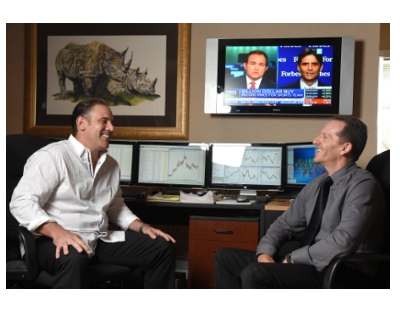
Wanted: $50 million to $100 million for two guys working out of a garage in Corona del Mar.
Well, not just any garage—eight computer monitors lined up on a table next to a rack of production servers connected to supercomputers.
A TV monitor flashes CNBC headlines. Comfortable couches sit in front of a wall papered with the photo of an idyllic Caribbean beach.
The scene could almost be like a computer company, since they are building algorithms to outflank Wall Street’s best and brightest.
Tom Ronk, a co-founder of Buyins.com Inc., and Ralph Dillon, a vice president of business development at Ronk’s WOPR Artificial Intelligence and Big Data Predictive Stock Analysis in Newport Beach, are starting a hedge fund that is seeking investors willing to explore the value of trading signals found by artificial intelligence.
The 800-pound-gorilla question is why would anyone trust these guys with tens of millions? This is Ronk’s first time fundraising. To date, his firm has no investors because he’s seeking a $50 million minimum and is just beginning to talk with them.
“The results are the only thing that matter,” Ronk said during the course of two interviews in his garage. “All anyone has to do is look at the research coming out of the machine. They can track it for themselves. The good thing about the stock market is that it tells you very quickly whether it’s right or wrong.”
A college dropout building algorithms in a garage a few blocks from the beach is a far cry from Wall Street. Yet Ronk’s algorithm caught some of Wall Street’s biggest brokers in nefarious trading tactics.
That algorithm revealed hidden details about naked short trading, where investors bet shares will fall, but without borrowing the stock to short it. It can be illegal, depending on the circumstances; publicly traded companies are frustrated when the number of shares being shorted can sometimes outnumber the number of shares floated.
A Mad CEO
Ronk sold his first report on naked short selling in 2005 to Patrick Byrne, chief executive of Overstock.com, a Utah-based company with a current market cap of $603 million.
That report spurred Byrne to file many lawsuits against brokerages that permitted the practice. The lawsuits gave his legal team access to raw data supplied by brokerages.
“The actual data confirmed that Tom Ronk was correct,” Byrne said in an interview. “He built a system 10 years ago that correctly identified naked short selling.”
Executives who complain about short traders are commonly derided on Wall Street, and Byrne recalled the New York Post published a picture of him with a UFO flying out of his head. Overstock.com was eventually vindicated by collecting almost $35 million in settlements from firms like Goldman Sachs and Bank of America Corp.’s Merrill Lynch.
Byrne said he doesn’t give investment advice on where to put money; however, he said Ronk “is a gentleman.”
“He’s a very straightforward guy,” Byrne said. “He knows the area well.”
A Bloomberg News TV show in 2007 did a special half-hour report on naked short selling, a segment that credited Ronk’s investigative reports and quoted him extensively.
Harvey Pitt, former chairman of the Securities and Exchange Commission, was so impressed that in 2008 he lobbied the SEC to license Ronk’s technology, and the pair even launched a website together called RegSho.com.
That lobbying effort failed.
Ronk said the SEC eventually decided it needed such data and this year awarded a contract for a “consolidated audit trail” to a much bigger Wall Street firm, Thesys Technologies LLC, a subsidiary of New Jersey-based trading firm Tradeworx Inc.
$50,000 Fine
Ronk’s background may cause concern among some investors.
In the late 1980s, he dropped out of the University of California-San Diego, where he was studying computer science and electrical engineering, to work for a Wall Street firm selling bonds.
“I made quite a bit of money in my first three months, so I decided to not go back” to school, he said.
He worked most of the 1990s for insurance giant Transamerica Corp., managing up to $150 million and at one point becoming its biggest options trader, he said.
In 1998, he sold a product called private investment in public equity, also known as PIPE, which gives public companies an alternative to doing a secondary offering by selling institutions a large block of stock. Even though his office manager and compliance officer signed off on the deal, the PIPE wasn’t on a list of company-approved products.
“Transamerica fired me. I was furious,” Ronk said. “I’ve been on Wall Street for 28 years, and I’ve had only one disclosure event.”
Although he protested, Ronk was slapped with a 30-day suspension and eventually forced to pay a $50,000 fine to the predecessor of the Financial Industry Regulatory Authority.
He’s also president of a penny-stock company called Casablanca Mining Ltd. (OTC: CUAU), which lists his Corona del Mar house as its headquarters. Ronk said he became involved in the company with relatives on the idea of exploring gold and copper sites in South America.
“In 2012, it looked like gold was going to do well for some time. Then it cratered.”
He said he hasn’t been involved in the company for a couple of years, although his name is still listed.
Ronk also has a registered investment advisory, Century Pacific Investments LLC, which lists a relatively small $15,000 in assets. Ronk said he’s not managing money, but wanted to maintain the minimum asset level to keep it in compliance with existing rules because he is issuing reports. He plans to eventually use it for assets under management. He said the firm doesn’t plan to take custody of the assets.
Nowadays, he is a registered commodity trading adviser and has earned a Series 65 from FINRA that qualifies him to act as an investment professional.
AI War Games
One thing not in doubt—Ronk’s fascination with artificial intelligence. He became hooked by the 1983 movie “War Games” featuring Matthew Broderick and the 1990s chess match between IBM’s Deep Blue and reigning world champion Gary Kasporov.
Since 1998, he’s been building algorithms and exploring the databases of the world’s biggest stock exchanges.
In 2005, Ronk began selling his reports to companies, charging them $18,000 a year. He estimated he’s sold reports to 2,000 corporations and nowadays has 10 to 15 corporate clients at a time.
“We provide them with complete forensic analysis with what happened in their company’s stock yesterday,” Dillon said. “They can see precisely what moved their stock up or down. We can pinpoint if there are problems or illegal trading.”
The principal product, called “SqueezeTrigger,” identifies the stock price when short traders begin to panic and start buying shares to cover their shorts (see separate story, this page). He also generates another 11 reports based on factors like insider trading, valuation and seasonality.
Ronk uses IBM’s artificial intelligence system, Watson, to research strategies and build algorithms. The company also licenses algorithms from companies like Morningstar Inc. Co-founder Matthew Pirvul, who is based in San Diego, writes the coding, so that reports are published without human intervention.
The system analyzes 15,000 U.S. stocks and daily suggests a possible trading action on 30 of them.
The artificial intelligence “looks at things that affects stock prices, and it lets the algorithms tell us what works and what doesn’t,” Ronk said. “Humans have an enormous amount of conscious and unconscious biases. I keep myself out of the loop as much as possible.”
He said he doesn’t trade on the reports so as to avoid conflicts of interest.
Calling Investors
Even with all the computing firepower, the current business generates less than $1 million annually in revenue, Ronk said, adding that buying data feeds from exchanges is expensive.
Dillon, a veteran of Wall Street firms like Smith Barney and Fisher Investments, joined the firm a couple of years ago and was impressed enough to invest his own money.
The pair estimated the company has spent about $15 million to develop the products and now wants to expand to 26 countries. They’re seeking an equity capital private placement for Buyins. It now has 10 contract employees.
They’re willing to sell reports or license the technology to other hedge funds. And of course, they’re aiming to manage money.
“Fifty to 100 million dollars would allow us to trade every trade that comes out of the machine, which is as many as 30 a day,” Ronk said. “We could have as many as 600 simultaneous open positions.”
They said that if they get the investments, they’ll probably move out of the garage and into an office by Fashion Island—a stone’s throw but worlds apart from Pacific Investment Management Co.