

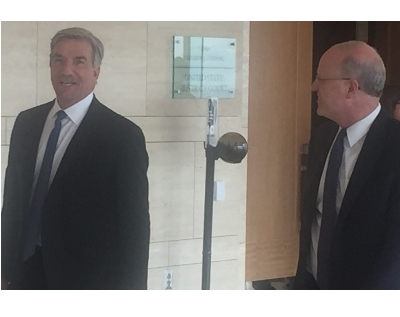
This one wasn’t close. Sort of. The jury in the retrial of longtime Orange County medical-device executive Jim Mazzo failed for a second time to reach a verdict on insider trading charges. But in the proceedings at the Ronald Reagan Federal Courthouse in Santa Ana, the eight women and four men tilted heavily toward acquittal: 10 to 2 on the 16 counts of disclosing pertinent, nonpublic information with criminal intent; 10 to 2 on three new counts of perjury, 9 to 3 on the fourth. In the first trial in May, jurors deadlocked at 8 to 4 to convict.
“We are unanimously agreed that we are hopelessly deadlocked,” the jury foreman wrote Judge Andrew Guilford just after lunchtime on Feb. 21. “Please advise us how to fill out the jury verdict form.”
Guilford’s courtroom deputy, Lisa Bredahl, read all 20 charges, the jury foreman responding to each with the vote tally.
Guilford asked jurors to raise their hands if more deliberation time would break the impasse. None did. The prosecution requested an Allen ruling—applies only in federal cases and in about half of states, including California—where Guilford could have required jurors to deliberate further in hopes of reaching a unanimous verdict. He denied the request.
First-Hand Witness
As the Business Journal’s reported, a number of top lawyers expressed surprise that the U.S. Attorney for the Central District of California decided to try Mazzo again. Perhaps it was because he had a “first-hand witness,” DeCinces, convicted on 14 counts of securities fraud in the first trial, and having signed a “cooperation agreement” to testify in this one.
“Trial No. 2, and they have an ‘insider who’s flipped,’ wondered Larry Rosenthal, a former federal prosecutor who’s tried insider trading cases. “You’d think they had a stronger case.”
Not even close.
Lead defense attorney Richard Marmaro argued that DeCinces was changing his story after 8 ½ years, and from the prior trial, in order to win a lighter sentence. There’s a consensus that the ex-Angels third baseman is looking at about five years’ prison time. And federal prisoners typically serve 85% of their sentences.
Calls to Justice Department lawyers Stephen Cazares and Jennifer Waier weren’t returned. Prosecutors can try a third time. They’d need to request a “status conference” with Guilford and respect Mazzo’s Sixth Amendment right to a speedy trial. Lawyers the Business Journal spoke to say that’s unlikely.
“Most likely they’ll ‘Nolle the case,’ Rosenthal said. That’s Latin and legal-speak for voluntarily discontinuing criminal charges, asking that the case be dismissed. Guilford has final say, including precisely how the case will be reflected in the record.
Other lawyers told the Business Journal flatly, “They’re not going forward.”
‘Good Guys Always Win’
Within an hour of news breaking on Feb. 21 of the mistrial, the Business Journal heard from some FOJs, friends of Jim. It’s a large group, but mostly using discretion, as the disposition of the case isn’t complete. Mazzo and his lawyers declined to comment.
“Good guys always win,” said a relieved OCTANe Chief Executive Bill Carpou. He’d been texting for trial updates from a business trip in Europe.
“I’m thrilled for a good friend and a great business partner.”
During the trial, Marmaro called about a dozen character witnesses, among them former AMO Executive Vice President Aimee Weisner. “He treats people in a way that makes you want to do better,” she testified.
“To see how Jim Mazzo fought with dignity and grace for truth to prevail is truly a profile in courage,” said Jim Doti, the longtime Chapman University president who also testified for the defense in the retrial.
The Sway?
No profit, other touts, character counts, DeCinces the poker player, a felon-for-a-witness who changed his testimony? We don’t know which defense or defenses carried the day for Mazzo with the majority of the second jury. Perhaps some saw a second prosecution of a man who made $0 from “the scheme” as excessive.
Former U.S. attorney Rosenthal surmised the jury had a hard time finding criminal intent and a clear motive, if in fact they believed the defendant disclosed “material nonpublic information.”
“When the motive becomes more difficult to understand, especially when it’s a solid citizen defendant, very difficult to convince the jury,” Rosenthal said. “We all screw up. If it looks like a screw-up, then the jury will be more reluctant to convict.”
Of course, the defense and Mazzo have flatly denied from day one that there was any violation of insider trading rules, specifically Securities and Exchange Commission rules 10b-5 and 14e-3 from the 1934 Securities Exchange Act.
“Jim Mazzo’s life has been turned into a nightmare,” Marmaro closed, “the prosecution charging him with something he did not do … end this nightmare once and for all. I respectfully ask for your verdict of not guilty on all counts.”
The defense lawyer just about got the not-guilty verdict. He may well have ended his client’s nightmare.
