

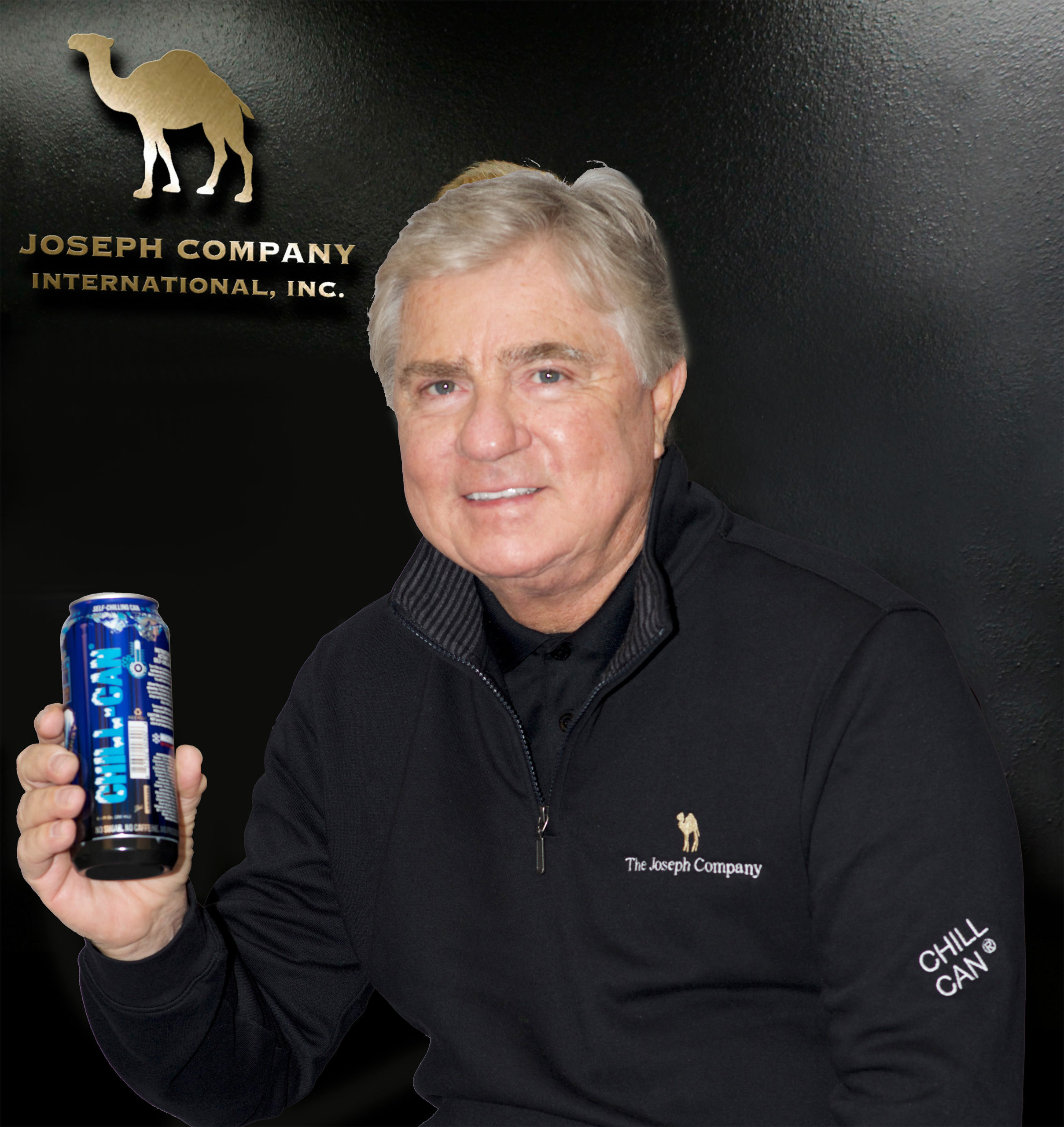
Beta testing of an Irvine inventor’s new can in 7-Eleven locations in Los Angeles is the latest chapter in a 25-year saga to bring self-cooling technology to consumers worldwide.
Mitchell Joseph is an inveterate innovator, Business Journal nominee for an Excellence in Entrepreneurship award, and the fourth generation of a family whose beverage bottling and distribution date to 1921 Youngstown, Ohio—where it ran Star Bottling Co. for 49 years. His Joseph Co. International Inc. is building a $21 million facility to boost capacity to a billion cans a year. The Irvine space can handle 10 million; he has a plastic bottler in the U.K., too.
The fifth generation—son Matteo Joseph, an MIT student—works for the firm.
The test is of 3,200 cans in 15 of the convenience chain’s SoCal sites that contain Fizzics carbonated coffee concoction, developed and owned by Japan-owned and Irving, Texas-based 7Eleven Inc.
Joseph and his team want expansion in that system and adoption by others.
“This is a sweet deal,” he said, as much about the can as 7-Eleven, the new Youngstown complex, and the long-time-coming future of his life’s work.
Thinks He Can
He figures his investment—time, talent and treasure—over a quarter century at about $85 million, including $10 million in cash. Funds came from “outside ventures and real estate,” with no debt or investors.
This is his third commercial version. Two late 1990s tries by PepsiCo and Heineken got scotched by eco-concerns, but he considers the missteps ways “not to invent the light bulb” or the business school shibboleth of “fail forward.”
Pepsi efforts helped create its iconic blue can, still in use; Heineken tinkering got the Dutch beer men pressurization know-how to make a 5-gallon keg without needing an internal carbon dioxide cartridge.
Joseph’s execution of his ideas has been on the Space Shuttle with the late Ohio Sen. John Glenn and with the U.S. Army in the desert.
He’s explored medical devices, like self-cooling sports braces and pharmaceuticals. Imagine “insulin in a shipping container on the open sea when the refrigeration goes out.”
He’s received the Ellis Island Medal of Honor and said the Environmental Protection Agency is cool with the can’s redesign and technology.
Ice Maker
Gabriel García Márquez protagonist Aureliano Buendia remembered when he discovered ice, and an old joke says the key to frozen water is “making more.”
Open the can.
The technology works—turn it upside down, twist the base, wait 90 seconds, drink right side up—holding a can that feels like one dusted a keyboard with compressed air. Whatever’s inside gets 30 degrees cooler than 91 seconds before.
The can cools 8.4 ounces of coffee via a “heat exchange unit”—a metallic inner chamber that, punctured by the twisting base, releases reclaimed CO2 contained in compact carbon powder derived from shredded coconut shells.
Even journalists can do it. But they’re a skeptical lot.
Questions remain. Is it a gimmick? Will people pay? Again and again?
Carbonated coffee started showing up in coffee shops last year.
Joseph and Executive Vice President Scott Berger believe very cold sparkling coffee will sell hot.
A Google search indicates a similar drink fell flat 20 years ago when Starbucks—also working with Pepsi—tried to sell us Mazagran—a carbonated coffee-and-cola cross-pollination that fizzled.
Charm Offensive
Fizzics is being tested at $2.99, $3.99 and $5.99. The only real question is whether 7-Eleven likes it.
“Because the self-chilling can technology is so groundbreaking, we wanted to introduce it with a super-innovative beverage,” said Director of Private Brands Tim Cogil in a statement. “Sparkling coffee sodas met all the criteria.”
Cogil cited the can’s “convenience to customers who want to enjoy a chilled drink” anytime, anywhere; 85% of its 66,000 stores are in foreign countries.
Some “have limited refrigeration,” Joseph said.
Berger says the “can inside the can” units are reusable if recaptured and that the can can be recycled.
Joseph said the technology involves “31 active U.S. patents and more than 400 overseas”—international markets being wild and woolier for enforcing intellectual property rights.
Second attempts are the triumph of optimism over experience; third time’s the charm and Joseph’s ready.
“Nobody is who the Joseph Co. is,” he said. “We’re the experts in self-contained cooling.”
Molecules in Motion
He greets a reporter, looking chill despite 25-plus years of sweating details. The septuagenarian keeps a healthy head of wavy white hair. Hallways adorned with awards—from engineering groups, government agencies, companies—vie for wall space with sports paraphernalia—Cincinnati Reds great Johnny Bench is a spokesperson—and photos.
Display cases hold earlier product iterations, including the Heineken “barrel” can. Another has a Disneyland Hotel-branded blended Kentucky bourbon.
The first rule of the Innovators Club seems to be that you can talk about it a little.
Joseph Co. also once sold its own energy drink in a standard can, West Coast Chill, carried in Albertson’s.
“We’re a bottling family and wanted our own brand,” Joseph said.
That was 20 years ago—he had the idea before energy drinks got huge—and “beverage companies came back” for bottling services and inventive prowess after the enviro-kerfuffle ended. So it seems obvious: the idea did its work and won’t be back.
That misunderstands the innovator’s mind, let alone any dilemma.
The no-caffeine, no-sugar drink was marketed to women. Such products today go phony-feminine with names like Bloom, Perfectly Petite and Flirt.
Could Joseph find room to move in that market?
He’s had 25 years to learn how—and cosmetics companies have already come calling, asking about “a lipstick tube that on a hot day” wouldn’t leave a lady with melted suburban decay.
If they want it cold—call it Revenge?—he’s the man.
