

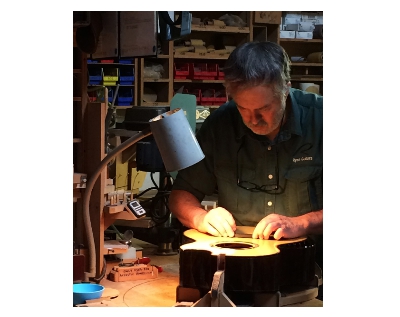
In a 42-year-old class C industrial building in Westminster, Kevin Ryan crafts $12,000 guitars.
There’s no name on the door; it goes on the guitars.
He sells 30 to 40 a year, some for $40,000.
Jackson Browne is a customer.
Folk and blues man Eric Lugosch, as well.
TV producer Michael Jacobs another.
The kinda guys who list Guitar Shoppe in Laguna Beach as an emergency contact.
Model Builder
Second-home guitar dealers—Norman’s Rare Guitars in Tarzana, the North American Guitar Co. in London—are why Ryan took a 10-by-10-foot booth for $2,700 at the National Association of Music Merchants show, or NAMM, at Anaheim Convention Center this week.
He’s attended for 25 years; this is his first exhibiting.
“We’re changing the business model,” Ryan said last week as he worked on a 10-string model that will be in booth 1902 in Hall E with nine other guitars—all 10 already spoken for by one dealer.
“I can only build so many guitars in a lifetime,” said Ryan, 61. The 10-stringer bears No. 922 and Ryan’s stylized, cursive R in flexible abalone on the guitar head near the tuning pegs.
“We need to get these guitars in a lot more hands.”
Riff Week
Others have the same idea.
A NAMM website search for “fretted” exhibitors—guitars electric and acoustic, ukuleles, mandolins, basses and accessories—turns up 907 results, from 660 Guitars Inc. in Gilmer, Texas, to Z.Vex Effects in Minneapolis.
On the list are several dozen Orange County exhibitors, including Kay Vintage Reissue LLC in Newport Beach, Rickenbacker International Corp. in Santa Ana, and Yamaha Corp. of America in Buena Park.
Fender Musical Instruments Corp., formerly of Fullerton and now in Los Angeles, is there, as is the Fullerton-based U.S. arm of Duesenberg Guitars in Hanover, Germany, and the Huntington Beach-based U.S. arm of Tagima Guitars in Brazil.
Accessory makers include Snark in Irvine, Bad Cat in Santa Ana, and Gruv Gear in La Habra.
Irvine-based logistics provider Aeronet Inc. gets product from Santa Monica-based Cordoba Guitars to NAMM.
Stratocaster Characters
Today a budding Buddy Holly or Buddy Guy could circle OC, collect parts—strings and pegs, a bridge, a neck—and build his own guitar.
Yesterday he might have to be Clarence Leo Fender or Adolph Rickenbacher.
Fender co-developed and mass-produced electric guitars in the 1940s and 1950s, including the Stratocaster in 1954. Rickenbacher began selling electric guitars in the early 1930s.
Fullerton still loves Fender; his widow, Phyllis, co-authored a book of reminiscings last year with Fender scholar Randall Bell, and the Fullerton Museum Center is home to the Leo Fender Gallery.
Local guitar makers today include Kirk Sand in Laguna Beach, who has built for Chet Atkins; classical guitar maker Monica Esparza in San Clemente; C.B. Hill in Huntington Beach, who has built for jazz guitarist Ron Escheté; and Ned Whittemore in Costa Mesa, who builds archtop jazz guitars and solid-body electric models.
Show of Shows
Buena Park global music maker Yamaha has 28,500 square feet at the Anaheim Marriott for NAMM.
Dennis Webster, product marketing manager for guitars, said he’s got “six new guitar-specific products” this year, including more in its TransAcoustic line.
“It’s an acoustic guitar with a device inside it that adds reverb and chorus without plugging it in,” meaning no need for amplifiers or another guitar.
This year Yamaha is also co-promoting with Calabasas guitar maker Line 6, which it bought four years ago.
It sells a million guitars a year, 200,000 in the U.S., 95% of which are acoustic models.
Webster said that month-to-month at least half of the top-selling imported acoustics are Yamaha and that last year it was the top seller in the category overall at 25% market share.
Most acoustic models sell for less than $1,000 at retailers and online.
Fretting
Perkins to Clapton, Page to Hendrix—not for nothing do Hard Rock Cafes put towering neon guitars out front.
Johnny Cash held it like a Tommy gun; the Boss slings it on his back like a broadsword Townshend smashed his to bits; Bryan Adams “played it till his fingers bled;” and Mark Knopfler lamented, “shoulda learned to play guitar.”
Hendrix is dead.
Townshend is pushing 80.
U.S. retail guitar sales plunged in the recession, regained the lost ground—and are stagnant at $1.2 billion a year.
Moody’s dinged two guitar stalwarts last year—Gibson Brands Inc. in Nashville, and Bain Capital-owned retailer Guitar Center Inc. in Westlake Village—which combined have more than $2 billion in debt coming due.
PE-owned Fender got a slight uptick, but its debt is still speculative, and it skipped a planned initial public offering in 2012.
Start Me Up
Webster said Yamaha dodged industry troubles and the recession; guitar sales boosts bordered on heroic.
Sales in the last decade have “grown every year in units and dollars [and] more than doubled” overall.
The economy “affected high-end music,” but not Yamaha’s mass-market lines.
It owns three plants in Asia, and “even in a recession people still want to buy things.”
They also go out less and, “100% of guitar players play at home.”
Doldrums haven’t dented fan fenders in another OC cottage industry: startups. Orangewood Guitars in Orange sells entry-level acoustic models online, built to its specs, for less than $200. “$1,500 would be too expensive to buy without seeing,” said Sooj Park, who co-founded the venture last fall with his brother, Eddie. They know the industry stats—but they’re also in their 20s, with all the optimism that entails, and come from a family of instrument importers, with all the knowledge that can bring. They’re marketing to millennials—online, not retail—and plan to increase offerings this spring.
Beautiful Music
Stringed instruments go back thousands of years—Egypt, India, Persia—and Antonio de Torres Jurado, 19th century luthier—guitar-maker, based on the word lute—is credited with creating the first modern one.
Association of Stringed Instrument Artisans in Lunenburg, Mass., offers education, seminars, and marketing help for luthiers; Guild of American Luthiers in Tacoma, Wash., lists several hundred schools that train them.
A guild spokesperson said, “Handcrafting perished during the war-depression-war” in the early 20th century but “hippie kids brought it back,” and guitar-making has grown for decades.
Ryan, the Westminster guitar maker, began in 1987 in his parents’ garage. He’d been building wind tunnels for Northrup. Dad was in aerospace; Mom a painter and pianist. He moved to the shop in 2000.
Guitar-making, “satisfies the artistic and the mechanical … combines the visceral and rational.”
“There’s a magic in it. It’s wood, wood, wood, then it’s something different. It’s difficult to do, and we’re doing it.”
Festival of Sawdust
Ryan once made a guitar out of “a redwood log that had lain in a river for a hundred and fifty years.”
There’s sawdust on the shop’s 2,300 square feet that looks embedded, or at least inlaid.
On a visit last fall there’s also water—distributed by staff because the Santa Anas were blowing and humidity was 18%.
Ideal for guitar-making is 45%, as it’s in the center of a U.S. range and a guitar is under a lot of pressure—about 180 pounds of torque, applied by tightened strings. The shop has 12 hydrometers to measure the air’s water content.
“A man with two watches never knows what time it is,” Ryan said. But with 12, his team has a shot.
Amilcar Dohrn-Melendez and siblings Nate, Hannah and Abe Buffett—the fabled Margaritaville denizen is a distant cousin—build guitars and lay the flexible pearled abalone on their surface.
More beauty.
Kevin’s wife, Barb, is “invaluable; this place would shut down without her,” and their dog Annie barks from the couch. Their son, James, is a Major League Baseball pitching prospect at St. Katherine College in San Marcos.
Sheet Music
A bottle of Yamazaki Single Malt Whisky, a client’s gift, is on the shelf.
Ryan smokes Hoyo de Monterey cigars.
There’s a sheet metal shop next door, which sounds like the polar opposite of climate-controlled custom crafting that connects to practices 6,000 years old.
Closer to the truth to say it’s a tension and tensile strength, like those guitar strings. The result in the right hands is … not made by hands.
Ryan uses computer-guided milling—another aerospace adaptation—laser-cutting, custom tooling, and high-tech ovens. Processes in place will let him hire people to make more guitars as he drives design.
His patents include one on the flexible abalone and on fluting set in an instrument’s curved armrest—the latter an unpatented Ryan amendment that’s kinder to players’ arms and provides more space for design.
“At the end of the day it’s a highly engineered piece of equipment,” he said. “And at the end of the day, you can take someone’s breath away with its beauty.”
