

Newport Corp. has one of the most nondescript names on Orange County’s business landscape—and it’s based in Irvine, by the way.
The name doesn’t illuminate the company’s core technology—photonics—or the dozens of commercial applications it has brought to market through the science of generating, harnessing and utilizing light.
Indeed, Newport Corp. has been a pioneer in laser technology for more than 40 years and, in many cases, the scientists, engineers and technicians who use its products don’t even know the company exists.
Those same products have helped scientists win Nobel prizes and engineers increase data on memory chips. They also aid doctors in surgery and provide vision for fishing boat captains to navigate the open sea at night.
“We’re not a household name by any means,” said Chief Executive Robert Phillippy. “But the things we do and the technology and products we provide are behind the scenes in some of the world’s biggest industries and some of the most significant applications in the scientific community.”
Newport Corp. can blame itself for its lack of public renown. It has long shunned the spotlight, preferring to keep a low profile, even in its backyard. Yet its footprint spans the globe with 15 locations, from its laser division in Santa Clara to recent buys in Israel and Austria.
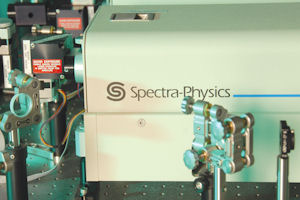
The company makes lasers and related controls on three continents for telecommunications, chipmakers, researchers, medical companies and manufacturers.

450 Workers Here
About 450 people work in Irvine, where it houses its precision components division and systems and integrated solutions business. It employs about 2,500 people companywide.
Wall Street analysts expect Newport Corp. to see more than $660 million in sales in 2012, a gain of more than 20%.
During the depths of the recession in 2009, Phillippy and his management team devised a plan to grow the top line by 20% annually over the next five years, coupled with strong earnings.
“When we did that, some people internally and externally rolled their eyes,” he said. “[But] we’re doing exactly what we put together.”
Newport focuses on four segments of the market:
• The scientific community, which includes lab work and research projects, accounts for about a third of its business.
“Whether its physics, biology or chemistry experiments, any work in optical materials or analysis, you would know our company’s name and quite frankly you would have something in your lab,” Phillippy said.
• The life and health science sector, which makes components for lasers and optics used to illuminate samples, accounts for about 25% of revenue. Customers include medical device and equipment makers such as Brea-based Beckman Coulter Inc. The unit works with microscope companies such as Pennsylvania-based Olympus America Inc. and Nikon Inc. in New York.
• Microelectronics, which includes optical assemblies that go into equipment that illuminates wafers so they can be meticulously examined for precision. Microelectronics accounts for about 25% of revenue.
Every chip manufactured today, if it was made on modern production equipment, is touched by Newport technology, according to Phillippy.
• Industrial, with includes a host of parts and products for micromachining and laser manufacturing.
Two recent acquisitions added new growth markets in emerging fields.
In July, Newport Corp. acquired Austria-based High Q Technologies GmbH—a family-owned maker of “ultrafast lasers”—and Israel-based optics, instrumentation and measurement company Ophir Optronics Ltd. It added more than 700 employees in both deals.
High Q’s lasers are used for flat cutting in Lasik surgical procedures. Phillippy said High Q’s technology will expand the possibilities for eye surgeries and other procedures.
“That’s just the beginning,” he said.
The addition is expected to strengthen Newport’s business in precision industrial manufacturing.
The $230 million Ophir buy provides in-roads in the precision infrared optics, photonics instrumentation and three-dimensional measurement equipment markets.
Digital Dentistry
Ophir’s technology holds promise in the field of digital dentistry and the aerospace and defense markets, a rather unlikely mix.
The Jerusalem-based company has a patented technology for a rapid and precise 3D scan. Technicians are beginning to administer the oral scanner to patients. In less than minute, a crown or mold image is taken. A machine then produces the 3D model, allowing patients to walk out of the office with a new crown or implant in one short visit.
The traditional process could take weeks as molds are sent to a lab and then crafted with ceramic materials by a technician by hand to match the tooth. The end product is then sent back to the dentist office before it’s applied to the patient.
On the defense side, Ophir’s infrared optical systems are increasingly being deployed on drones, other unmanned aerial vehicles and on ground transportation.
The company has an agreement with a manufacturer building night-vision systems for BMWs that allows drivers to see beyond their headlights, a compelling feature for drivers on Germany’s autobahns or coastal cruisers in California.
“Totally Cool”
The technology also holds commercial applications in security, boating and other areas.
“The stuff we’re doing is totally cool,” Phillippy said.
The acquisitions provide greater diversification to the company, while reducing its exposure to the highly cyclical chip capital equipment market, according to James Ricchiuti, a senior analyst at Needham & Company LLC in New York.
“Ophir has added to the company’s considerable strength in photonics, while providing access to a number of new and fast-growing markets such as thermal imaging, infrared optics and 3D non-contact measurement,” Ricchiuti said. “High Q Technologies has enhanced Newport’s position in the health and life sciences market, particularly in biomedical applications.”
Newport was founded in 1969 by John Matthews, an engineer from California Institute of Technology, during the nascent days of laser experimentation. The first optical laser was invented about a decade earlier.
The company moved from its longtime home in Fountain Valley to Irvine in the early 1990s. It was originally called Newport Resource Corp.
The company was built on a technology that became one of its flagship products and is still sold in dozens of countries today. It’s an optical table used in laser experiments—a steel-clad, honeycomb that provides stability by eliminating ambient vibrations.
Newport Corp. engineers soon followed with optical mounts and other tools for use with the table. Then come detectors, power meters, sensors, fiber optics and spectroscopy instruments that help dissect and analyze an object’s light.
“Populating the catalogue around this lab space was how the company grew in its early days,” Phillippy said.
Today that catalogue is 1,600 pages and filled with more than 10,000 products.
