

Kirk Strodel stitches up bullet holes in a deer hide at his hodgepodge Costa Mesa taxidermy shop.
“I’ll make this look like a deer,” he said.
The finished product will be a mounted deer head, a hunter’s trophy.
Strodel, who owns the 27-year-old Living Designs Taxidermy with his brother Randy, mounts all sorts of creatures, including brown bears, wild boar, buffalo, bobcats, opossum, squirrels, snakes, chickens and quail. He’s even turned a few African lions into rugs.
Taxidermists don’t stuff animals.
The skins are artfully stretched around a “manikin”—a true-to-life mold that’s either bought from a catalog or made at the workshop. Living Designs does about 200 pieces a year.
Some people want to display only an animal’s head. Others want a life-size replica.
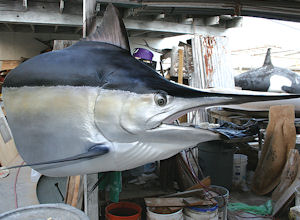
Living Designs also is headquarters for local sportfishers who want to have a mounted trophy replica of their prized catch.
“They’re artists,” said Bill DePriest, publisher of Pacific Coast Sportfishing Magazine in Newport Beach. “They understand what the fish really looks like.”
The Strodels have made about seven hand-painted replicas for DePriest, including a 1,275-pound black marlin.
DePriest caught the marlin in Australia, measured it, snapped a few photos and let it go.
Living Designs made a replica from the photos.
“I end up introducing everyone to them because their stuff is the best I’ve ever seen,” DePriest said.
Living Designs also makes fish decor for restaurants.
Costa Mesa-based King’s Seafood Co., which has restaurants in Huntington Beach, Orange and elsewhere, has Living Designs replicas hanging on the walls of its restaurants.
Demand from restaurants has slowed because chains aren’t opening as many locations these days.
The Strodels also handle birds, fish and small animals that are native to the county.
Opossum, Rabbit
Some of the smaller ordinary animals, such as opossum, are mounted for dioramas at museums and educational centers such as the Environmental Nature Center in Newport Beach.
The smaller animals can be harder to do.
“Rabbits are difficult because they have thin skin,” Randy said.
“It’s like tissue paper—it’s real difficult to work on,” his brother added.
Why would someone want a mounted rabbit?
“People mount all different things,” said Kirk, noting that animal mounts are like other collectibles.
The brothers’ 1,000-square-foot workspace is crowded with a mishmash of taxidermy tools, bleach containers, funnels, tin cans, molds, hanging skins and all sorts of mounted animals.
Amid the clutter are two live love birds chirping in a cage.
A recent visit found Randy working on a slick black-feathered duck with a distinct orange bill.
He held it up by its feet.
“This is a bird that’s been in a guy’s freezer for a year,” he said. “He shot it in Maine. I’m defrosting it now.”
The bird eventually will be part of the customer’s large duck collection.
Kirk brings out a small quail posed on a pedestal depicting its natural habitat.
“This was a boy’s first quail,” he said.
One of Living Designs’ biggest and longest projects was a bear posed on all fours.
It took more than a year to do.
The Strodels charged $5,000 for the bear, and say it turned out to be too little.
The owner of a local medical business shot the bear on a guided hunt in Kodiak, Alaska.
“It’s a very expensive hunt to go on,” Kirk said, guessing the trip cost the business owner as much as $25,000.
Time, Prices
It takes six months to a year to do a deer head, three months for birds and ducks. Prices range anywhere from $200 for a bird up to thousands for large animals.
Then there are pets, such as a parrot that belonged to a local woman for 20 years.
“Sometimes I do other pets,” Kirk said.
There are several steps involved in turning a dead critter into a lifelike replica.
It starts with the delivery.
Hunters and others typically bring their animals to Living Designs in an ice chest. Kirk works a half day on Saturday, which is when many people like to drop off the animals.
The animal needs to be skinned, if it isn’t already.
“It’s almost like taking a sock off,” Kirk said.
Sometimes the animal arrives skinned but still with some flesh that needs to be removed.
The skin then is covered with salt, which soaks up moisture from the hide. Then skins are hung and dried for a couple of days before being sent to a tannery, which turns the hide into a workable piece of leather.
“It’s like a shammy,” Kirk said of the deer hide he’s working on, which is labeled with the customer’s name.
Kirk will wrap the skin around the manikin.
Finishing Touches
He’ll add finishing touches such as eyes.
“See some eyes right there,” he said, pulling out a box with pairs of all sorts of realistic looking glass eyes.
On the deer head, he’ll touch up the black nose and the black ring around the eyes with paint. He’ll add a clear coating to the nose to give it a wet look, making it appear alive.
Kirk sees himself as an artist.
“You have to have a knack for it.”
There is artistry in the posing of the animal as well, he said. The Strodels used to look at books and magazines to find poses. Now they find images on the Internet.
“I pose it to what looks pleasing,” he said.
Sometimes the customer requests a pose.
Kirk doesn’t hunt. He said he experiences the animals from another point of view.
“I’ve always had an interest in animals,” he said. “Each one is a sense of accomplishment.”
History
Kirk started taxidermy when he was a boy. He responded to an ad in the back of the Boy Scouts of America magazine “Boy’s Life” that said: “Learn taxidermy.”
He took a correspondence course. His 1970 diploma from the Northwestern School of Taxidermy hangs on the wall.
Prior to opening his own taxidermy shop, he apprenticed for a taxidermist that used to be in Garden Grove.
There are a handful of taxidermists left in the county, including Bill Taylor’s Taxidermy in Fountain Valley. Many others have closed because the owners retired, Kirk said.
There’s still plenty of competition, local or not.
Hunters often take their animals to taxidermists near hunting sites.
Living Designs competes for business from all over based on the quality of its work, which is conveyed via word of mouth. The shop doesn’t even have a website.
It’s a lot of work and a modest living with some oddball moments. Kirk once made a two-headed chicken for a carnival worker.
Kirk enjoys it.
“There’s never a dull moment,” he said. “I never know what’s next.”
