

You won’t find Stanley Black & Decker Inc. on this week’s list of the largest public companies based in Orange County.
You will find a substantial part of the New Britain, Conn.-based hardware maker’s operations here.
The company keeps industrial design and engineering groups, as well as testing labs, in a 127,700-square-foot facility in Lake Forest. More than 400 employees there work on a roster of brands that includes household names such as Pfister faucets and Kwikset locks.
“The upfront work gets done here,” spokesperson Debbie Millsap said. “Once the product goes through the design and testing here, it rolls out to manufacturing operations depending on the product line.”
Manufacturing happens at other places across the U.S. and in Mexico and China.
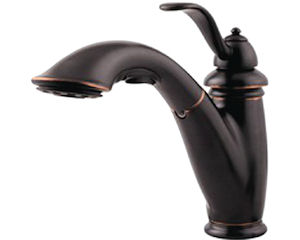
Pfister makes kitchen and bath faucets, fixtures and accessories.
Kwikset is a manufacturer of door locks and hardware, including knobs, levers and electronic keyless locks.
The Lake Forest workers are part of Stanley Black & Decker’s Hardware & Home Improvement Group. It started in 2000, when Black & Decker, then an independent company, combined the design and marketing operations for its Kwikset brand with Pfister, which had been in Los Angeles before shifting to Lake Forest.
Talent
The move to Orange County kept the brands close to a crucial element: a talented and trained labor pool.
“Being based here is a real asset to us,” said Trent Harrington, senior brand marketing manager for Pfister. “It’s the central hub for that central skill set. We always attract the highest caliber designers.”
In 2003 Black & Decker acquired Weiser and Baldwin, two other brands of locks, knobs, handles, knockers and other hardware for doors. They were folded with Kwikset into a “security” business, while Pfister was the lone “plumbing” brand.
“So that’s how the business was operating until the Stanley acquisition,” Millsap said.
Stanley bought Black & Decker for $4.5 billion in 2009, a deal that brought together two companies with long histories.
Stanley Works began in 1843 at a small shop in Connecticut, making bolts and hinges.
Black & Decker Corp. was established in 1910 at a machine shop in Baltimore.
Stanley had about $4.4 billion in annual revenue at the time of the deal, while Black & Decker accounted for a little more than $6 billion.
The deal came amid the recession, and sales initially sagged. They’re back up now, with a 20% gain in 2011, putting overall revenue about on par with totals for the two companies before the deal.
About 10% of Stanley Black & Decker’s business comes from the Lake Forest-based group of brands.
• Headquarters: New Britain, Conn.
• Business: maker of hardware, tools
• Founded: 2009 (from acquisition of Black & Decker Corp. by Stanley Works)
• Ticker symbol: SWK (NYSE)
• Market value: about $13.2 billion
• Notable: Design, marketing operations for various brands, more than 400 employees in Lake Forest
Tandem
A team of five industrial designers there work in tandem with six colleagues in China. Having another team in Asia “allows us to do business 24 hours a day,” said Jay Czerwinski, director of industrial design and packaging. “We’re leveraging that very well.”
Products ranging from a high-end door knocker for the Baldwin brand to a faucet handle for Pfister start with sketches on tablets that become computer renderings of the 2-dimensional images. Designers fine-tune their ideas based on feedback from consumer market research.
“What we design is like jewelry for the home and the workplace” Czerwinski said.
The computer design is then sent to the first floor of the Lake Forest center, where a series of doors leads from one testing lab to another. The rooms house a variety of machinery, ranging from a prototype device that resembles an incubator and produces mock-ups to a sledgehammer sort of machine that tests the strength of door locks.
Engineers can make their mock-ups out of starch powder, metal or various types of gooey fluid, Czerwinski said.
A fast process will turn out a prototype in half a work day. It typically takes a few hours more because the prototype machine often handles more than one job at a time.
“We set it at the end of the day, go home, and the next morning it’s all done,” Czerwinski said.
Samples
A sample of a prototype goes to the Stanley Black & Decker packaging team, where a group of engineers drop it, rub it, and shake it on a wooden platform that’s built to rattle like the back of a moving truck. Then they devise packaging for the item and put it through the same paces.
Additional tests include putting products inside a chamber that simulates years of erosive condition. Some models go into freezers and heaters to check how they react to extreme temperatures.
“We can also give the model to marketing, who takes it around all four corners of the country, validating it with customers,” Czerwinski said.
Having a prototype in hand enables the different Stanley Black & Decker teams to start on photography, advertisement and catalogs, among other things.
“We can shave off time and costs, and add quality,” Czerwinski said.
The latest push for Stanley Black & Decker’s security business is to tap into the electronic locks market.
The Kwikset brand is offering locks that use wireless connections inside a home. A recent partnership with Los Angeles-based technology firm Belkin International Inc. is set to develop a remote-lock system. The system is expected to enable users to monitor locks remotely through Internet-connected phones.
“Things are going to start talking to each other,” Czerwinski said.
Locks, anyway—not so much on faucets.
“Faucets are more like classical music instruments,” Czerwinski said. “People like them for the simplicity. They’re more like sculptural pieces.”
The hospitality market has been hot for Pfister.
“The last couple of years…we’ve made a lot of traction in the hospitality space,” Harrington said. “We’re working with some major hotel brands out there.”
Becoming part of Stanley has brought many benefits, Harrington said, one of which was access to “some of the bigger hospitality customers like Disney.”
Disney Business
Pfister has rolled out some exclusive designs for Disney and other customers, including the Surfrider Foundation, a nonprofit with 90 chapters worldwide.
“The team out here is responsible for not only getting products designed, but also its getting delivered,” Harrington said. “It comes from the energy and mind of the people in OC. We’re pulling the best of the best and we have an extensive training program out in Lake Forest. We are predominantly driven by people who are part of this community.”
