

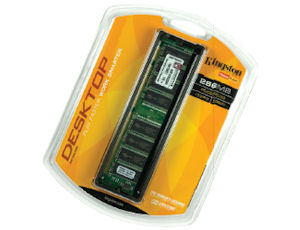
It’s been a summer of discontent for Kingston Technology Co.
After a roaring start to the year, the Fountain Valley-based maker of memory products for computers and consumer electronics is bracing for a slowdown amid falling prices for memory chips and a pause in demand for computers.
“Typically, we have seen the third quarter and the first half of the fourth quarter be very strong,” said Al Soni, Kingston’s vice president of strategic alliances. “But this year, we see demand to be, at best, pretty flat.”
During the first half, Kingston rode high on rebounding demand for electronics, rising prices for memory chips and a slowly recovering economy.
The upbeat view led cofounder and President John Tu to say he sees Kingston growing sales by about 45% to roughly $6 billion in 2010.
Kingston, which buys memory chips and assembles them onto circuit boards or as flash memory devices, saw sales of $4.1 billion in 2009.
In early 2010, memory chip sales were double their 2009 low, bringing more revenue and better profits to Kingston and others in the commodity memory products business.
The industry overall was “very buoyant and aggressive,” Soni said.
“It was a very good start,” he said. “PC shipments worldwide were showing very healthy signs of growth. We had strong forecasts, and semiconductor companies also started feeling good.”
That’s expected to change as consumers pause on computer purchases.
PC maker Hewlett-Packard Co. warned in July it is seeing a slowdown in Europe as people there halted some of their spending.
Intel
Chip kingpin Intel Corp., a bellwether for the technology industry, last week cut its outlook for the current quarter and gave a cautious statement about the rest of the year, citing “weaker-than-expected demand for consumer PCs in mature markets.”
It’s a pretty big turnabout.
“In the second quarter, everyone was gung ho and very excited,” Soni said. “Even Intel’s forecast was very healthy. But then in July we started to hear the first messages of a slowdown.”
Intel’s gloomy outlook has shaken up Wall Street in the past few weeks.
Wedbush Securities Inc. analyst Patrick Wang said he’s “incrementally more negative on the PC supply chain, in light of lowered third-quarter forecasts for both Intel and (Advanced Micro Devices Inc.) as well as an expectation for softer dynamic random access memory chips pricing and questionable demand.”
All of this has added up to a reversal in prices for memory chips, the building blocks of Kingston’s products.
The company’s bread-and-butter business is memory modules—circuit boards loaded with memory chips that speed up the performance of computers and consumer electronics. It has 40% of the market for modules, according to the latest data.
It also makes flash memory products, drives and storage cards for cameras, cell phones and computers.
An oversupply of chips crimps Kingston’s sales and profits and pushes down the value of its stockpiles.
Prices
The price of the most common type of memory chip used in computers is off about 12% from the second quarter, according to El Segundo-based market tracker iSuppli Corp.
Prices are seen sliding further during the fourth quarter and in 2011, according to iSuppli.
When memory chip prices fall, it drives down prices for Kingston, which is forced to follow suit on what it charges its customers, which include the biggest PC makers.
“The average selling prices and our revenue start to drop,” Soni said. “At best, we are hoping to keep unit shipments going at the same run rate.”
It also pinches profits at PC makers, which tend to limit the amount of memory they build into computers in order to keep costs down for consumers.
PC makers have to keep prices the same or even raise them, which in turn, discourages consumers from buying.
“The cost of materials went up pretty high,” Soni said. “There was some pressure building up among PC companies to reduce the memory content or keep it flat.”
Kingston still may hit the $6 billion revenue mark this year, but it will be a tougher climb, according to Soni.
“We still have a very good shot at it,” he said. “We have four months left and we will be very close if not right at $6 billion.”
Kingston’s plan, for the most part, is to go with the flow.
“We are in a commodity business, so prices move and we move along with them,” Soni said. “We do lose money as prices go down, but there is no other choice but to flow with the market.”
