

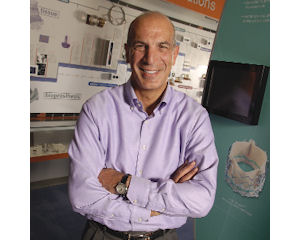
Edwards Lifesciences Corp., the largest medical device maker in the county by employees, plans to keep a key part of its manufacturing in Orange County, Chief Executive Mike Mussallem said in a speech last week.
“We want to keep our brand-new stuff close to home,” Mussallem said in Costa Mesa last week before the Orange County Business Council. “The highest-value (products) will stay in Orange County.”
Irvine-based Edwards plans to keep more than 1,000 manufacturing jobs at its headquarters, even though it is “expensive to do manufacturing” here, Mussallem said.
Edwards has more than 2,500 local workers, making it the largest medical device employer here, according to the Business Journal’s annual list.
Products made here include a type of heart valve that’s seen as the biggest industry advancement in years. The company’s Sapien valve is inserted via a catheter and doesn’t require open-heart surgery, unlike traditional replacement valves.
Sapien and competing devices are seen opening up the valve replacement market to millions of people who aren’t candidates for major surgery.
Edwards now is doing a large U.S. clinical trial for Sapien and could see Food and Drug Administration approval in late 2011. Sapien already is sold in Europe, where sales are relatively small but growing.
The company also has plants in Utah, Puerto Rico, the Dominican Republic, Sing-apore and Switzerland. Those plants and other operations employ about 4,000 people.
The more extensive operations elsewhere, Mussallem said, aren’t the result of California policies that make it hard for many manufacturers to operate here.
“Because we sell all over the world, we’ve got a global presence,” he said.
Nearly 60% of Edwards’ $1.5 billion in yearly sales comes from outside the U.S., including more than $100 million for Sapien.
Sapien’s early European adoption and American prospects have spurred Edwards.
The company’s shares are up 45% in the past 12 months with a recent market value of about $6.4 billion. The shares saw a 2-for-1 split in May.
Mussallem, looking relaxed in a blue blazer and steel-blue shirt, also talked about his company’s strategy and place in an industry dominated by bigger companies.
Edwards’ Focus
Edwards isn’t looking to be a broad, diverse company, Mussallem said, like device kingpins Medtronic Inc. and Johnson & Johnson.
“We’re not the cheapest (and) we are not the biggest,” Mussallem said.
Edwards is focused on heart disease with devices proven to be superior in clinical trials, he said. That puts “a lot of pressure” on Edwards’ research and development arm, Mussallem said.
Edwards spends about 14% of its yearly revenue on research, up from about 5% in its early days 10 years ago as a spinoff of Baxter International Inc., based near Chicago.
Mussallem, who led an industry effort on healthcare reform, shared his thoughts on being involved in the political process.
“It was a heck of an education,” he said.
Last year, Mussallem and other healthcare industry leaders met with President Obama and advisers in Washington, D.C., to discuss parameters for health reform.
The industry’s key issue: a tax on medical device makers to help pay for reform.
AdvaMed, the Washington-based industry group that Mussallem chaired up until March, opposed the tax, contending it would cause smaller device makers to cut research and development and pass the costs on to hospitals, insurers and others.
A device tax is part of health reform. But at $20 billion spread over 10 years, the tax is lower than the $80 billion proposed in earlier versions of the legislation.
Overall, Mussallem said that he thinks enacted health reform addresses the key issue of getting access to care for the uninsured but does little to control rising costs or improve quality.
