

Comarco Inc.’s long reliance on a few big customers could prove to be its ultimate undoing.
The Lake Forest-based power adapter maker—which was among the fastest-growing public companies based in Orange County only a few years ago—is in jeopardy of closing its doors for good after losing prized customer Lenovo Information Products Co.
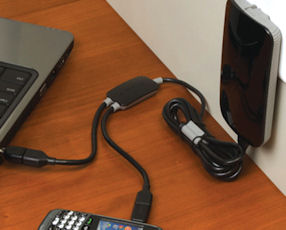
The Shenzhen, China-based subsidiary of Lenovo Group Ltd., the world’s largest PC maker, will receive the remaining 25,000 units of Comarco’s Constellation product this quarter before its contract is terminated.
The device allows multiple electronic devices to charge simultaneously.
Comarco anticipates it will generate “no or de minimus revenue” following these shipments, raising “substantial doubt about our ability to continue,” the company said in a recent filing with the Securities and Exchange Commission.
Comarco executives did not respond to requests to comment on this story.
Lenovo accounted for nearly all of Comarco’s $6.3 million in sales in the 12 months through Jan. 31, the end of its fiscal year, and its $1.4 million in sales through the April quarter.
Targus Deal
The sales figures are a far cry from Comarco’s heyday in the late 2000s, when sales boomed thanks to an exclusive deal with Anaheim-based Targus Inc., the world’s largest maker of laptop bags, backpacks and related computer accessories.
That contract catapulted Comarco to No. 2 on the Business Journal’s 2010 list of the fastest-growing public companies, with revenue growth of 228% over two years, to $37 million.
“The biggest guy in the universal aftermarket power business is Targus,” Fredrik Torstensson, vice president of sales and marketing for Comarco, said at the time. “We are now kind of married together.”
The marriage ended in divorce about two years later, when Targus terminated the agreement after a product recall of its branded universal wall power adapter, which were made by Comarco. The adapter contained faulty wiring, causing the connector tips to heat and melt the plastic encasing, and posed “a burn hazard to consumers,” according to the U.S. Consumer Product Safety Commission.
The adapters, which were sold at Wal-Mart, Best Buy, amazon.com and other big retailers, were tailored for wall outlets and car and airplane use. The recall was one of many troublesome developments the company has seen as it tweaked its core business with minimal success in recent years.
Earlier Days
The company, originally established in 1960, was once a defense industry stalwart that tested weapons for the Navy. It sold that business, along with information technology staffing and airport lease management units, before entering the wireless accessory segment in the late 1990s.
The company has over the years sold software, processed microfilm and built a shopping center. In 2000 it had sales of $39.2 million and employed nearly 200 people.
A restructuring in 2008 included the sale of two unrelated businesses. Switzerland-based Ascom Holding AG bought a unit that made and serviced wireless testing gear for $13 million. Comarco also sold off a unit that made and serviced emergency roadside call boxes in a management-led buyout to Case Systems LLC in Irvine.
Those moves left Comarco’s power charger business as the sole remaining entity.
The company was losing money even before Lenovo decided to end its contract for chargers.
Comarco has posted operating losses of nearly $2 million since 2012, with negative cash flow of $7.1 million through the first seven months of this year.
It changed its sales strategy last year to move beyond original equipment makers and sell directly to consumers.
The company also is involved in two lawsuits related to product recalls, contract breaches and patent disputes.
The ongoing problems have prompted Comarco—which is traded on the low-profile over-the-counter exchange—to seek additional funding through debt or equity financing to meet working capital needs, and explore monetizing intellectual property.
The company has provided little assurance it will succeed on either front.
“We cannot be certain we will be able to secure additional financing on terms acceptable to us, or at all,” the company said in a recent regulatory filing. “We may have to evaluate other alternatives or partially, or entirely, cease our operations.”
