

Money does grow on trees for Irvine-based ChromaDex Corp., which makes ingredients for dietary supplements, cosmetics and other products from fruits and plants.
The company had $8.1 million in sales for the 12 months through June, a 60.2% jump from two years earlier that landed it the No. 16 spot on the Business Journal’s list of fastest-growing public companies based here (see Special Report, page 27; list, page 32).
ChromaDex’s ingredients—and some products of its own—are based on patents the company licenses from universities and other research centers.
Sales Gains
Recent steps to expand its patent portfolio have driven sales gains, according to Frank Jaksch Jr., cofounder and chief executive.
ChromaDex recently struck a licensing deal with Cornell University for exclusive rights to technology for manufacturing nicotinamide riboside, a vitamin found in milk that has potential to improve cardiovascular health and glucose levels, according to the company.
It licensed technology from the University of Mississippi for a new product of its own called pTeroPure, an anti-anxiety supplement based on pterostilbene, a compound found in blueberries.
“We take those technologies and spin them out in terms of ingredients or consumer products,” Jaksch said. “The secret sauce (of the growth) is accumulating intellectual property that has a high level of value.”
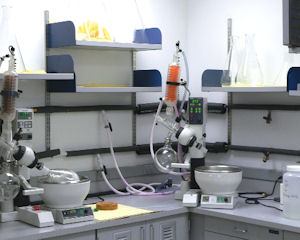
The company handles sales and marketing and distribution at its headquarters here. It has a laboratory in Boulder, Colo., for testing and manufacturing.
It acquired its Colorado operation in 2003, when it bought the technical and analytical services group of NaPro BioTherapeutics Inc. and renamed it ChromDex Analytics.
ChromaDex employs about 70 people companywide, with about half in Orange County.
ChromaDex began in 1999 to fill a “niche that was growing very rapidly but was largely underserved,” said Jaksch, who earned a bachelor’s degree in chemistry and biology from Valparaiso University in Indiana.
Steady growth saw an extra boost during the recent recession for ChromaDex and the rest of the dietary supplements industry, according to Jaksch.
“The 2008 market meltdown further forced people to tighten their belts and look for alternatives” to more expensive brand-name medicines, he said. “The past three years have been pretty good for the dietary supplements market.”
Jaksch acknowledged “a lot of skeptics and negative press” about natural products but notes they haven’t prevented growth.
“The dietary supplement market in the U.S. is a $28 billion market and is continuing to grow even in the face of skepticism,” he said.
ChromaDex emphasizes its difference from pharmaceutical companies.
“The pharmaceuticals market is largely about treatment of disease; the dietary supplementary market has the ‘prevention’ mindset, the ‘I want to stay away from the doctor’ kind,” he said.
Back Home
After beginning in Irvine, ChromaDex moved to Laguna Hills and then to Santa Ana before coming full circle with a return to offices in Irvine.
“Since we’re in a high-density population here, there are a lot of highly qualified people in chemistry,” Jaksh said. Manufacturing is done out of state since “running a chemistry business in California is difficult for a company like ours,” he added.
ChromaDex sells its products throughout the U.S. and internationally. It has distributors in Australia, Brazil, Korea, Japan, Germany and other global markets.
