

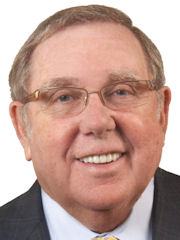
Product diversification has been a big part of recent gains for Costa Mesa-based Ceradyne Inc., which saw sales grow 40% to $572 million and earnings nearly triple to $83.9 million in 2011.
Diversification also is a key to Ceradyne’s ongoing five-year plan to reach $1 billion in annual sales by 2016.
It’s a strategy that’s easier said than done, though.
Last year’s surge came in spite of a cooling in Ceradyne’s solar-related business. Demand for the ceramic solar crucibles it makes shot up at the beginning of 2011 but plummeted in the second half of the year, with shipments becoming “a fraction of what they had been less than six months earlier,” according to Ceradyne Chief Executive Joel Moskowitz.
Customers, primarily solar module manufacturers in China, demanded price cuts, which squeezed margins on the product.
“Our solar business out of China is causing me grief right now,” Moskowitz said. “But we were able to weather this significant decrease.”
Ceradyne is No. 25 on this week’s list of biggest public companies based in Orange County (see List, page 12; related stories throughout issue).
Much of the company’s revenue comes from ceramic products and components for the defense, automotive and commercial uses. It’s widely known as a maker of defense-related gear, a reputation that got a big boost in the early 2000s with its lightweight bulletproof vests.
Yet being known as just a defense contractor means the business is only partially understood, according to Moskowitz.
“People still think of us as primarily defense,” he said. “But we’re actually more diversified. De-fense is still big, but it’s just one-third of our bus-iness. The other two are industrial and energy.”
The industrial segment has been strong for Ceradyne, helping offset the headaches from China.
Boron Products
Ceradyne also makes boron products, and had a record year on shipments from its factories in Quapaw, Okla., and Quebec, Canada.
“We make boron carbide from scratch,” Moskowitz said. “We do a lot for powder manufacturers.”
Some of Ceradyne’s boron products are used in make-up, including well known products such as Revlon Inc.’s Age Defying foundation base.
Other markets served by Ceradyne include food packaging, for which Ceradyne provides the inner lining of potato-chip bags.
“We melt the aluminum and metalize it through an evaporation boat to create a moisture barrier,” Moskowitz explained. “It’s about $15 million to $20 million in business.”
Ceradyne saw record growth coming from its subsidiary Semicon Associates in Lexington, Ky.
Semicon makes dispenser cathodes, electrical conductors that are used as part of Ceradyne’s electron guns.
Ceradyne also licensed its ion implant hardware patents to Nissin Ion Equipment Co. Ltd in Kyoto, Japan in December. Ion implant is a technology used widely in semiconductor device fabrication, a process used to create electronic circuits.
The various product lines in commercial markets were coupled with the steady flow of business in defense, pushing Ceradyne closer to meeting its five-year plan.
• Headquarters: Costa Mesa
• Business: ceramic products, components
• Founded: 1967
• Ticker symbol: CRDN (Nasdaq)
• Market value: about $796 million
• Notable: serves U.S. agencies, government contractors, industrial manufacturers
Ceradyne landed a multi-year deal last year that would provide groundwork for continuing its production of ceramic armor plates through 2014. The initial orders were set at $127 million for delivery this year and completion by next March.
It also received orders for enhanced combat helmets last month. Initial orders and full production are expected to top $170 million.
The company has about $285 million in backlog orders, about $100 million more than a year earlier.
It also has $275 million in cash and a new vice president to oversee acquisitions and corporate development, making expansion plans viable.
“Financially we’ve never been stronger,” Moskowitz said.
Moskowitz established the company in 1967 after gaining an education in ceramics engineering at Alfred University in New York, a discipline that was unusual then, and still is now, Moskowitz said.
Ceradyne now employs more than 400 people in Orange County and 2,000 companywide.
Moskowitz said Ceradyne expects its boron business to expand into China. The company also is looking to grow its subsidiary ESK Ceramics in Kempten, Germany, which it acquired in 2004.
ESK is focused on industrial-related ceramics. It makes up about 30% of Ceradyne’s revenue, and will “provide a reliable base as our more niche-focused products in solar and defense experience greater swings in revenue,” Moskowitz said.
Ceradyne issued its first cash dividend to shareholders in March, at 15 cents per common share. The company also has authorization to buy back $100 million worth of stock.
