

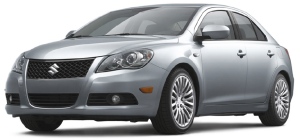
The 2010 Kizashi sedan may be the most important auto launch in Brea-based American Suzu-ki Motor Corp.’s history.
The Japanese maker of small cars and sport utility vehicles has been besieged by the national downturn in auto sales, shrinking market share and raising questions about the viability of its U.S. operations.
For many, the Kizashi sedan appears to be Suzuki’s last attempt to keep a hand in the U.S. auto market.
The Kizashi—which means “something great is coming” in Japanese—is the largest vehicle Suzuki has built and is meant to compete with established models such as Toyota Motor Corp.’s Camry, General Motors Co.’s Chevrolet Malibu and Ford Motor Co.’s Taurus.
The sedan, built by parent company Suzuki Motor Corp., comes as the automaker has shed much of its lineup—mostly renamed models from South Korea’s Daewoo Motor that had received poor consumer ratings.
In 2001, General Motors, Suzuki and Shanghai Automotive Industry Corp. bought most of Daewoo Motor’s assets, renaming the venture GM Daewoo Auto and Technology Co.
Suzuki renamed a number of Daewoo’s cars, including the compact Daewoo Nubira, now called the Forenza, and the midsize Daewoo Magnus, now known as the Verona.
The Kizashi sedan represents a new direction for the automaker, as Suzuki designed the car from scratch.
“The Kizashi is a completely different product,” said Gene Brown, vice president of marketing and public relations at American Suzuki. “It’s Suzuki from stem to stern.”
Toshihiro Suzuki, Suzuki Motor’s chief director of overseas sales, described the Kizashi as “not necessarily our last chance.”
But poor sales for the sedan would force Suzuki to re-evaluate its position in the U.S., he said.
American Suzuki officials have promised that the launch marketing budget will be the automaker’s largest ever.
“I can’t say how much we’re spending other than exactly the right amount,” Brown said.
Suzuki spends about $100 million annually on TV and other media, not including online, according to TNS Media Intelligence, a unit of London-based ad agency WPP Group PLC.
The sedan will be available this month and will be priced at $19,000 for the basic model.
The ad campaign is expected to start next spring with a theme of “premium without the premium.”
Suzuki is targeting the car primarily as a sports sedan alterative for younger buyers looking for some excitement in a midsize car.
“We are working on which markets have the best opportunity,” Brown said. “We have good results in places like Denver, Seattle and Philadelphia.”
Marketing Changes
The automaker also is undergoing a change in how it markets itself.
“We have been in the process of reinventing our brand and the downturn accelerated that with this car being the culmination of that,” Brown said.
Suzuki has faced questions about why it still is trying to crack the crowded U.S. auto market.
Yuuki Sakurai, chief executive of Tokyo-based Fukoku Capital Management Inc., which manages about $10 billion in investments, suggested in July that Suzuki should withdraw from the U.S.
“It’s time for them to decide whether they pay a high price to continue business there or stop the bleeding,” Sakurai said.
Yasuaki Iwamoto, an auto analyst at Okasan Securities Co. in Tokyo, was even more outspoken.
“It makes more sense for Suzuki to put its limited resources into small cars,” Iwamoto said. “Forget about America.”
Suzuki is among smaller automakers trying to hold on as the U.S. auto market tumbles into a three-decades low.
So far this year, U.S. auto sales are down about 25% from a year earlier.
The recession, joblessness and weak consumer confidence have pushed U.S. auto sales to their lowest point since 1976.
Suzuki’s sales have fared even worse than the industry as a whole. Through November, they were off 55% from a year earlier to 36,810 vehicles.
One Japanese automaker, Isuzu Motors Ltd., already exited the U.S. market in January after continued poor sales.
Suzuki’s market share had been less than 1% of U.S. sales before the recession and has shrunk even further this year.
The automaker has seen its number of dealers drop to about 400 nationwide from 460 last year. Further attrition is likely this year.
Its three highest-performing dealers—all in Florida—closed this year.
Still, Suzuki executives said they are optimistic. They cite industry forecasts suggesting that auto sales could rebound 45% in the next two years, with a number of those sales for smaller cars.
