
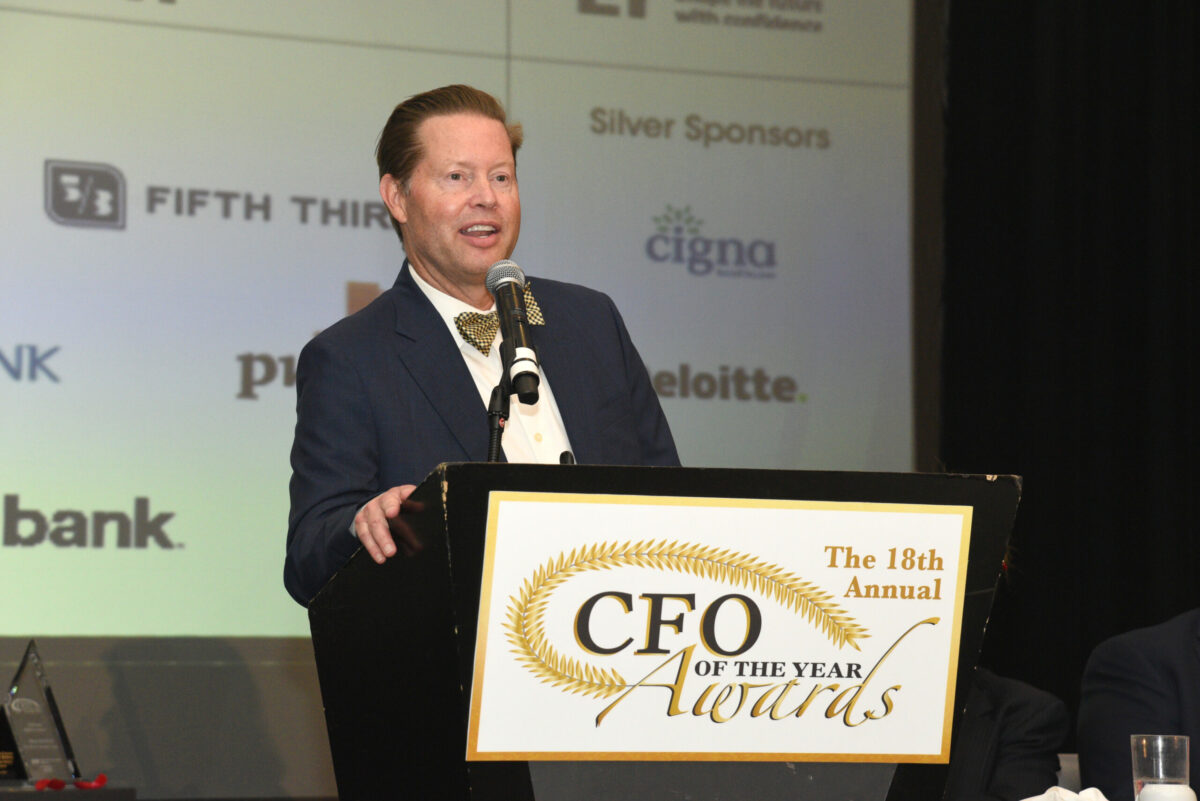
A year ago, Alex Thurman forecasted that Glaukos Corp. would grow revenue in 2025 by 25% to between $475 million to $485 million.
The maker of the world’s smallest medical device exceeded expectations.
“Glaukos had a phenomenal year in 2025,” the chief financial officer told the Business Journal. “Total revenues for the year were a record $507 million on the back of year-over-year growth of 32%.”
By the end of 2025, the Aliso Viejo-based company had a 10-year revenue compounded annual growth rate that topped 20%, he said. Furthermore, the company experienced gross margin expansion over the course of 2025, with the fourth quarter “landing” at 85%.
Shares of the maker of a device implanted into the eye to treat glaucoma have risen by about 45% since hitting a 52-week low of $73.16 in October. At press time, the shares traded at $105.89 and a $6.2 billion market cap (NYSE: GKOS).
A year ago, Thurman won a Business Journal CFO of the Year Award in the public sector. After taking on the role in 2022, he built a financial infrastructure to serve 16 international direct sales markets and integrated a new ERP system. He also heads Glaukos’ technology systems, making sure the company isn’t hacked.
He eliminated all of Glaukos’ convertible debt and unwound a portion of the associated hedge instrument, providing the company with a significant amount of cash.
“We continue to build our strong balance sheet, ending the year with $283 million of cash and equivalents, with no debt,” he noted last week.
In late 2023, Glaukos won approval for iDoseTR, a revolutionary treatment for glaucoma.
“iDoseTR did $136 million in sales in just its second year on the market and drove record revenues within our U.S. glaucoma franchise, which experienced year-over-year growth of 50%,” Thurman said.
Company executives are excited not only about its potential for glaucoma, but they also believe it could eventually replace other eyedrop medications to treat problems like dry eyes and presbyopia.
Last year, it invested $150.6 million in research and development, culminating in the U.S. FDA approval of Epioxa, which he called a transformative therapy for keratoconus, a sight-threatening corneal disease.
Thurman, who graduated from Brigham Young University, spent two years as a Mormon missionary in Uruguay.
“My wife and I continue raising our four kids (we are convinced you are never done with this) and specifically welcomed back our second oldest son from a two-year mission to Guatemala,” Thurman said.