

A valuable and accurate source of data on income flows between states is the annual IRS publication that reports the adjusted gross income of tax filers. The recently released 2023 report reveals that California continued to lose adjusted gross income (AGI) and population to other states.
Losses to California in 2023
In 2023, a total of 607,000 people moved out of state with an adjusted gross income of $38.2 billion. That compares to an inflow of 401,000 people into the state with a total AGI of $25.2 billion. Those outflows and inflows represent a net loss to California of $13 billion in AGI and 206,000 in population.
California’s not alone. Other states with relatively high state and local taxes experienced net outflows of AGI. While California lost $13 billion in net AGI in 2023, New York lost $10.6 billion, and Illinois lost $6.1 billion.
On the other side of the coin, states with lower state and local taxes saw higher net inflows of AGI. Florida, for example, increased its net AGI resulting from state-to-state migration by $20.7 billion while Texas gained $5.3 billion.
The three states that received the most net AGI outflow from California in 2023 were those with no personal income tax: Texas (net inflow of $2.3 billion), Nevada (net inflow of $1.5 billion), and Florida (net inflow of $1.3 billion). The net population outflows from California to these states were Texas (41,000), Nevada (19,000) and Florida (13,000).
California’s loss of $13 billion in AGI was greater than Illinois’ loss of $6.1 billion.
But California’s economy is much larger than that of Illinois. On a relative basis, the losses or gains in a state’s AGI need to be made relative to the AGI of those filers who remained in the state. For example, California’s net loss of $13 billion in 2023 as a percent of California’s total AGI of $12.9 trillion for those who remained in the state was -0.72 percent.
That is a lower percentage loss than Illinois’ relative loss of -1.8 percent in AGI. While California’s net loss of $13 billion was the largest among the 50 states, its relative loss of -0.72 percent ranked 5th.
When the gains and losses in AGI for all 50 states are made relative, as described above for California and Illinois, a not-surprising pattern emerges. States with higher state and local taxes generally lost AGI on a relative basis while those with lowers taxes gained AGI.
As shown in Figure 1, the 12 states that ranked lowest in state and local taxes gained an average of 0.68 percent in net inflow of AGI. The next lowest ranking in taxes gained an average of 0.26 percent, while the next set of 13 states in tax ranking lost -0.06 percent.
The 12 states with the highest taxes, including California, lost an average of -0.24 percent. Note that California’s loss of -0.72 percent was higher than the average for all 12 states that ranked in the highest 38-50 categories.
Cumulative Losses to California
It should be noted that Figure 1 only shows changes in AGI for 2023. What makes these findings even more alarming to high-tax states like California is that their losses are cumulative.
The sum of the net outflows in California’s AGI from 2020 to 2023 is $85 billion. That sum, however, understates the total loss. Since the net outflows of AGI and population in prior years continue into subsequent years, the cumulative total net loss to California’s AGI over the 2020 to 2023 period is $223 billion and 3.7 million in population.
If California’s net loss of $13 billion in AGI and 206,000 in population is conservatively assumed to stay the same through 2028, the cumulative net loss in California from fiscal years 2020 to 2028 would be $842 billion in AGI and 13.2 million in population.
When we discussed this cumulative loss of people and AGI leaving California to Art Laffer, he said, “Once you leave Alcatraz, you’re not coming back.”
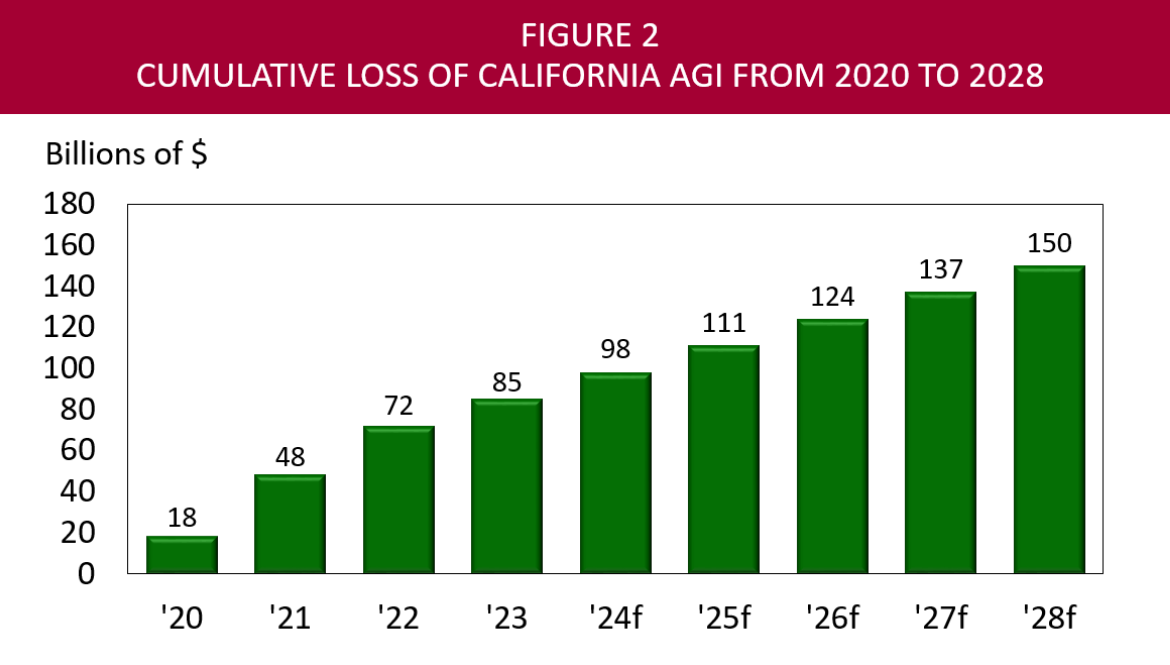
To understand how the loss skyrockets to $842 billion by 2028, consider that the $18 billion in losses in 2020 continues every year beyond 2020, since the AGI of those lost Californians continues through 2028.
Hence, in 2021, the loss is the $18 billion lost in 2020 plus the additional $30 billion lost in 2021, for a total impact of $48 billion. By 2022, the loss is $48 billion plus the $24 billion in 2022, for a total of $72 billion.
By 2023, the loss is $72 billion, plus the $13 billion in 2023, for a total of $85 billion. If that $13 billion loss continues each year, the loss will increase to $150 billion by 2028, as shown in Figure 2. Note that the cumulative losses during the 2020 to 2028 period sum to $842 billion.
The magnitude of these numbers suggest we are at a tipping point where the Laffer Curve begins to take hold: higher taxes lead to lower revenues, while lower taxes lead to higher revenues.
Rather than the proposed “Billionaire Tax” ballot measure that is already driving billionaires and their businesses out of the state, it’s time for a Kennedy-style tax cut for California.
Lawmakers in Sacramento may be surprised to learn that reductions in tax rates over time yield higher, not lower, revenues.
