

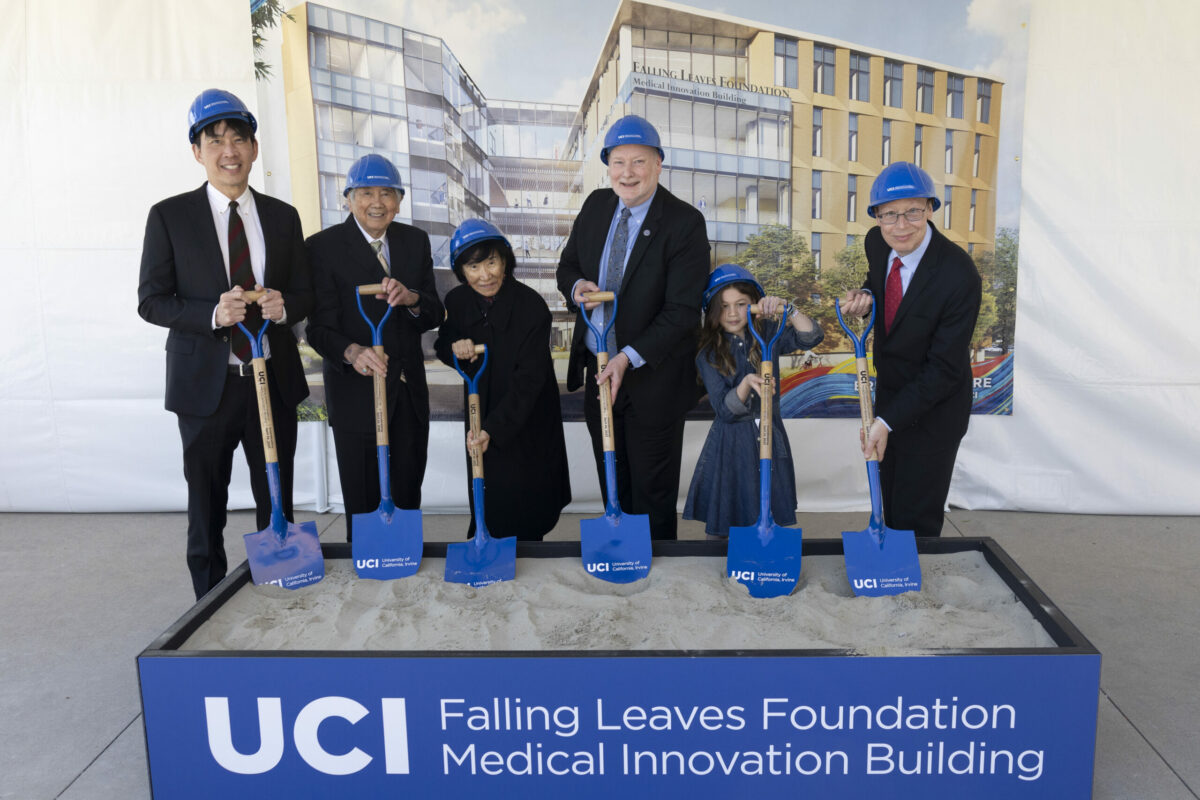
Editor’s Note: Professor Robert Mah and Dr. Adeline Yen Mah in 2007 established the Falling Leaves Foundation to promote research such as the understanding of RNA functions. Adeline, who became a doctor and practiced in Orange County, is the author of “Falling Leaves: The Memoir of an Unwanted Chinese Daughter,” which recounts growing up in China during the Communist Revolution; the book became a bestseller, with more than 1 million copies sold. Robert, a UCLA professor, has two species and a genus named after him for his research on anaerobic archaebacteria. In total, the Mahs have donated over $50 million to UCI to support the Falling Leaves Foundation Medical Innovation Building.
When we first envisioned creating a space that would bring together the best minds in science and medicine, our dream was to nurture innovation that could change lives. We wanted to build a place where collaboration replaces competition, where discoveries move from the laboratory bench to hospital bedsides, and where, for the larger world, the pursuit of scientific knowledge ultimately leads to a healthier, more compassionate climate.
That dream took form in the Falling Leaves Foundation Medical Innovation Building at UC Irvine Health Sciences District. Opened in May, it is one of the largest interdisciplinary research hubs on the West Coast. The six-story, 215,000-square-foot facility is home to more than a dozen programs devoted to advancing human health. Its design—accessible, open and filled with light—fosters communication and idea-sharing among the extraordinary scientists who call it home.
As we walk through its hallways, we are humbled by the scope of discovery unfolding here. Each floor tells a story of hope —of minds united in the development of basic and applied sciences to prevent disease, restore health and ultimately improve lives for generations to come.
Second Floor: The Frontiers of Molecular and Vaccine Science
At the entrance level on the second floor, lies the Robert A. Mah Molecular Innovation Center and the Adeline Yen Mah Vaccine Center.
At the innovation center, scientists led by the brilliant organic chemist, Dr. Glenn Micalizio, collaborate to design, develop and synthesize complex, three-dimensional organic molecules by discovering and applying new synthetic reactions and concepts to produce natural and variants of natural organic compounds, leading to new drugs and treatments.
They are poised to develop next-generation drugs, therapeutics and complementary therapies through ongoing in-house collaborations spanning cancer biology, integrative health, neuroscience and infectious diseases, thereby fortifying a continuous cycle of medical advancement. To date, they have developed more than 40 unique stereospecific molecular transformations for the syntheses of new compounds.
Next to the innovation center is the Adeline Yen Mah Vaccine Center, led by the visionary scientist Dr. Philip Felgner. Here, researchers are advancing nucleic acid medicine—a groundbreaking approach that uses the body’s own genetic material to create vaccines and immunotherapies. Inspired by the success of mRNA vaccine technology, the team is developing novel ways to combat cancer, autoimmunity, and neurodegenerative disease.
Their work also includes a personalized vaccine immunogenicity test that allows individuals to assess their immunity and receive targeted boosters.
The dream of this center is bold: to usher in an era when diseases, once feared, can be prevented before they take hold.
Third Floor: Curing Cancer and Healing the Skin
The third floor is a hub for two intertwined missions—to conquer cancer and to heal the body’s largest organ, the skin.
The Immuno-Oncology and Precision Cancer Therapeutics Research Programs, under the leadership of Dr. Richard Van Etten, represent the cutting edge of personalized medicine. Researchers here are learning how to use each patient’s own immune system to fight leukemia, lung cancer and other malignancies. Their laboratories pulse with the determination that someday, cancer will no longer be a death sentence but a disease that can be cured—one patient at a time.
Sharing this floor, the Interdisciplinary Skin Science Program, directed by Dr. Kristen Kelly, unites experts studying inflammatory disorders like eczema and psoriasis, pigmentary diseases, genetic skin conditions and skin cancers.
By combining dermatology, cell biology and imaging, they are creating new treatments and diagnostic tools that will help millions. Their vision is one of restoration—to help patients heal not only physically but emotionally, allowing them to face the world with comfort and confidence once again.
Fourth Floor: Understanding the Brain and Protecting the Planet
On the fourth floor, science looks inward to the brain and outward to the environment.
The Epilepsy Research Center, known affectionately as “The EpiCenter,” is led by Dr. Robert Hunt. Here, researchers are developing new therapies—from gene and cell treatments to natural compounds —aimed at curing epilepsy and repairing the nervous system after injury.
Their goal is as audacious as it is compassionate: to one day eliminate the seizures that afflict millions worldwide.
At the Center for Neural Circuit Mapping Translational Neurosciences Program, led by Dr. Xiangmin Xu, a trailblazing team is seeking to map the human brain in unprecedented detail to advance therapies for Alzheimer’s, depression, autism and more. Through this endeavor, researchers aim to unlock mechanisms and pathways that underlie neurodevelopmental, neuropsychiatric and neurodegenerative disorders to ultimately cure diseases of the brain.
Just down the hall, the Environmental and Occupational Toxicology and Disease Program, led by Dr. Andrea De Vizcaya Ruiz, studies how the chemicals we breathe, drink and touch influence our health over a lifetime. From microplastics to air quality to climate-related toxins, this team is uncovering how environmental exposures shape our biology—and how we can protect vulnerable populations from harm.
Their dream is prevention—to ensure a cleaner, safer, and healthier world for generations to come.
Fifth Floor: Combating Diabetes and Advancing Quality of Life
The fifth floor is devoted to critical health areas impacting millions of people—diabetes, neurodegenerative diseases and depression.
The UC Irvine Diabetes Center, under Dr. Qin Yang, brings together more than 20 investigators focused on both type 1 and type 2 diabetes. Here, researchers are identifying new molecular targets, developing improved glucose-monitoring technologies, and creating strategies to prevent diabetes-related complications. Their dream is simple yet transformative—a world where diabetes no longer devastates families or shortens lives.
Also, within these walls, the Sue & Bill Gross Stem Cell Research Center’s Neuroscience Program, co-directed by Drs. Brian Cummings and Leslie Thompson, is developing stem cell-based therapies for neurodegenerative diseases such as Huntington’s, Parkinson’s and Alzheimer’s. Here, the boundaries between science and compassion blur—as researchers strive to transform stem cells into treatments that can restore memory, movement and independence.
Soon, the Noel Drury, MD Institute for Translational Depression Discoveries, led by Dr. Diego A. Pizzagalli, will move into the fifth floor, to tackle our understanding of depression’s origins, treatment and prevention.
Sixth Floor: Restoring Sight
On the top floor, science takes aim at one of humanity’s most profound challenges—blindness.
The Brunson Center for Translational Vision Research and the Genome Editing Research Program, led by Dr. Krzysztof Palczewski, is pioneering gene therapy techniques that could soon cure inherited blindness. Using breakthroughs in molecular biology and noninvasive imaging, they aim to reverse and prevent cell degeneration in the eyes. Their hope is breathtaking—that one day, no child will have to live in darkness because of a genetic flaw.
From Innovation to Impact
Extending beyond the walls of the Falling Leaves Foundation Medical Innovation Building is the Precision Omics Collaboratory, which unites experts in genomics, proteomics and metabolomics to decode the molecular fingerprints of disease. They aim to translate these discoveries into FDA-approved diagnostic tests that guide personalized treatments. It’s a place where “omics” science meets the human story—where the complexity of biology becomes the key to precision healing.
A Shared Dream
Each floor of the Falling Leaves Foundation Medical Innovation Building represents a different frontier of science, yet all share one dream—to translate discovery into healing. When we dedicated this building to UCI, our goal was to plant seeds of knowledge that would grow for generations. As we see these remarkable scientists collaborate, innovate and inspire, we are filled with gratitude and hope.
We believe that the discoveries born here will not only advance medicine but also reaffirm the highest purpose of human endeavor: to alleviate suffering and uplift life.
It is our heartfelt wish that the work carried out within these walls will continue to unfold like the leaves of a great tree—each branch reaching farther toward understanding, each discovery adding color and vitality to the world.
