

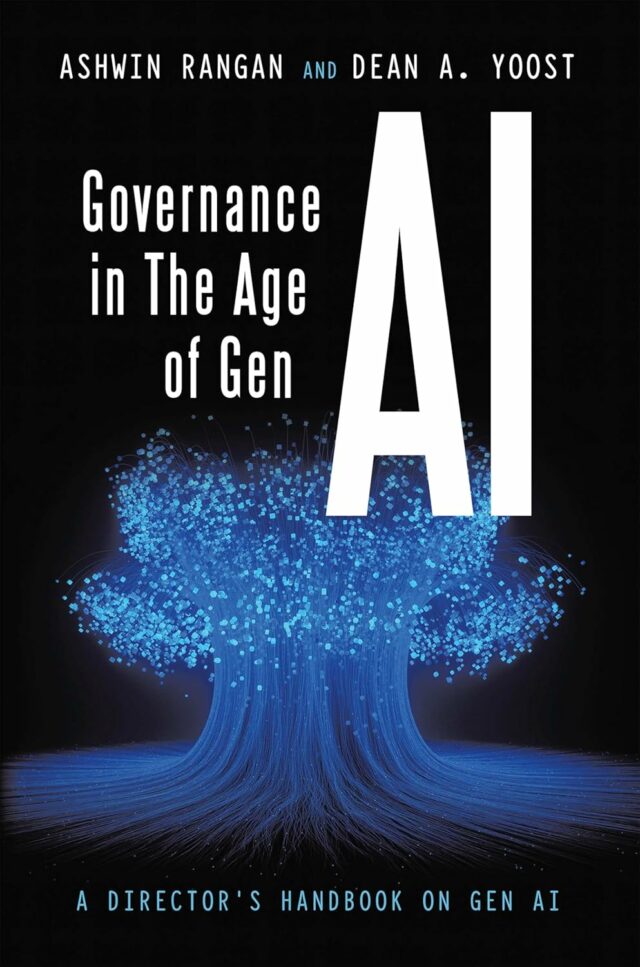
Editor’s note: What follows is an excerpt from “Governance in the Age of Gen AI; a director’s handbook on Gen AI,” written by Ashwin Rangan and Dean A. Yoost. Rangan was the chief innovation information officer at ICANN, the Internet Corporation for Assigned Names and Numbers that ensures the security, stability, and resilience of the internet; he’s won several awards, including InspireCIO’s “CIO of the Year – 2023” ORBIE Award. Yoost, who was chairman of Vicara Health, a software company in healthcare, is a board member of Pacific Life Insurance Company.
We were inspired to write this book after experiencing a growing disconnect between the rapid adoption of generative Al and the lack of oversight in the boardroom.
———————————————————
While generative AI demonstrates tremendous potential across domains, an even newer range of possibilities is on the horizon. Future advances will focus on refining the details and coherence of generated content to make it indistinguishable from human-created content.
Generative models that can interact in real-time with users by taking inputs and generating outputs dynamically will lead to new applications in interactive storytelling, personalized content generation and content creation in gaming, education, virtual environments and more.
Generating content across modalities simultaneously, such as images from textual descriptions, will create new applications in assisting the visually impaired, enhancing human-computer interaction and expanding content generation.
In the future, controlling specific attributes and characteristics of content, such as style, sentiment or emotion will be generated, enabling more precise content generation tailored to specific preferences and requirements. Tailoring these models to specific domains or industries will assist in tasks like medical imaging analysis, financial forecasting and personalized learning. Generative models that can learn incrementally from new data or adapt to changing circumstances will lead to more robust and adaptive systems capable of evolving alongside datasets and user preferences.
——————————————————————————
As generative AI models become increasingly more powerful, there will be growing concerns about its potential misuse including generating deepfakes that are used in spreading disinformation and infringing on privacy. Tomorrow’s research will focus on developing methods to detect and mitigate these threats, as well as establishing guidelines for the responsible development and deployment of such questionable use of technology.
——————————————————————————
A study performed by Cognizant in partnership with Oxford Economics predicts that generative AI will affect, in some way, almost 90% of all U.S. jobs. The study finds that the technology’s effect will be influenced by the rate of business adoption and how quickly users can adapt to new ways of working. The research forecast that Generative AI technology could boost U.S. productivity by 1.7%-3.5% and grow the U.S. GDP between $477 billion and $1 trillion in annual value over the next 10 years.
Jobs with higher levels of knowledge work will be most affected. In the past, advances in technology and automation have mainly impacted manual labor and process-centric knowledge work. Generative AI will do the opposite.
——————————————————————————
Robots armed with AI capabilities will be able to take jobs that humans are not particularly skilled at or no longer interested in doing. A robot powered by generative AI could be answering questions while hoovering the floor, managing schedules, planning dinner, helping write reports for work, creating personalized learning plans for children and suggesting movies to watch in the evening.
——————————————————————————
McKinsey & Company finds that for most of the technical capabilities, generative AI will be able to perform at a medium level of human performance by the end of the decade. Professionals in education, law, accounting, technology and the arts are likely to see parts of their jobs automated sooner than previously expected.
McKinsey’s research forecasts that businesses are likely to see the most significant benefits from the deployment of generative AI in their marketing and sales area. Banking and technology will realize sizable effects in the acceleration of their software engineering.
——————————————————————————
Gartner predicts that by 2026 three-quarters of businesses will use generative AI to create synthetic data, up from less than 5% in 2023. The push toward synthetic data, which mimics the patterns of real-world data without the actual information from real individuals or entities, will support systems where real data is expensive, unavailable, imbalanced or unusable because of privacy regulations.
Introducing synthetic data into models enables businesses to simulate environments and identify new product and service development opportunities. It also can facilitate fast prototyping of software, and digital or hybrid experiences.
The synthetic data could be used in areas that directly correlate to an organization’s growth like the development of customer segments and experiences as well as training of machine learning models. By 2027, Gartner forecasts that more than one-half of the generative AI models will be specific to either an industry or a business, up from only 1% in 2023.
There is a growing appetite for domain-specific models that are smaller and less computationally demanding. Minimizing the energy and resources requirements for AI training and development is essential.
——————————————————————————
Generative AI will make it easier to create images and videos of just about anything to an extent that it will become more difficult to distinguish generative AI content from reality.
Generative AI will soon enhance the design and development of immersive environments and experiences that can be explored through virtual and augmented reality.
The technology will be able to be used to create more lifelike avatars in the metaverse capable of dynamic actions and interactions with other users. AI models are already capable of mimicking human voices. In music, generative AI will become an invaluable tool for songwriters and composers, creating novel compositions that can serve as inspiration or encourage musicians to approach song writing in new ways.
New generative AI tools will emerge that will allow designers to simply enter the details of the materials to be used, so that the algorithms can create step-by-step instructions for engineers to create the item. Interesting new possibilities open up when generative AI capabilities are commingled with other new technologies.
For instance, generative AI tools could create recipes for creating new items, which could then feed 3-D printers, quickly rendering prototypes. Conversely, AI could be trained on large datasets, previously impossible to parse due to computational limitations, to discern patterns and lead to new discoveries.
——————————————————————————
Problems abound such as bias, where real-world data scraped from the Internet is riddled with biases; copyright, where artists, writers, and coders have already launched class action litigation alleging infringement; and job impact on white-collar workers like data analysts, lawyers, accountants and journalists.
——————————————————————————
The fear that the creation of smart machines could have disastrous, even apocalyptic, consequences has long been an AI undercurrent. Generative AI’s arrival has been villainized with an assortment of dystopian scenarios. This creates a perception that artificial intelligence someday will be the doom of humans by spreading misinformation, then taking away jobs, livelihoods, and, finally, lives, leading to the extinction of humans.
Science fiction contributes to this perception in films depicting AI and robots running the world with domesticated humans used by machines just like humans have been doing with animals.
This perspective of a dystopia future should not be accepted as a foregone conclusion. Humans are recognizing the risks and dangers of AI.
——————————————————————————
Generative AI has the potential to tackle some of the world’s thorniest problems like new treatments for diseases, more access to mental health support and crop yield optimization.
Generative AI represents the beginning of a new era, a paradigm shift, and a new approach to problem-solving. It is the embodiment of human imagination and creativity, bolstered by computing power. The technology transcends the boundaries of being just competitive or innovative.
