

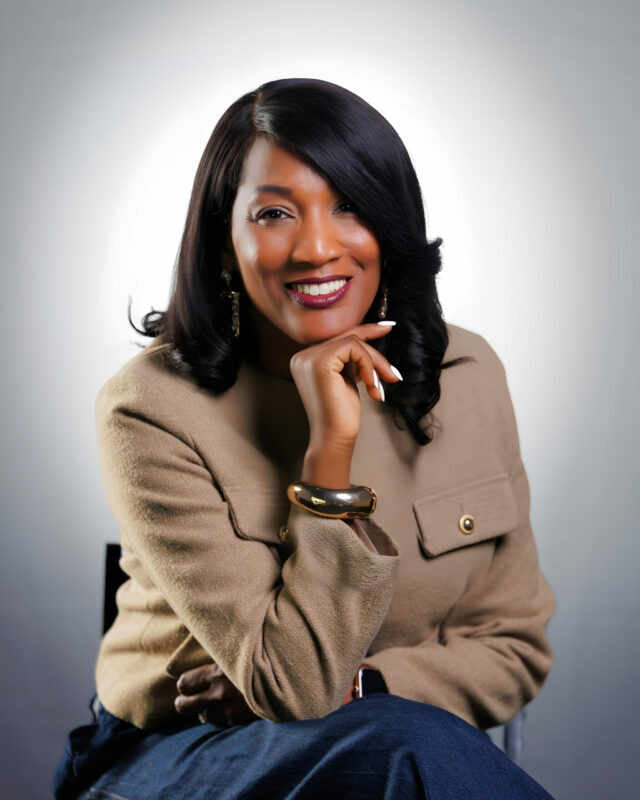
Editor’s Note: Debora Wondercheck is the founder and CEO of Arts & Learning Conservatory and is the Arts Commissioner for the City of Costa Mesa. For the Business Journal’s annual list of nonprofits, see page 14.
A 10-year-old girl sat by herself at a new school, shy, worn down, isolated and emotionally detached from the world moving around her. Home was a women’s shelter across the street: one room, a set of bunk beds, three siblings and a mother doing everything she could to keep everyone afloat.
That young girl was me. At school, my cello was the one constant. I kept to myself, moving through the day quietly, preferring the company of an instrument that had carried me through more miles, literal and emotional, than most people realized.
One lunch period, I slipped into the music room and began playing the bass line of Michael Jackson’s “Billie Jean.” A student passing by stopped. “Is that ‘Billie Jean’? Are you playing Michael Jackson?” He called his friends. Suddenly I was surrounded by kids asking, “Can you play ‘Beat It’? Can you play this? Can you play that?” I played every request. And in that moment, something shifted.
My talent reframed how they saw me. Instead of the stigma and judgment that often shadow a child who is homeless, what I saw in their eyes was regard, unexpected, affirming and real.
They accepted me, even when they knew I lived in the shelter. And in that performing arts magnet school, with strings, choir, musical theater, art and dance, something dormant began to reawaken. My personality surfaced again. I found my voice.
Chicago Area
I grew up just north of Chicago, the youngest in a full household of five brothers and one sister. My mother, Iola King, carried a painful memory from her own childhood. Raised in an affluent, predominantly white neighborhood in the 1940s, she was barred from joining her school orchestra at the age of 10.
It cut deeply, and she never forgot it. She vowed that her children would never be denied the right of an arts education. When she married, she prayed for a large family and asked God, “Please give my children the gift of music, and I’ll make sure they serve you all of their days.”
And so we did. Music became part of my daily life, woven into the rhythm of our home just as naturally as meals or chores. My oldest sister played cello and string bass, and trained as a classical vocalist. My brothers took up viola, violin and cello. My brother with special needs learned bells and tambourines under my mother’s patient guidance.
I started violin at age 3, but the high pitch drove me up the wall. When my teacher arrived for lessons, I would hide behind the floor-length curtains, praying she’d give up, but my shoes betrayed me every time. I told my mother I wanted to switch to cello. She insisted I was too small and said when I turned 5, I could try. I suspect she hoped I’d move on. But on my fifth birthday, I marched right up and asked, “Where’s my cello?” She smiled and said, “Well, I suppose we’d better find one.”
Not long after, one of my brother’s cello teachers, a member of the Chicago Symphony, told my mother, “If your kids get really good at this, they can earn college scholarships.” That was all the motivation she needed. My gentle, sweet mother turned into a drill instructor. Practice became non-negotiable. And one by one, each of my siblings earned scholarships across the country. Music was the force that shifted the trajectory of our lives.
Escaping in the Night
The other reality inside our household was far more volatile. My siblings and I lived with the constant threat of a dangerous environment driven by my father’s abuse. My mother absorbed most of it, until the harm began to reach us as well. For years she planned an exit, fully aware that leaving with seven children could escalate the danger. She’d heard the stories of women trying to flee, being caught and dealing with greater abuse, even 10 times worse, sometimes leading to death.
After her three oldest were safely launched to college on music scholarships, she made her move. She gathered the four of us still at home. We escaped in the middle of the night, a suitcase in one hand and an instrument in the other. We boarded a train to Denver and spent four months in a women’s homeless shelter. When my dad found out where we were, we fled again, and this time to San Diego, living in a Salvation Army facility before finding a women’s shelter in Oceanside.
Eventually, we secured a home of our own. My mother went back to college, earned a degree in child development and taught at a preschool.
‘You Need to Give Back’
My mom called nearly a dozen private teachers to find someone who would take me as a cello student. She explained “We have no money, but my daughter is truly talented.”
Each one said no. On the final call, after hearing another rejection, she finally said, “You need to give back,” and shared “We’ve gone through a lot.”
What she didn’t know was that the teacher on the other end was a Juilliard graduate and president of the Music Teachers’ Association. For eight years, she gave me private lessons. And my cello playing just soared and excelled because she was the best of the best.
I hoped to attend Berklee College of Music in Boston, but my mom wanted me closer to home and at a Christian university. I attended Vanguard and later earned a master’s from California State University, Fullerton. I began teaching in the Newport-Mesa Unified School District, earning Teacher of Promise my first year, and then joined Irvine Unified School District as a String Specialist, Master Teacher and conductor of the elementary honor orchestra.
I was comfortable in my role, but music programs were being cut across the region. I just couldn’t watch that happen, as music had fundamentally transformed my life. So, in 2004, I launched our first Arts & Learning Conservatory summer camp with 21 students performing a condensed version of “Sound of Music” for 100 attendees. The next year, 145 kids came! I continued conducting part-time and leading the conservatory the other half. By 2018, I stepped in full-time as CEO.
The Healing
We rely on donations, nominal fees for service from schools and families, grant writing, and sponsors who invest in making our programs possible. In 2016, the Borland Family donated a building that is now our current theatre.
Today, we serve nearly 4,000 students annually in 50 schools, offering instrumental music and turnkey musical theatre programs to children. Our full “Theater in a Box” model delivers everything a school needs for a production: directors, designers, technical staff, and costumes, brought directly to the school to mount a complete show.
Since 2004, we’ve reached more than 30,000 students and produced 120 shows. We’ve earned many awards including Arts Organization of the Year from Arts Orange County. We have partnered with Pacific Symphony, Think Together, YMCA, Boys & Girls Club, and regional universities. About 15,000 people attend our professional and youth performances each year, and we’ve awarded over 2,000 scholarships. Our goal is to expand into South Orange County, San Diego, the Inland Empire, and eventually nationwide.
I still witness a troubling level of hostility in Orange County. In Costa Mesa, my teenage daughter was recently surrounded and targeted with racial slurs by 11 boys on e-bikes, an act delivered with cruelty that was chilling. What was most alarming was how emboldened and entitled they acted. It was truly despicable. What was also unsettling was the silence. No one stepped in. No one called for help. That kind of silence is a breakdown of community accountability.
Moments like this are a wakeup call, and the arts can help.
Creative expression steadies young people, and neuroscience backs it. The arts regulate the brain, calm the nervous system, and build long-term resilience. When youth feel seen and supported, their choices, behavior and impact shifts. After more than two decades of expanding access to the arts, I’ve seen thousands of children experience transformation, finding healing, strength and a new trajectory for their lives, just as I did.
