

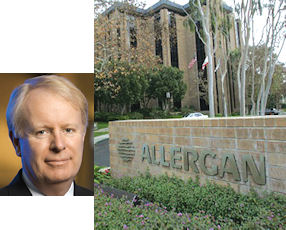
Allergan Inc.’s board of directors features plenty of differences, with representatives from the worlds of academia, science, consumer goods and the corner office.
The nine-member group takes pride in its focus on finding the common ground of stewardship over the Irvine-based drug maker’s operations, which brought in $5.8 billion in revenue last year.
“From a personal perspective, I think this is a board where everyone is engaged 24-7,” says Russell Ray, an investment banker and 10-year veteran of the board. “We are intimately involved in the direction of the company.”
Ray’s inside view complements his earlier perspective on Allergan.
“I called on [Chairman and Chief Executive] David [Pyott] and [Chief Financial Officer] Jeff [Edwards], and knew the company as well as one could know working on the outside,” says Ray, now a general partner at HLM Venture Partners, which has offices in Boston and San Francisco.
Allergan’s directors bring various skills to the board.
Ray says his contributions include “a broad knowledge and experience in the capital markets, raising equity or debt, and then it would be helpful on the business development side.”
Allergan also can draw on the experience of Mike Gallagher, a former chief executive of New Providence, N.J.-based Playtex Products Inc. He’s been on the board for 15 years, and recently was named the lead independent director.
“I have a lot of executive experience working with Wall Street, mergers and acquisitions, managing a large team of people, putting together compensation … dealing with the issues that CEOs manage,” Gallagher says.
2-Day Schedule
Allergan’s board meetings stretch over two days and begin with three- to three-and-a-half-hour meetings on a Monday for four standing committees: finance and audit; organization and compensation; corporate governance; and science and technology.
The first day wraps up with a board dinner. A full board meeting that runs from 7:30 a.m. to 12:30 p.m. is held the following day.
Allergan’s board held six full meetings in 2012, and each director attended at least 75% of those meetings, according to the company’s preliminary proxy statement filed with the Securities and Exchange Commission.
“Directors are also kept informed of our business through personal meetings and other communications, including considerable telephone contact with our [chairman], lead independent director and others regarding matters of interest and concern to us and our stockholders,” Allergan said in its filing.
The ongoing communication typically helps the group reach a consensus.
“If we follow that kind of approach, we pretty much get to the same place … where there really is very little disagreement,” Gallagher says.
Conflicting Views
They don’t shy away from conflicting views.
They do count on boardroom decorum—“diplomatic give and take, back and forth,” Ray calls it—to see themselves through any differences.
Pyott says he gets big-picture advice from his fellow board members—and keeps in mind that he must answer to them when it comes to executing strategies.
“Clearly, a director isn’t there to manage the day-to-day or the month-to-month operations,” Pyott says. “If they are worried about that, the CEO should be worried about the soundness of his chair.”
“I’m a director elsewhere, so I have those views,” says Pyott, who’s on the board of Irvine-based heart valve maker Edwards Lifesciences Corp. and Avery Dennison Corp., a maker of labeling and packaging products with headquarters in Pasadena.
Allergan has grown from $700 million to more than $5 billion in annual sales since Pyott became chief executive 15 years ago. He credits a “very high-quality team of directors” as a key to the steady increases.
“We really do a matrix of what kind of experience and competencies and capabilities we want,” Pyott says.
The company also uses executive search firms to find directors.
Allergan has had a chance to apply its matrix in recent months. Dr. Peter McDonnell and Timothy Proctor have been nominated for the board, and their candidacies are due to be considered at the company’s annual meeting next month.
They’ve been nominated to fill the spots of Drs. Herbert Boyer and Stephen Ryan, each of whom earlier this year announced plans to retire from the board.
Boyer is a scientist and cofounder of South San Francisco-based biotech pioneer Genentech Inc., now part of Roche Group in Switzerland. He had been on Allergan’s board since 1994.
Ryan, an ophthalmologist, became a director in 2002.
Allergan has a guideline that once a director reaches 73 years of age, “that’s a real discussion” regarding retirement, Pyott says.
Allergan founder Gavin Herbert retired from the board last year.
“We’re sorry to lose them—they’re not happy to be retiring,” Pyott says of the threerecent departures from the board.
On the bright side: “It’s healthy to bring in new thinking, new perspectives,” he added.
McDonnell, a former University of California, Irvine, professor, now directs the Wilmer Eye Institute at Johns Hopkins University in Baltimore.
It was “kind of obvious to bring in another great professor of ophthalmology” after Ryan retired, Pyott says.
McDonnell is an expert on corneal disease, while Ryan’s expertise is in the retina.
Diageo
Proctor is general counsel for Diageo PLC, a U.K.-based spirits maker with brands such as Johnnie Walker whisky and Guinness beer.
“We’re bringing him in for his international and large-company experience,” Pyott says. “He’s been at the center of a very major consumer goods company for a while.”
Allergan’s other directors are: Dr. Deborah Dunsire, chief executive of Millennium: The Takeda Oncology Co., a drug maker in Cambridge, Mass.; Dawn Hudson, vice chairman of Boston-based consultancy Parthenon Group LLC; Dr. Trevor Jones, a former director general of the Association of the British Pharmaceutical Industry; and Louis Lavigne, a former Genentech chief financial officer and executive vice president.
The new members maintain Allergan’s long-standing practice of seeking varied perspectives for a board.
Their veteran colleagues remain as reminders of the standards the body has kept for decades.
“This has been a very strong board for a very long time—the quality of the board members, the collegiality of the board, and the processes we use remain the same,” Gallagher says.
