

Orange County generic and branded drug companies are in the mix of a brewing fight over some $100 billion worth of drugs due to come off patent over the next two years.
The battle involves a flurry of patent lawsuits brought by branded companies against competitors seeking to make generic versions of proprietary drugs before patents even expire.
Among the plaintiffs and defendants are some of the area’s better-known drug makers, including: Irvine-based Allergan Inc.; Avanir Pharmaceuticals Inc. in Aliso Viejo; generic drug maker Teva Pharmaceuticals Industries Ltd., which is based in Israel and has an Irvine plant; and Woodcliff Lake, N.J.-based Par Pharma-ceuticals Inc., a generic specialists that’s in a $410 million deal for Irvine generic company Anchen Inc.
The parade of lawsuits is “starting to peak, if it hasn’t already peaked because a lot of these patents, these blockbuster drugs are either going off patent in the next couple of years, or already are off patent,” said Thomas Krzeminski, a partner and patent infringement attorney with Knobbe Martens Olson & Bear LLP, an Irvine-based law firm.
Filing lawsuits “is happening with increased frequency,” Krzeminski said.
Drug makers that are either based in Orange County or have operations here are no strangers to suing over patent matters.
Allergan and Duke University in Durham, N.C., sued Amityville, N.Y.-based Hi-Tech Pharmacal Co. last month over allegations that Hi-Tech was producing and selling a generic version of Allergan’s eyelash grower Latisse prior to the expiration of three patents that cover the drug.
Allergan owns two of the Latisse patents. Duke owns the third one and licenses it to Allergan, according to a report in the Triangle Business Journal.
Hi-Tech declined to comment on the case, and attorneys for Duke and Allergan could not be reached.
In May, Allergan won a round in court in another patent battle over Latisse when a federal appeals court reversed a lower-court loss and returned the case to the federal district court in Santa Ana.
That case involved a lawsuit Allergan filed in 2009 against several companies, including Hen-derson, Nev.-based Athena Cos-metics Inc., as well as Cosmetic Alchemy LLS and Stella Inter-national LLC, both of Arizona. Allergan alleged the companies either infringed upon Latisse’s patents or in-duced others to do so.
Allergan’s tactics have drawn some heat. A Women’s Wear Daily article quoted officials of several companies that were defendants in a 2007 patent lawsuit over Latisse’s active ingredient, bimatoprost, saying the drug maker was trying to do “market cleansing” prior to introducing Latisse in 2009.
Allergan’s patent covering bimatoprost expires next year, but it has others that stretch until 2024.
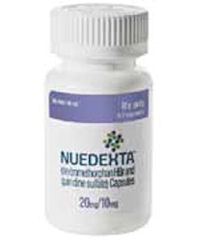
Avanir also has been involved in recent patent frays over its Nuedexta medication that treats pseudobulbar affect, a condition that involves involuntary emotional outbursts like laughing or crying.
Avanir began selling Neudexta in February.
Hayward-based Impax Laborato-ries Inc. said last month that it was challenging the Nuedexta patents. Avanir has sued Impax for patent infringement.
It also has sued Par and Actavis Inc., a Morristown, N.J.-based unit of Actavis Group HF in Iceland, over patents for Neudexta.
Par and Actavis applied to the FDA to sell generic versions of Neudexta before Avanir’s patent for the drug expires.
Teva, which also makes some branded drugs, filed lawsuits against Canonsburg, Pa.-based Mylan Inc. and the Sandoz unit of Switzerland-based Novartis AG after they filed applications to market generics of the Copaxone multiple sclerosis drug before its patent expires in 2014.
A federal judge has denied a motion by Mylan to dismiss the suit against it.
The ability of branded drug makers to sue generics producers grew out of a 1984 federal law called the Hatch-Waxman Act, which was originally intended to encourage the entry of generic drugs that are cheaper than patented versions.
Created Scenario
“It created a scenario where you could have name-brand drug companies bring patent lawsuits against generic drug companies before the generic drug ever hits the market,” Krzeminski said.
Under the act, a drug maker has 45 days to file a lawsuit against a potential generic maker in order to obtain an automatic 30 extra months of patent exclusivity.
The law also defines a “notice letter” sent by the generic maker to the name-brand company as infringement, setting the suit in motion.
That means the Food and Drug Admin-istration cannot approve a generic drug maker’s application for that period of time or until a ruling on the patent’s validity is made.
“These are always decided by a federal judge,” Krzeminski said.
A jury is not necessary because there are no monetary damages in Hatch-Waxman patent cases, he said.
“Most judges that I’ve been before, they want these cases to trial and decided before that 30-month stay is up.”
