

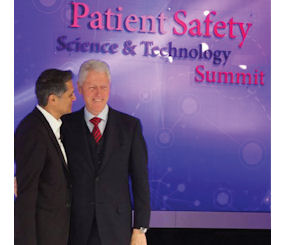
Joe Kiani’s patient safety movement went to Washington last week.
The chief executive of Irvine-based patient monitor maker Masimo Corp. visited the U.S. Senate’s Health, Education, Labor & Pensions Committee to offer suggestions on how to prevent patient deaths in hospitals.
Kiani said he was hopeful the patient safety suggestions “would translate into legislation that will hopefully allow us to move mountains.
“Instead of doing one hospital at a time, we can hopefully overnight, for example, save 100,000 people a year because there’s a mandate to properly wash your hands before seeing a patient … or there’s a mandate that there’s continuous monitoring of patients on opioids after surgery,” Kiani said in a phone interview last week.
Kiani wants his industry to start sharing data gleaned from the range of devices, including products made by his company. The goal is to give healthcare providers a comprehensive file that would help avoid instances such as conflicting medications or improper dosages—errors that often are behind the grim statistics on what are generally considered preventable patient deaths.
Kiani’s push goes against some long-standing business practices—some medical device makers tend to view the information their machines gather from patients as proprietary data with potential value in the marketplace.
Legislation to require data sharing could allow the movement to reach its goal of zero preventable patient deaths by 2020 “much, much faster,” Kiani said, adding that a mandate by the Centers for Medicare & Medicaid Services on some of his testimony points could also speed up progress.
Sen. Tom Harkin, D-Iowa, chairs the committee that heard Kiani’s testimony. Sen. Lamar Alexander, R-Tenn., is the ranking minority member.
Lawmakers’ Responses
Lawmakers “had really good questions and grabbed on to this tangible goal, which was awesome,” said Kiani, who has been working on both sides of the political aisle in an effort to get patient safety legislation on the books.
He said his efforts have crossed over divides in California, where Rep. Dana Rohrabacher, R-Huntington Beach, is a supporter of the movement along with Sen. Barbara Boxer, a Democrat.
Vice President Joseph Biden also has had discussions with Kiani on the patient safety movement, with more meetings of the two planned, Kiani said.
His recommendations to the Senate committee included:
• Creating what he called a “patient data superhighway” through the banning of “walled gardens.”
Walled gardens take place when healthcare technology companies and some providers block data sharing between devices in order to capture market share, among other things.
“Technology solutions must be required to openly share information, particularly when their purchase is subsidized with taxpayer dollars, and patients’ lives are dependent on it,” the executive told the senators.
• Increasing transparency with standardized processes to define, measure and report hospital-acquired infections and conditions.
Kiani said those rates should be publicly reported to provide a basis for quality comparisons.
• Use incentives and disincentives for patient-safety measures at hospitals.
Kiani said Congress should expand the current Medicare policy on hospital-acquired conditions, which determines payments for service. He said the policy should include a list of causes of preventable deaths and suspend payment for treatment of the primary health condition in cases where a patient dies until it’s determined whether the cause of death was preventable.
Hospitals that institute evidence-based practices to prevent deaths “should be shielded from malpractice lawsuits to the fullest extent possible,” including through damage limits, Kiani said.
Some 30 hospitals, including Hoag Memorial Hospital Presbyterian, which has campuses in Newport Beach and Irvine, and nine medical device makers are on board with the effort, Kiani said.
“I’ve been calling the other [medical device makers], but we haven’t had the blitz yet” to get more companies involved in the effort, he said.
The patient safety movement started at the beginning of 2013 under the banner of the Masimo Foundation for Ethics, Innovation and Competition in Health Care.
President Clinton
The foundation held an initial patient safety summit in January at the Ritz-Carlton in Laguna Niguel and boldly announced its goal of zero preventable patient deaths in hospitals by 2020; it attracted the attention of former President Bill Clinton.
Clinton invited Kiani to become a part of his Clinton Global Initiative, which held its annual meeting last week. Kiani and his team made an appearance.
“They wanted us to make the commitment to this movement at their plenary session,” Kiani said, adding that he spoke right before President Barack Obama appeared at the initiative.
Kiani said that while giving people access to healthcare services is good, “for the new millennium that’s not good enough. It should be access to healthcare that guarantees patient safety and patient dignity.”
Some of the next steps in the movement, Kiani said, involve participating hospitals reporting their before-and after patient death rates after incorporating changes.
That data would be shared at the next patient safety summit, which will take place in January.
