

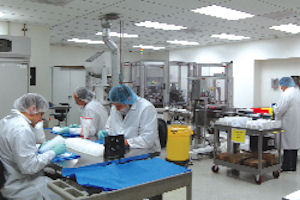
Irvine-based Advanced Sterilization Products is growing again amid a push by hospitals and surgery centers to prevent infections.
ASP makes devices and solutions that are used to clean and sterilize medical instruments as well as operating rooms and other areas of hospitals and surgery centers.
It’s part of New Brunswick, N.J.-based Johnson & Johnson, a conglomerate that counts about $65 billion in yearly sales from drugs, medical devices and consumer products.
ASP falls under J&J’s Ethicon division, which had $3.5 billion in sales through the first nine months of 2010.
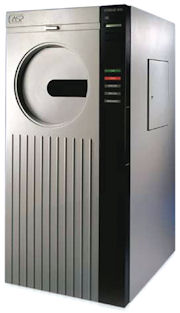
J&J doesn’t break out data on specific business units. Sales of ASP’s Sterrad, Evotech and Cidex branded products have grown at “a really high double-digit rate globally” during 2010, President Chuck Austin said.
ASP is selling more devices for several reasons, including new research indicating that most post-operative and other infections contracted in hospitals are “something that can be prevented,” Austin said.
He said he expects to see more growth driven by the Centers for Medicare and Medicaid Services’ decision in 2009 to stop reimbursing providers for “preventable” infections that result from a hospital stay. Healthcare-related infections continue to be a sore point for hospitals. Figures from the Centers for Disease Control and Prevention show that some 2 million people are infected during their hospital stays, with some 100,000 deaths and a cost to the healthcare system of $25 billion annually.
“We think that’s a conservative number,” Austin said.
ASP sees opportunities for further gains because hospitals want to move away from the standard sterilization method, ethylene oxide and steam. Ethylene oxide can be toxic, while steam can damage devices.
St. Joseph
St. Joseph Hospital in Orange has six of ASP’s Sterrad machines in its three sterile processing departments. The hospital uses them to sterilize endoscopes and other surgical instruments that are unable to withstand pressure and temperatures associated with steam, said Scott Bereki, its sterile processing manager.
ASP competes with companies such as Steris Corp. of Mentor, Ohio, which has about $1 billion in yearly sales, and St. Paul, Minn.-based Ecolab Inc., which has yearly sales of $6 billion.
In the Irvine Spectrum, ASP runs its sales and administration along with manufacturing, research and development and training from a 111,611-square-foot complex. It has about 400 employees there.
ASP’s push to grow comes on the heels of some regulatory snags.
In May, ASP got a warning letter from the Food and Drug Administration as a follow-up to a 2009 inspection.
Regulators cited problems at the company, including failures to verify design changes to ASP’s sterilizers and a lack of assurance that finished devices met certain requirements, according to the letter.
The FDA’s inquiry “was really focused on some of our process controls,” Austin said. “At no point was there any question about the efficacy of our products, and I think that’s an important thing to remember.”
The matter now is in hand and ASP is back to “business as usual,” he said.
“There are no restrictions on our commercial activities,” Austin said.
FDA regulators plan another unannounced inspection.
“They don’t tell you they’re coming—they just say ‘good morning,’” Austin said.
ASP isn’t the only sterilizer maker under scrutiny. The FDA revoked approval for one of Steris’ products last year.
ASP responded by doubling production of its competing Sterrad machine and increasing shifts at its plant in Irvine, according to Karen Borg, vice president of worldwide marketing. She told Crain’s Cleveland Business in July that ASP had a series of Internet seminars to target Steris customers.
“Pretty much anybody who’s got a Steris, we’ve had a conversation with,” Borg told Crain’s.
ASP mainly uses its own sales force and hospital buying groups to sell its devices, with independent representatives handling the Middle East.
Also helping sales: Hospitals have begun spending again on devices and machinery after clamping down during the recession.
ASP declined to say how much its machines cost on average, but Austin noted that the credit crunch likely played a role in the cautious spending by hospitals and other customers through 2009. He said ambulatory surgery centers were hit harder than hospitals because many of the former are doctor-owned and had trouble with financing.
Austin said parent J&J’s own credit arm helped in cases where it could provide financing for customers.
New products also are part of the ASP story. This year, it introduced a group of products to be used with its Sterrad NX compact sterilizer for operating rooms.
Other new products include Evotech ECR, a device that provides “high-level disinfection” and eliminates the need for manual cleaning of endoscopes used in surgeries, something Austin described as a “particularly onerous set of steps for healthcare workers.”
ASP also has started to roll out Glosair, a line of peroxide-based sterilizing devices for area disinfection. ASP got Glosair through its late 2009 buy of Gloster Europe, a French company, and plans to launch it here in 2011.
ASP will be continuing to pursue licensing deals, partnerships and joint ventures, as well as “acquisitions as they make sense in given markets,” Austin said.
Global Sales
About 60% of ASP’s business is outside the U.S. It operates in about 160 markets and is focused on what are referred to as the developing “BRIC” markets—Brazil, Russia, India and China—because they “are putting a lot of money into their healthcare systems,” Austin said.
ASP is one of several J&J business units that are based in Southern California. Others include Neutrogena Corp. in Los Angeles and Johnson & Johnson Pharmaceutical Research and Development LLC in La Jolla.
Biosense Webster Inc., a catheter maker, is in Diamond Bar.
ASP’s roots date back to the 1980s, when researchers developed dry, low-temperature gas plasma technology to sterilize medical devices. The first Sterrad system was installed in Germany’s Hospital Bremervorde in 1992. U.S. regulators cleared Sterrad for use here a year later.
