

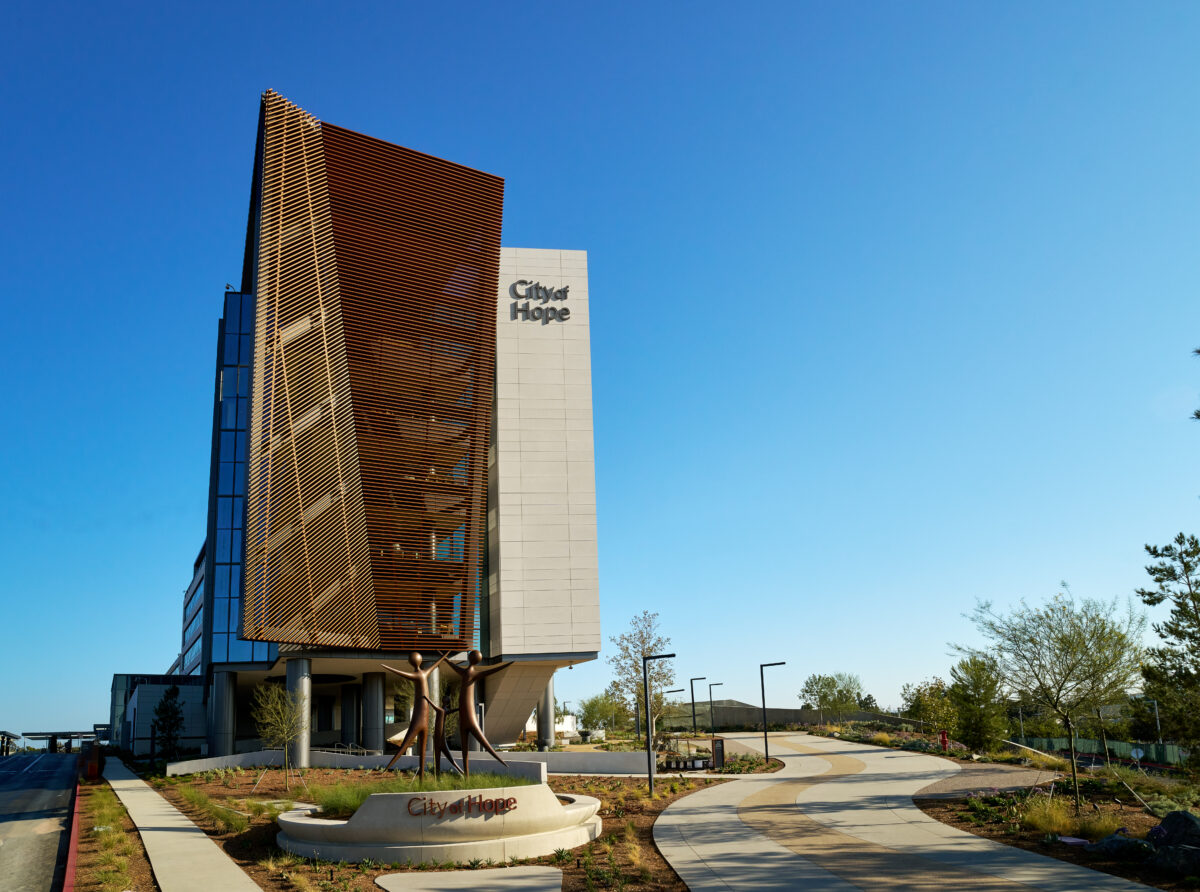
City of Hope Orange County officials assert there is nowhere in Orange County with more cancer experts under a singular roof than its new cancer specialty hospital.
City of Hope is recruiting about 750 nurses, pharmacists and more to work at the facility.
“They’re experts in their field, some of them top in the nation,” City of Hope OC President Annette Walker told the Business Journal.
It’s a first-of-its-kind facility for the region, becoming OC’s first and only hospital solely focused on preventing, treating and curing cancer.
The hospital, which officially opens on Dec. 1, is on track to be fully staffed by early January, according to Walker.
“I’m very pleased because that was one of my biggest concerns,” she said.
It is located next to the Lennar Foundation Cancer Center, an outpatient facility that opened in 2022. The two buildings are connected “to ensure care is uninterrupted throughout the entire journey.”
Together, along with five regional clinics, they are part of a $1.5 billion investment that City of Hope committed to in 2019 to expand local cancer services in response to the high number of people leaving the region to seek care.
Since arriving in Orange County, City of Hope has served more than 40,000 patients and is expected to create over 1,700 local jobs once hiring for the hospital is completed.
Last month, City of Hope announced a $30 million gift from local executive and philanthropist Ron Simon, $25 million of which will go toward future employee housing. In the meantime, the gift will fund rent subsidies for employees until the land is secured.
Walker said that they’re going to start accepting applications from employees starting in January.
Personalized Approach
The six-story, 174,000-square-foot hospital has 73 total beds, which may not seem like a lot compared to other facilities in Orange County that typically have more than 200 beds.
Physician-in-Chief Dr. Edward Kim said, however, that this is because each bed is reserved for patients with cancer.
“If you go to any hospital in this region and actually see how many beds the number of patients with cancer occupy, it’s not 73,” he said during a Nov. 6 preview tour of the facility.
Similarly, there are just four operating rooms that Kim says are the largest in the county, each measuring more than 700 square feet. Having large ORs benefit the operating team, giving them enough space to work in a calm environment, Kim said.
“We feel that is the right number to make sure that our surgeons perform their very best,” Kim said.
Unlike most hospitals, City of Hope’s facility does not have an emergency room.
Instead, patients can check into a 24/7 Evaluation & Treatment center on the first floor where they are assessed if they can go home, need further treatment or need to be admitted to the hospital.
This space replaces a traditional ER, which can expose immunocompromised patients on therapy to people with the flu and other illnesses, according to Kim.
Other features found in the hospital include two larger family suites on the upper levels, each with a private bathroom and a separate room with a sofa, which can accommodate patients with multiple family members who wish to spend the night during more extended hospital stays.
City of Hope most recently opened an immersive spiritual care center within the hospital.
By selecting on a touchscreen, patients and their families can surround themselves in the environment of several places of worship, including a chapel, mosque and synagogue.
The center is named in honor of the late Mark Wetterau, a philanthropist and former chief executive of the multibillion-dollar food manufacturer Golden State Foods in Irvine. He was also the first donor to City of Hope’s strategic fund.
730+ Clinical Trials a Year
Kim, a lung cancer expert who practiced for 25 years, said that he views the typical standard of care for cancer patients as “yesterday’s treatment.”
Staying true to this mindset, City of Hope recently opened clinical trials to screen for pancreatic cancer, stomach cancer and will soon start a program for thyroid cancer.
There are currently no general recommended routine screenings for all three cancers, Kim said.
“These are areas where there is no standard of care,” he told the Business Journal. “It’s not even reinventing a standard of care.”
Pancreatic cancer, in particular, is difficult to detect early and is the third-leading cause of cancer-related deaths. Last year, City of Hope received a historic $150 million gift from entrepreneur and philanthropist Emmet Stephenson Jr. and his daughter Tessa Stephenson Brand to further pancreatic cancer research in honor of Emmet’s wife and Tessa’s mother, Toni, who passed away from pancreatic cancer in 2020. It is the single-largest gift in City of Hope’s 111-year history.
City of Hope conducts more than 730 clinical trials each year across Atlanta, Chicago, Phoenix and California.
City of Hope has invested in recruiting national experts to lead these trials and oversee the latest technologies at its hospital and outpatient cancer center.
Kim said that City of Hope is running the first cannabis study in the county, looking at the combination of THC and CBD, two cannabinoids, in people after chemotherapy, and enrolled its first patient last month. It’s being overseen by Dr. Richard Lee, who also runs the Cherng Family Center for Integrative Oncology at City of Hope.
City of Hope also brought on physician-scientist Dr. Percy Lee from City of Hope Duarte in 2022 to launch and lead the radiation oncology department at the Lennar Foundation Cancer Center, which is said to be the only cancer center in the world doing adaptive therapy using a trio of advanced MRI-based radiation machines under one roof.
Cancer Survivor Shares Her Story
Kommah McDowell may not be here today if it weren’t for a second opinion from City of Hope Duarte.
McDowell, 49, was diagnosed with breast cancer when she was 29 years old. Prior to this, she was disregarded for seven months by her primary care physician, who said she was “too young” to have cancer.
A surgeon wanted to perform a lumpectomy, a surgery to remove the tumor and a portion of tissue, followed by radiation treatment. She reached out for a second opinion at City of Hope, where a specialist found that she had two rare forms of breast cancer with a survival rate of 5%.
“I would have died from the treatment the original doctor was going to perform on me,” McDowell told the Business Journal.
Now a survivor of 20 years, she is out of treatment and in follow-up care.
McDowell, a San Diego resident, used to drive three hours to Duarte. With City of Hope expanding cancer services to Orange County, her commute has gone down to less than an hour.
“This is huge for Orange County, but it’s equally important to surrounding counties,” McDowell said.
