

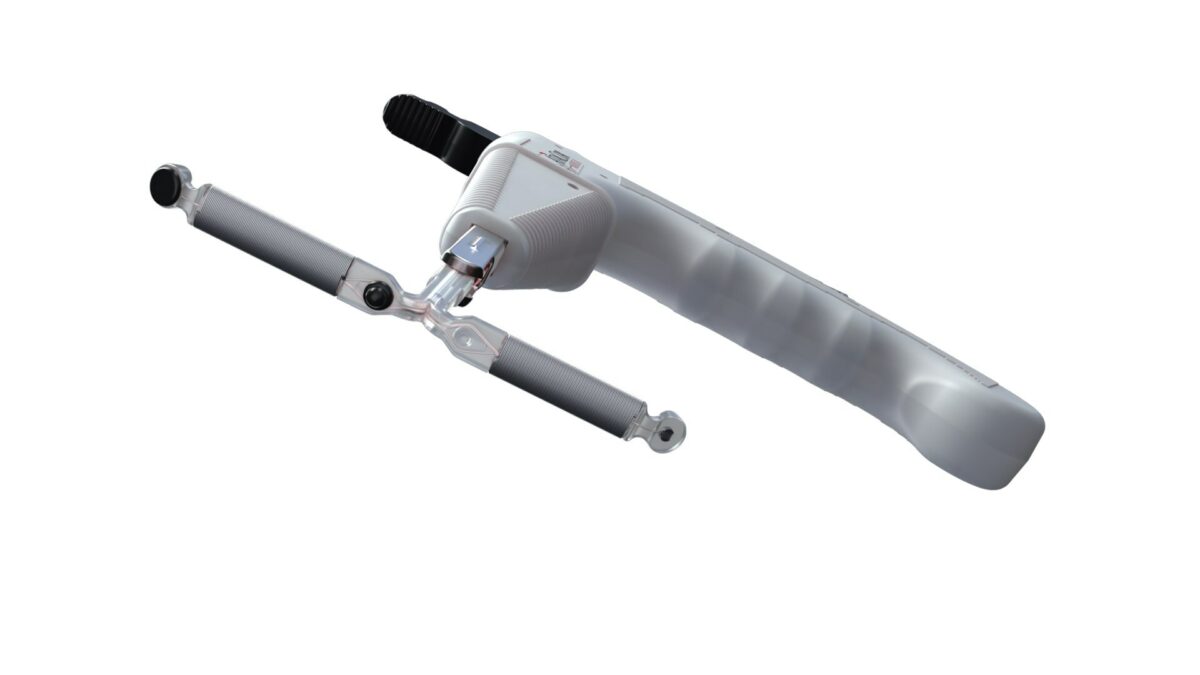
AtaCor Medical Inc. announced that it’s collaborating with healthcare giant Abbott Laboratories to develop a next-generation defibrillator system for abnormal heart rhythms.
The collaboration provides a commercial pathway for the San Clemente-based early-stage cardiac device company to launch its first product, a wire connecting a defibrillator to the heart that doesn’t need to be placed inside or onto a patient’s heart.
“Being able to have a name such as Abbott to tie to carries a lot of weight,” Rick Sanghera, co-founder and chief executive of AtaCor, told the Business Journal.
Abbott is developing an investigational implantable cardioverter defibrillator (ICD) that will pair with AtaCor’s lead delivery system through the partnership.
“Abbott is continually looking to advance innovation that can improve therapeutic options available to physicians treating people with life-threatening heart rhythms,” Vish Charan, divisional vice president of product development at Abbott’s cardiac rhythm management business, told the Business Journal.
AtaCor said it plans to conduct an investigational device exemption (IDE) clinical trial with about 250 enrolled patients this year evaluating the combined system.
“We’re on the last stages of the testing that we need to do with Abbott doing the same thing on their end on the device, and we will be submitting that to the FDA this year and evaluating that under a pivotal study called the Alarion EV Study,” Sanghera said.
Company Pivot to Defibrillators
AtaCor, founded in 2014, started as a company focused on pacemakers, a device that delivers low-level electrical pulses to regulate heartbeats.
Over the years, AtaCor has expanded to defibrillation and is now primarily a defibrillation company, according to Sanghera.
Pacemakers provide ongoing and frequent regulation while defibrillators deliver a strong electrical shock in the event of life-threatening arrhythmias that can lead to cardiac arrest. Many defibrillators have pacemaker capabilities as well.
A physician typically inserts a defibrillator by making an incision near the collarbone and guides a lead, or a small, insulated wire through the vein to the heart, where the defibrillator is attached to monitor its rhythm to detect dangerous irregularities.
The human heart beats 100,000 times a day, equal to 35 million times a year, according to Sanghera. With this, hardware can break down and needs to be replaced, which can lead to a series of complications including vascular injury, lead fractures or malfunctions and infections.
What AtaCor has done is create a lead that goes through the rib space adjacent to the sternum, avoiding the heart altogether, Sanghera said.
“The anatomy going through the rib space is a really nice pathway to get the lead where we want it and reduces the energy that is required to shock the heart, so the device becomes smaller and much more amenable for patients,” Sanghera said.
World’s First Implantable Under-the-Skin ICD
The first defibrillator without any wires attached to the heart was developed by another San Clemente medical device maker called Cameron Health.
The device, placed under the skin, is the world’s first and only subcutaneous ICD for the treatment of sudden cardiac arrest, according to the company.
Sanghera served as director of research for 10 years at Cameron Health, which was acquired by Boston Scientific for $1.35 billion in 2012.
He remained with the company for two more years before leaving to start AtaCor Medical in 2014 with Alan Marcovecchio and Sean McGeehan.
“I was able to make the hard decision to leave and ask myself where the industry is, and can we get pacing outside the heart?” Sanghera said. “That was really the birth of AtaCor.”
Since then, the company has gone through several pivots and challenges, including fundraising.
It took the company four years before it closed on its nearly $9 million Series A round in 2018.
“Your goal isn’t always the finish line,” Sanghera said. “The goal is that next significant milestone that allows you to fundraise again and get there.”
AtaCor has raised approximately $137 million to date. Its most recent round was a $75 million financing round last October with proceeds helping fund the company’s pivotal FDA study.
