

Allergan Inc. rolled with the punches last week, announcing a new president on the same day its shares took a hit on the threat of possible generic competition for one of its key eye drugs.
Then the Irvine-based drug maker punched back, laying out plans to challenge a recent ruling by the Food and Drug Administration that favors the generics.
The response helped halt a downward trend for Allergan’s shares that started on June 24, after the FDA said a generic version of the company’s Restasis dry-eye treatment could be approved without requiring human tests if a generic’s composition is similar enough.
The proposed standard from the agency touched off a 12% dip, with 15.5 million Allergan shares trading hands, close to six times typical daily volume. The company’s market value fell below $25 billion for the first time in nearly a year and remained down about 10% for the week, despite a slight bounce back later in the week.
The company zeroed in on safety concerns about the FDA’s proposal for generics and vowed to make a vehement case in calling on the agency to reverse itself.
The proposed testing measures for generic versions of Restasis “cannot predict clinical safety and efficacy, and thus cannot be used to establish bioequivalence,” Allergan said, adding that it would provide feedback to the FDA during a 60-day period in which the agency accepts public comments.
The drug maker “is reviewing all of our potential options, including filing a citizen’s petition, to ensure that the appropriate scientific considerations are evaluated.”
Citizen’s petitions are filed to the FDA to request the agency to take certain actions.
Allergan’s pugnacious posture offers a reminder of the ongoing importance of its eye pharmaceutical franchise even as it racks up sales with flashier products such as wrinkle-smoother Botox.
Restasis Revenue
The company got its start in the early 1950s with eye drops. Restasis alone is expected to have sales of $850 million to $890 million this year, some 15% of the company’s projected total of about $6 billion in sales.
Wall Street was of mixed mind on Allergan and Restasis.
Allergan will issue a “robust response” to the FDA’s guidance on a generic version of Restasis, said David Maris, an analyst with Toronto-based BMO Capital Markets.
Allergan “isn’t taking this lying down,” and last week’s sell-off was a market overreaction, Maris said in a research note.
Others weren’t so cheery on Allergan’s outlook.
A “non-infringing” Restasis generic could come to market within 12 to 24 months and potentially put 20% to 30% of Allergan’s profits at risk, said Seamus Fernandez, an analyst with Boston-based Leerink Swann LLC, in a report issued after the FDA’s opinion.
Fernandez downgraded Allergan shares to “market perform” from “outperform.”
“Despite a great history of commercial execution, an unparalleled position in injectable cosmetics and strong growth of Botox’s therapeutic indications, we believe only a clean resolution of the Restasis situation” would prevent Allergan from “converting from a core growth holding to a capital allocation story in the near term,” Fernandez wrote.
Annabel Samimy, who follows Allergan for St. Louis-based brokerage Stifel, Nicolaus & Co., said a generic version of Restasis could eventually slash Allergan’s sales by as much as 30%.
Samimy said in a research note that she didn’t expect a generic to be approved for at least another two to three years and that, although the longer-term implications of the recommended generic development path “remain unclear … the possibility of generic entry on Restasis has caused pressure to the stock.”
Ingram’s Appointment
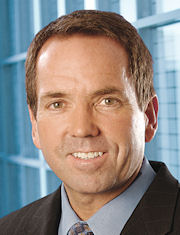
It appeared the appointment of Douglas Ingram as its new president also helped Allergan blunt the blow from the FDA.
Ingram will report to Chief Executive David Pyott, who had also been serving in the president’s role, and lead its global commercial operations. He most recently was executive vice president and president of the drug maker’s Europe, Africa and Middle East region.
Ingram “has consistently demonstrated leadership and high performance across many segments of our business,” Pyott said in a statement released on the afternoon of June 24.
