

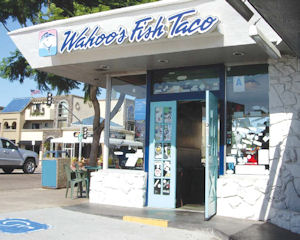
The fish taco market is wide open, and an Orange County-based pioneer is making the point in San Diego.
Santa Ana-based Wahoo’s Fish Taco—which has about 60 stores and an estimated $35 million in sales, according to a recent Business Journal list—is looking south for growth.
The competitive field in San Diego is a far cry from the 1980s, when fish tacos were a new, offbeat import from Baja California. These days they seem to be on the menu everywhere from white-table-cloth restaurants to beachfront watering holes and midtier casual chains.
“Everybody has tried to get into the game, at the low end or the high end,” said Marc Simon, chief executive of Rubio’s Rest-aurants Inc.
The Carlsbad-based chain has about 200 locations and $190 million in annual sales, according to Technomic Inc., an industry researcher in Chicago.
Quick Boost
John Park, a co-owner of Fish101 in suburban Encinitas, has gotten a quick boost from the trend. Sales of fish tacos are running about double the expectations when Fish101 opened four months ago, he said.
Rubio’s Simon said the chain has put expansion plans on hold to focus on improving sales at existing stores.
Enter Wahoo’s, which is growing in San Diego with franchise deals. Tal O’Farrell and Steve Lake—better known as the businessmen behind skateboard maker Sector9 Inc.—have Wahoo’s franchises in La Jolla and Point Loma, with an option to open a third.
“We’re looking hard in Carmel Valley and Del Mar,” O’Farrell said.
Wahoo’s now has five restaurants in San Diego.
“There’s a lot of room for growth,” said Tom Orbe, vice president at Wahoo’s, which is also opening restaurants in Colorado, Neb-raska, Texas and New York.
Rubio’s Simon, meanwhile, said his company is looking to go back to its roots.
Founded in 1983 by father and son Ray and Ralph Rubio, the company went public in 1999. Mill Road Capital of Greenwich, Conn., took it private in a $91 million deal in 2010.
Simon arrived as chief executive earlier this year and began a back-to-basics push.
The center of the Rubio’s menu is beer-battered, fried fish in a tortilla. In a bid for efficiency during its days as a publicly traded company, the chain hired a third party to bread the fish in preparation for the fryer.
The move was “well-intentioned,” Simon said. “It improved efficiency and consistency. But we lost something in the process: a sense of pride.”
Too Mechanized
Simon, a restaurant industry veteran, says it’s possible for kitchens to become too mechanized.
He’s now focusing on customer service and pushing to get away from the fast-food atmosphere at Rubio’s.
Simon said he wants unique tastes and textures. He said he prefers cases of avocados to avocado pulp squirted from a gun.
That drives prices up, but Simon said he’s not worried about offering a menu of items in the $7 to $9 range.
“For every dollar I grow the top line, I get more margin dollars,” he said.
Wahoo’s menu combines Asian, Brazilian and Mexican elements with “nothing deep fried,” O’Farrell said.
Then there is the atmosphere. Walls are covered with bold stickers that surfboard and skateboard companies use as a form of guerilla marketing.
Wahoo’s seeks to build relationships with surf and skate enthusiasts—which seem so be a good business plan on La Jolla’s Pearl Street, where the next door neighbor is Mitch’s Surf Shop.
Graves is a reporter for the San Diego Business Journal.
