

The $213 million pending buy of SenoRx Inc. could set the tone for acquisitions this year.
The Irvine-based company, which makes devices for diagnosing breast cancer, is the first Orange County-based medical device maker to be bought in 2010.
C.R. Bard Inc. of Murray Hill, N.J., offered about 14% more than what SenoRx’s stock was trading at before the May 4 offer.
Bard hasn’t yet outlined what it plans to do with SenoRx’s operations in the Irvine Spectrum.
SenoRx, which has 95 workers in OC and 165 companywide, said Bard’s goal was to “integrate the two businesses while minimizing the impact on current employees” in a Securities and Exchange Com-mission filing.
The deal is expected to be completed in the third quarter, after which SenoRx will become part of Bard’s peripheral vascular unit.
Chief Executive John Buhler, who took over on an interim basis in February and was elevated to the permanent post after Lloyd Malchow’s death in March, was unavailable for comment.
Into Fold
In a statement announcing the deal, Bard said buying SenoRx would allow it to provide devices that work through X-rays and magnetic resonance imaging to its existing set of ultrasound-based devices used to determine breast health.
Bard’s breast care devices include the Finesse biopsy system and UltraClip, a tissue marker.
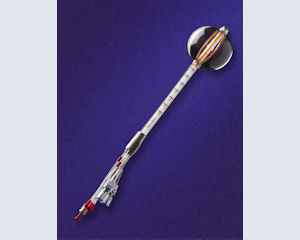
SenoRx, which has annual sales of about $55 million, makes the EnCor breast biopsy system, GelMark breast tissue markers and Contura, a balloon catheter that delivers radiation to diseased breast tissue.
The sale of SenoRx to a larger device maker such as Bard, which counts yearly sales of $2.5 billion and a recent market value of about $8 billion, “is not a trend that’s unusual,” said Bob Campbell, a managing director in the Newport Beach office of Los Angeles-based investment bank B. Riley & Co.
“In the medical device market, it’s very typical to see companies that are still at an unprofitable stage” but have revenue and some market acceptance to be sold instead of continuing to grow as a larger public company, according to Campbell.
SenoRx posted a net loss of $1.1 million in the first quarter, up from a $928,000 loss a year earlier. The loss disappointed analysts, who on average were looking for a $525,107 profit.
The business should turn profitable for Bard “very, very quickly,” Campbell said.
Bard has said it expects the SenoRx deal to add to its earnings in 2011.
SenoRx’s first-quarter revenue grew 4% to $13.4 million but came in below Wall Street’s estimate of $15 million.
Even with that, analyst Lawrence Neibor of R.W. Baird & Co. in Milwaukee called SenoRx “a solid bolt-on acquisition” for Bard’s existing breast biopsy business.
Neibor also said he expects Bard to quickly bring SenoRx to profitability, although Bard said that it expects the deal to reduce its 2010 profit by $7.7 million to $10.6 million.
Wall Street expects Bard to earn a $536.7 million profit on sales of $2.7 billion in 2010.
Another analyst, Amit Bhalla of Citi-group Inc., took a different view, downgrading SenoRx on news of the deal.
Bhalla is concerned about the earning potential of SenoRx’s main devices.
In a research note, Bhalla noted that biopsy procedures were down in the quarter and that revenue from the Contura catheter fell 21% to $2.3 million in the first quarter, down from $2.9 million a year earlier.
Reasons for Drop
Last year a medical group issued
guidelines that raised the age of patients eligible for the radiation treatment, which limited the pool of available patients for Contura.
A smaller pool of patients, slow doctor acceptance and an increase in competition from Bedford, Mass.-based Hologic Inc., which is promoting its MammoSite Radiation Therapy System, also contributed to the drop in revenue, according to Bhalla.
SenoRx got its start in 1998 and was known as BiopSolation Medical before changing its name. The company went public in 2007, raising about $45 million.
Boston-based MPM Capital LP, Paragon Associates of Dallas and other institutional investors own the biggest stake in the company.
SenoRx was founded by Paul Lubock, the company’s senior vice president and chief technology officer, and Fred H. Burbank, a former chairman who’s no longer with SenoRx.
This isn’t the first time Bard has bought an OC device maker.
In 2005, it bought Genyx Medical Inc., a venture-backed startup maker of urinary incontinence devices that was based in Aliso Viejo, for $60 million.
