

Sage North America is out to transform itself from “a house of brands” to a “branded house.”
“We want to be viewed as … one big brand versus a collection of little brands,” said Gabrielle Boko, the Irvine-based software maker’s executive vice president of marketing.
The laser-like focus on brand consistency started last year, when the company decided to stamp the Sage name on its entire portfolio of products after years of functioning as a collection of disparate brands.
The company, a unit of U.K.-based Sage Group PLC, grew steadily over the last 30 years—mainly through acquisitions that were bolted on as largely independent operations.
Sage North America has 2,300 employees across 13 offices in Irvine, Oregon, Virginia, Georgia, Florida, Pennsylvania, Washington and Canada. Its sales added up to $325 million in the six months through March, up 4% from the same period a year ago. Sage’s gross profits totaled $81 million for the period.
The Irvine operation is the largest unit of its parent company, which is traded on the London Stock Exchange and reported sales of roughly $1.1 billion and gross profits of $301.6 million for the six months ended in March.
Sage started its new approach to marketing last year, with a campaign created by San Francisco-based Doremus, its advertising agency of record. That campaign focused mostly on presenting the products under the Sage name and offering tangible enticements such as software features and price breaks.
The effort resulted in a 30% increase in brand recognition year-over-year, the agency said.
Sage now wants to take the brand campaign a step further.
“We are looking [to] evolve from specifics conversation toward audience conversation,” said Boko, who joined the company in July after a 6-year stint with Germany-based SAP AG, one of the best-known names in a market that ranges from big competitors to niche specialists.
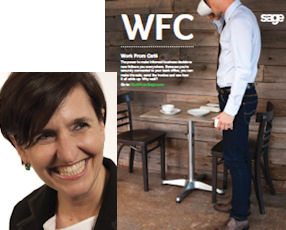
The new print ads, also created by Doremus, started appearing last month in a roster of business magazines that included Fortune and Businessweek.
The ads feature prominent acronyms—WFH and WFS—which stand for “Work From Here” and “Work From Café.”
It’s a high-tone approach that foregoes showcasing Sage products in favor of showing young entrepreneurs on the move, conducting business out of a coffee shop or a train station.
They might be taken for a fashion ad at first glance, with a modest version of the Sage logo as the only overt plug for the company.
“The whole idea is to communicate wherever you [choose] to work, Sage has the technology … to support you, whether it’s at your home office, on your way there, or at the work site,” Boko said. “There is no difference in product experience.”
The branding campaign is targeting small and midsize businesses for accounting services such as purchasing, invoicing and payroll processing. Ads aim to be “conversation starters” about how Sage can help small businesses be faster and more successful by giving them “the freedom to focus on what they do best,” be it construction, baking or interior design, she said.
The campaign’s $500,000 budget also will fund advertising on several digital platforms. They will include video ads and banners on websites such as Entrepreneur.com, as well as SBTV.com, an all-video small-business portal, and the Pandora online radio station.
The ads will run in the North America market until the end of the year, serving as a test run for a global campaign that parent Sage PLC plans to tailor for its regional units early next year.
Marketing executives from around the world, including Boko, will meet in December at Sage PLC’s headquarters in London to fine-tune a global message “that resonates with new audiences and expresses the ideas of confidence and freedom to small businesses,” she said. It will likely carry on the same idea of portraying Sage as a “branded house.”
The global campaign also will continue to focus mainly on print and digital. Additions of social media—with ads on Google Hangout, YouTube, LinkedIn and Twitter—also are expected.
