

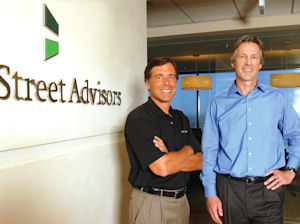
Green Street Advisors Inc., which built its name picking real estate stocks, is contrarian these days.
The company’s executives expect prices for office buildings and other commercial real estate to keep rising, even as other experts warn another crash could be on the way.
“I think that’s an exaggerated claim,” said Green Street President Craig Leupold, who scours charts, graphs and other metrics to make his point.
He and other Green Street analysts estimate commercial real estate prices have risen 25% since they bottomed out a year ago. Conditions are ripe to keep momentum going, they contend, especially with rebounding prices just back to 2005 levels.
Green Street sees apartments in demand, rents on their way up and business travelers filling up hotels.
Fundamentals—a property’s value, occupancy and cash flow—are moving in the right direction, according to Green Street founder and research director Mike Kirby.
Gloomy news reports, foreclosure data and commercial real estate indexes are outdated by the time they’re published and don’t paint an accurate picture of the high-end real estate market, according to Kirby.
“Those, we believe, are flawed,” he said.
Green Street is known in real estate investment circles around the world. The company provides analysis of shares of real estate investment trusts—real estate funds that pass along most of their profits to shareholders—as well as on real estate markets.
The company also manages some investments and offers trading in shares of real estate companies. It doesn’t do underwriting of real estate fund offerings, something Green Street says keeps its analysis unbiased.
Clients
Clients include money managers, hedge funds, pension and endowment funds, investment banks, insurance companies and REITs themselves.
Green Street has a relatively low profile locally, where its Newport Beach headquarters is in the shadows of bond fund heavyweight Pacific Investment Management Co. and is miles away from rivals on Wall Street.
The company got its start 25 years ago with humble beginnings: an executive suite in Newport Center, two desks, two phones, a Compaq computer, a floppy diskette loaded with Lotus 123 and a dorm refrigerator plastered with college decals and full of beer.
Founders Kirby and Jon Fosheim met in the early 1980s in New York. Fosheim was doing distressed deals at Bear Stearns Cos. Kirby had just completed an internship there during graduate school at the University of Chicago.
They were sitting in a tiny SoHo bar called the Green Street Cafe when they forged a business plan based on controlling the debt of distressed companies and properties.
The founders both grew up in South Dakota. They wanted to ditch Wall Street culture and start a business in the Southwest.
They settled on Newport Beach because “if the business failed, we’d have a nice, warm beach to sleep on,” Kirby said.
Green Street opened in 1985.
The first two years were a profitless struggle. The company got its start during the onset of the savings and loan crisis and ensuing days of the Resolution Trust Corp.
One day, a client asked them to look at a real estate fund and determine its value. After subtracting debt, they determined the portfolio was worthless—something Wall Street analysts completely missed. It wasn’t long before other fund managers who needed eyes and ears to track their portfolios started calling.
By 1987, Green Street had found its niche.
In the early 1990s, REITs were a sleepy industry that grabbed few headlines on Wall Street. By 1993 more REIT stock offerings were hitting the market. Within three years, more than 70 REIT offerings were launched, spurring Green Street’s growth.
John Lutzius was the founders’ first hire in 1992. He had stints at Citibank’s treasury department in New York and at the leveraged lending group of Security Pacific National Bank in Los Angeles.
Green Street’s office didn’t exactly exude success when Lutzius first walked in. So he asked Kirby and Fosheim to look at their company tax returns.
That was “a sign of a good analyst,” Kirby said.
Lutzius now is Green Street’s managing director of international operations in London.
Leupold was brought on in 1993 as the second hire.
Most of the company’s early employees are in senior positions now.
Headquarters
The company’s 15,000-square-foot, eighth-floor office houses 50 analysts, consultants and administrators. It’s decorated with photos of landmarks such as the Huntington Beach pier, the famed Crab Cooker restaurant in Newport Beach and views of the coast, mountains and surf.
The conference room has panoramic views of the Pacific Ocean, rolling hills and Saddleback Mountain.
A spacious kitchen is stocked with candy and other goodies. A stainless steel refrigerator is packed with premium beers for half-day Fridays.
Green Street’s consulting team recently valuated a $500 million investment for the Teacher Retirement System of Texas largely in shorts and sandals. No one at the office is older than 50.
“It’s a whole anti-Wall Street thing,” said Chief Operating Officer Warner Griswold, dressed comfortably in jeans and a polo shirt.
Griswold fits the Green Street mold. He’s 37, went to Ivy League school Brown University, has an impressive resume and prioritizes life and family above work.
He doesn’t mind the knocks he hears from colleagues down the street who give him a hard time for showing up in cargo shorts on Mondays.
“I just feel sorry for them,” said Griswold, a Tustin native who was hired in 1996.
No Late Nights
Green Streeters take their cue from their boss, who leaves the office everyday at 4 p.m. When some employees started to work later in the evenings, it ticked off management because others started following suit.
Executives reprimanded them and threatened to dock bonuses for messing with the culture.
Even though analysts don’t work long into the night, expectations are high.
Laura Clark said she starts reading her BlackBerry at 5:30 every morning to keep up with market reports and news from New York. She zips through Google alerts, newsfeeds and economic reports before she leaves for work.
A senior associate who covers strip malls, Clark said she never knows what the day will bring. In one day she could be taking client questions, offering views on stocks or weighing in on a company’s performance or capitalization rate.
During earnings season, she’s churning out reports, crafting thought pieces, digging through financial statements and sitting in on conference calls.
“It’s never the same day,” said Clark, sifting through data on her office computer.
Retail real estate is going through some challenging times, as small shops were hit hard in the recession. Many of them went out of business, lifting vacancies nationwide.
“These markets are still not back,” said Clark, who was hired 18 months ago after covering real estate funds for six years in her native Atlanta. “This is the new normal.”
That’s a term borrowed from Pimco’s Bill Gross, manager of the world’s largest bond fund and largest mutual fund of any kind, to describe the post-crash economy. It’s a phrase echoed a lot at Green Street.
Cedrik Lachance, who covers malls, travels about every six weeks to visit properties. Recent trips include Florida, San Francisco, San Diego, Chicago and Las Vegas.
The 38-year-old managing director sums up his job and Green Street’s function pretty succinctly: “We try to figure out if the stock we cover is cheap or expensive.”
Offices
In 1995, Green Street opened a trading desk in Dallas. A London office came in 2008 to cover public and private real estate companies in Europe.
Executives are eyeing a possible expansion in Asia.
The company’s executives don’t like to talk about the cost of their services. But in some cases clients pay seven figures for Green Street’s analysis and consulting.
Green Street is extremely selective in choosing and retaining customers. In 25 years, the company has built itself into a premier researcher and flexes its muscles when it needs to.
“We fire clients” if they misuse the research or don’t want to renegotiate pricing, Leupold said.
Picks
Picking stocks is what put the company on the map. Its “buy” recommendations have generated annualized total returns of 25% since 1993, compared to an 11% industry average.
Of course, these are hypothetical bets. That’s why the company established Green Street Investors, a subsidiary that manages an account that follows investment recommendations.
The $100 million portfolio has generated nearly 500 basis points annually above a benchmark since its inception four years ago.
Performance
Since 1993, Green Street “buy” recommendations have outperformed “holds,” which have outperformed “sell” recommendations.
Revenue is more dependent on the amount of real estate shares traded than their performance. Green Street covers 81 U.S. companies and 15 in Europe.
When the company was founded 25 years ago, the market value of REITs was $8 billion. Today, it’s more than $250 billion.
“We’ve always been bullish on this industry,” said Kirby. “Our business doesn’t boom, but it’s extraordinarily resilient in tough times.”
Green Street Advisors Inc.
• Business: real estate, REIT analysis, money management, trading
• Headquarters: Newport Beach
• Offices: Dallas, London
• Employees: 70
• Companies covered: U.S., 81; Europe, 15
