

Reduced reimbursements from insurers and increased competition have led a number of hospitals here to branch out as the effects of last year’s healthcare reform begin to settle in.
Among the changes: a focus on specialties and branded urgent care centers and retail clinics that bring in more revenue and ease burdens on hospital emergency rooms.
“They have to think of creative ways to remain in business and fulfill their mission,” said Mitch Morris, a Costa Mesa-based principal in the life science and healthcare practice of Deloitte Consulting. “Some hospitals are looking at increasing the percentage of revenue from sources other than being a hospital.”
Surgery centers, wellness programs, diagnostic imaging and “other kinds of business that occurs outside the hospital walls” are gaining favor in an age of healthcare reform, according to Morris.
Specialty services are attractive because they bring more patients who are able to pay for their care, either on their own or through insurance, Morris added.
The result: reduced risk on eventual reimbursements and more predictable revenues.
Specialty practices are a big push for some hospitals.
At UCI Medical Center, a teaching hospital in Orange, there’s an emphasis on “selective programs that we do that nobody else does,” according to Chief Executive Terry Belmont.
UCI Medical Center’s specialties include a gastrointestinal disease center, a focus on ovarian and cervical cancers, a high-risk maternity and neonatology unit, robotic surgery and weight-control procedures.
The goal: getting more insured patients.
“Every hospital wants to serve the entire community, and they have a mixture of uninsured, underinsured, poorly insured and well-insured,” Belmont said.
Specialty practices help offset the costs of treating uninsured and underinsured patients, especially at public hospitals.
UCI’s recent $556 million expansion adds several services that could bring in more privately insured patients.
They include a radiology suite with imaging and diagnostic devices, an inpatient orthopedic unit and enhanced labor and delivery and postpartum units.
Hoag Brand on Care Centers
Hoag Memorial Hospital Presbyterian, with campuses in Newport Beach and Irvine, is among those offering services beyond its main hospitals.
It recently opened Hoag Orthopedic Institute in partnership with doctors at its Irvine campus.
Hoag also is moving into urgent care clinics with the first of five planned walk-in centers in partnership with doctors in Tustin.
The hospital operator is looking to open four other centers within the next two years.
“We identified urgent care as an opportunity to lower the cost of care,” said Cynthia Perazzo, Hoag’s vice president of strategy and business development.
Hoag’s first center treats lacerations, minor fractures, infections, coughs and colds— “standard urgent care,” Perazzo said.
The urgent care centers are expected to ease pressure on Hoag’s emergency department, “which is pretty busy,” Perazzo said.
Hoag generally ranks as the county’s No. 1 hospital by net patient revenue (see story, page 34, List, page 36).
The hospital doesn’t look at urgent care as a revenue opportunity, according to Perazzo.
“It’s really about patient access and about extending quality services into the communities that we serve,” she said.
Easing ER Pressure
There is a defensive aspect to the urgent care centers. Perazzo said she expects that insurers—perhaps including health maintenance organizations—will target what they deem to be “unnecessary visits to the emergency room” in a bid to cut costs as healthcare reform takes hold.
Hoag’s urgent care accepts various insurance plans, including HMOs and Medicare, the federal health insurance program for older Americans. The clinics also will treat patients who pay out of their own pockets.
Hoag is licensing its name to the urgent care venture.
It has partnered with Robert Amster, a doctor and longtime Hoag medical staff member who runs Your Neighborhood Urgent Care LLC, a Cypress-based company that provides management services to doctors.
Amster has worked on developing urgent care facilities in other parts of the county, according to Perazzo.
The hospital picked Amster for several reasons, including his willingness to set quality guidelines and operating standards, she said.
None of the Hoag Urgent Care doctors will be employed by the hospital. California state law prohibits direct employment of doctors by hospitals.
Hoag is eyeing potential locations in Irvine and Huntington Beach, according to Perazzo.
MemorialCare Medical Centers, a Fountain Valley-based hospital operator, also has branched into specialty businesses beyond its hospitals.
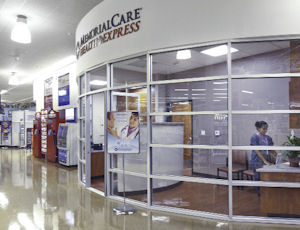
Last year, MemorialCare opened three HealthExpress clinics inside Albertsons supermarkets in Huntington Beach, Irvine and Mission Viejo as part of a pilot program.
The HealthExpress clinics provide basic healthcare for sore throats, ear infections, coughs and colds, as well as sports and school physicals.
MemorialCare, which has hospitals in Fountain Valley, Laguna Hills and San Clemente, opened HealthExpress to help keep unnecessary cases out of emergency rooms and to steer patients to primary care doctors.
“A low-cost, easy place to get some of the simple things made sense,” MemorialCare Chief Executive Barry Arbuckle said after the opening of the first of the centers last year.
MemorialCare’s entry into store health clinics could mark a maturation of the business, according to Arbuckle.
New View on Retail Clinics
A decade ago store clinics “were growing like crazy, and then all of a sudden, they plateaued,” he said.
Investors grew disinterested after they found the facilities didn’t offer big profits, according to Arbuckle.
Rising burdens on emergency rooms and expectations that insurers will tighten up on reimbursements has changed the outlook.
Besides HealthExpress, MemorialCare’s also worked to develop specialties.
MemorialCare’s Orange Coast Memorial Medical Center in Fountain Valley made a heavy investment in outpatient care in recent years.
In 2009, the hospital opened a $50 million tower that Chief Executive Marcia Manker said was built to serve a growing number of patients who were coming to the hospital for procedures that didn’t require extended stays.
Manker said at the time the tower opened that outpatient procedures had grown more than 300% since MemorialCare bought the hospital in 1986.
