

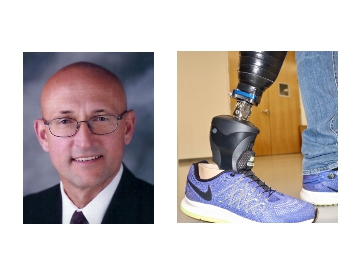
When your private equity investor wants to cash out, it’s often with a sale. Irvine-based Freedom Innovations LLC said it couldn’t be happier with a strategic partner like German prosthetics maker Ottobock.
The union, which closed last month for an undisclosed sum, brought together Nos. 1 and 3 in prosthetics maker sales on the American market, according to Ottobock.
It allowed the exit of previous Freedom owner, private equity firm Health Evolution Partners in San Francisco. Newly appointed Freedom Chairman Maynard Carkhuff said Ottobock is “an ideal partner for us.”
He said that despite synergy, the two companies have no plans to “rationalize [any] product line,” but will implement a dual strategy under which they’ll expand their portfolios under their respective brands. Freedom, which specializes in advanced and premium-price lower limb prosthetics, will introduce more affordable products.
Freedom has a manufacturing facility in Utah and at its Irvine headquarters. It plans to manufacture its core carbon fiber products at the 26,000-square-foot Utah facility. It will bring research and development, and manufacturing of more sophisticated Mechatronic products to Irvine, where it occupies approximately 41,000 square feet.
Freedom employs more than 150 people around the world, 53 based at its Irvine headquarters.
German Partner
Ottobock develops orthopedic technology; it has over 8,000 employees and sales last year of over $1 billion.
Carkhuff said he’d known Otto Bock Group President and Chief Executive Hans Georg Näder for years. “He took over the business 27 years ago and grew the company organically from $100 million to over $1 billion.”
Ottobock was founded in Germany in 1919 by prosthetist Otto Bock. Näder is a third-generation owner. The company had been privately owned by the Näder family via Otto Bock HealthCare GmbH & Co. KG. The family now owns 80% of the business following Swedish private equity firm EQT Partners’ acquisition of a 20% stake in Otto Bock HealthCare in June.
EQT, a medical technology investor with strong ties to the powerful Swedish Wallenberg family, is the first shareholder outside of the Näder family in the company’s 98-year history. It focuses on investing in medical technology companies, specifically family companies, and is expanding its presence in German-speaking countries. Its healthcare investment includes hearing aid specialist Sivantos Pte. Ltd. and Italian artificial hip joint maker Lima Corp.
Näder said Ottobock plans to “become more agile, to adapt to the future even more quickly, to strengthen our leading position in digital transformation and to realize hidden performance and profitability potential.”
The Freedom buy is in line with Ottobock and EQT’s Roadmap 22 strategy: Ottobock will pursue “ambitious growth targets in the business areas of Prosthetics, Orthotics, Human Mobility and MedicalCare,” a company statement said.
Dave Reissfelder was named chief executive. He’s headed Ottobock subsidiary BionX Medical Technologies Inc. in Bedford, Mass., a prosthetic foot and ankle product maker that Ottobock acquired in March. Its Empower Ankle device is based on robotics technology developed by Hugh Herr, who heads the biomechatronics group at the media lab at Massachusetts Institute of Technology.
Carkhuff and Reissfelder report to Ottobock.
Technology
Freedom products are reimbursed by Medicare. It has a wide range of prosthetic offerings designed to allow users to live a productive, uncompromised lifestyle. It has over 80 products with prices ranging from $350 to over $3,500 for foot products, $11,000 for ankle offerings, and $18,000 for knee products.
“More than two-thirds of the amputees are [results of] peripheral arterial disease [due to] obesity, diabetes and old age. But another major component, roughly 25%, comes from traumatic accidents, like sports, industrial and car accidents,” said Carkhuff, noting that the latter group is made up of a much younger population with more active lifestyles.
Users include world-record marathon runner Amy Dodson and Olympic snowboarder and former “Dancing with the Stars” competitor Amy Purdy—she and her partner placed second in the competition—“our products need to serve higher functions,” Carkhuff said. He added that Freedom invests about 15% of revenue in research and development, higher than the industry average of 4% to 5%, according to the company.
Freedom manufactures Plié 3 at its Irvine site. It says the new microprocessor-controlled knee responds 10 to 20 times more rapidly than other microprocessor knees, and offers more responsive stumble and fall protection. Users can more easily move at their own pace in any direction, pivoting and going up and down slopes.
“We are calibrating optimum resistance and position [of the prosthetics] every five milliseconds—like every step,” said Freedom Vice President of Research and Development John Robertson.
He said that Kinnex, “the world’s fastest responding microprocessor ankle/foot technology” that launched last year, is part of manufacturing operations in Irvine.
Features include longer-lasting battery power, water resistance, and smart technologies that help maximize prosthetics to act “as much like the real [thing] as possible,” Robertson said. He indicated that the company is always improving technology, such as adding bicycle mode—“knees need to know to switch off and be nonresistant when biking”—and golf mode, turning on resistance and stabilizing the foot when swinging a club.
He said the company plans to expand the Irvine team with 15 hires.
Carkhuff said the goal is to accelerate growth for both Ottobock and Freedom, with an IPO slated two years down the road.
“For me personally, it is a very exciting acquisition where we get to maintain our brand identity and heritage, leveraging our patents to develop innovative technology.”
