

Two years of heavy losses at banks and thrifts based in the county seem to be coming to an end.
A dozen homegrown banks and thrifts returned to profitability in the first quarter, according to recently reported Federal Deposit Insurance Corp. data.
The banks that returned to profitability joined seven others here that already were in the black.
Another 11 still saw losses.
Two of those—Westminster-based Saigon National Bank and San Juan Capistrano’s Capital Bank—saw losses widen from the fourth quarter.
The nine others in the red all made steps toward profitability in the first quarter, according to Grace Wickersham, senior vice president at Irvine-based bank investor and consultant Carpenter & Co.
“After using most of 2008 and 2009 to build reserves and improve credit quality at the expense of earnings, the financial condition of the majority of Orange County banks seems to have stabilized,” she said.
Costa Mesa’s Pacific Mercantile Bank, the largest based in the county by assets, jumped from a nearly $3.6 million fourth-quarter loss to a $251,000 first-quarter profit.
The bank credited that improvement to a $3 million or 57% increase in interest income from loans versus a year earlier.
Pacific Mercantile also reported a $2.3 million or 65% decline in provisions for loan losses from a year earlier.
“The trends are improving,” said Nancy Gray, Pacific Mercantile’s chief financial officer.
The bank’s nonperforming loans, where borrowers are 90 days or more behind on payments, dropped 7% from a year earlier, “the biggest quarterly drop we’ve seen in almost two years,” Gray said.
Costa Mesa-based Pacific Premier Bank, the county’s third-largest bank or thrift by assets, ended last year with a quarterly loss of $174,000.
At the end of the first quarter, Pacific Premier moved into the black with a gain of $557,000.
“The economy certainly seems to have bottomed in the second half of last year,” said Steve Gardner, chief executive at Pacific Premier. “It certainly seems we’ve stabilized and we’re seeing some modest positive trends in the early part of this year.”
Still, uncertainty remains about the state of credit, according to Gardner.
“For our bank, things have been relatively strong,” he said. “But a lot of others still have a lot of exposure to commercial real estate. And that market remains weak.”
Pacific Premier has tried to stay away from construction loans as well as land development lending, according to Gardner.
“We’ve remained a fairly plain vanilla, traditional business lender,” he said.
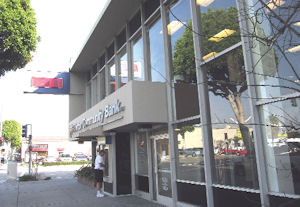
Fullerton Community Bank, a savings and loan that’s the fourth-largest bank or thrift in the county, cut its losses in half to $1.4 million in the first quarter from the fourth.
Tom Meyer, the thrift’s chief executive, said he’s unsatisfied with the results.
“We’ve reduced our losses, but it has come at a price,” he said.
Fullerton Community has been working on bolstering its reserves, according to Meyer.
Its construction and land portfolios have been cut in half from about 9.2% at the end of 2008 to about 4.5% at the end of this year’s first quarter, he said.
“We’ve taken losses in order to sell off some of those loans,” he said. “We’ve also written down the land piece of the portfolio pretty aggressively.”
The thrift’s commercial real estate portfolio has held up better, according to data compiled by San Francisco-based investment bank Stone & Youngberg LLC.
It found that Fullerton Community’s exposure to that part of the market is in line with levels suggested by regulators for savings and loans, according to Michael Natzic, head of Stone & Youngberg’s community banking group.
“They’ve been writing commercial real estate loans fairly conservatively,” he said. “That part of their portfolio appears pretty stable.”
Sunwest
Profits at Tustin-based Sunwest Bank, the county’s fifth-largest bank, slipped from the fourth to first quarter.
Sunwest had a first-quarter profit of $2.6 million, down from a fourth-quarter profit of $8.5 million.
The bank’s lower first-quarter profit still was the highest of any bank or thrift in the county.
Compared to a year earlier, Sunwest’s first-quarter profit saw the biggest jump—rising 62% or by $1.7 million.
The drop from the fourth quarter stemmed from gains reported in late 2009 from an earlier acquisition, according to Glenn Gray, the bank’s chief executive.
“That really helped to boost fourth quarter results,” he said.
The bank’s first-quarter profit is probably more representative for Sunwest, according to Gray.
“Loan demand is still sluggish,” he said. “We’re seeing very conservative cash management by small-business owners. They’re still in the mindset of building savings rather than investing in future growth.”
Fountain Valley-based Centennial Bank, the county’s second-largest bank or thrift by assets, generated a big turnaround.
It shifted from a $5.3 million fourth-quarter loss to a profit of almost $1.7 million in the first quarter.
But Centennial saw a key measure of bad loans and real estate versus cash reserves shoot up in the first quarter.
The bank’s Texas ratio—first used in the 1980s to evaluate banks in the Lone Star State—came in at more than 100, according to data compiled by Carpenter.
The ratio, developed by analysts at Royal Bank of Canada’s RBC Capital Markets, serves as a yardstick to gauge the health of banks and is considered to be a red flag when it moves past 100.
Two years ago, Centennial Bank had a Texas ratio of around 2.
What the ratio means for Centennial Bank isn’t entirely clear.
“Centennial isn’t a traditional commercial bank,” said Gary Findley, an Anaheim-based banking analyst and consultant. “Their history is more as an industrial loan, higher-octane commercial financing operation. They deliberately take on more risk including higher delinquency factors into their business plan. The trade-off is that they also make higher profit margins.”
The only other local bank with a Texas ratio greater than 100 at the end of the first quarter was Westminster-based First Vietnamese American Bank.
The bank opened with fanfare in 2005 as the first to specifically target Vietnamese-Americans and their businesses in Little Saigon, which spans Westminster, Fountain Valley, Garden Grove and Santa Ana.
The area is home to an estimated 200,000 Vietnamese.
First Vietnamese’s Texas ratio at the end of the first quarter was 262, up from 234 at the end of the fourth quarter.
Another Little Saigon bank, Saigon National, which opened a few months after First Vietnamese in 2005, improved its Texas ratio.
At the end of the first quarter, Saigon National’s ratio fell to 87.5 from 117 at the end of the fourth quarter.
