

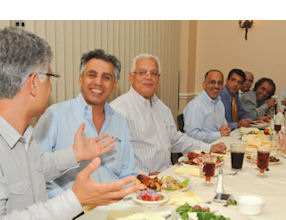
Immigration and corporate attorney Ali Farahmand is about to call the meeting to order.
The weekly gathering for the Strategic Business Group has drawn about 25 members of Orange County’s closely knit Persian business community, representing a cross-section of professional services, from accountants and dentists to doctors and consultants.
New arrivals greet colleagues and friends as tomato-and-cucumber salad, mint leaves, flatbreads and cheese spreads are passed around the U-shaped set of tables in a side room at Caspian Restaurant in Irvine—a social center for the local Iranian-American community, which generally prefers the term Persian to signify its heritage.
Members of the Strategic Business Group provide updates on upcoming activities and referrals for potential business leads. The tips don’t often translate into sales—the exercise is more about building relationships.
The group generates more than 500 referrals annually that are tracked through proprietary software, Farahmand says.
The group tallies the results at year-end, when a prize is awarded for the most referrals.
David Kanani begins a short seminar on financial planning, a requested topic, as dishes of soltani and other specialty stews are served.
Kanani, who runs a financial advisory in Irvine, came to the U.S. in September 1977, two years before the Iranian Revolution.
He never returned to live in Iran after leaving the war-torn country.
“The culture change was huge,” Kanani says, referring to the breadth of opportunity the U.S. promised.
It’s a sentiment shared by many of the Persians who’ve settled in Orange County, home to one of the largest concentrations of the ethnic group in the U.S.
200,000-Plus
So it’s no wonder that Irvine is home to more than one business group for Persians. The Network of Iranian-American Professionals of Orange County, with more than 300 active members, also is based in the city.
Retired market researcher Hossein Hosseini estimates the Persian population in OC to be between 200,000 and 250,000, on par with the Vietnamese-American community that garners more attention and lays claim to the Little Saigon district as a geographic and cultural center.
Persians have no such physical center here, though they celebrate the annual Mehregan Persian Harvest Festival, which attracts thousands to the Orange County Fairgrounds each October for a two-day celebration of food, live music, costumes and games.
“I realized we were undercounted,” says Hosseini, a statistician by trade who conducted his own study on Iranian-Americans in the U.S., using the 2010 census as a basis.
His findings provide a deeper look than most federal government assessments, which don’t require residents to identify themselves as Iranians on survey forms, though they can write in that detail.
Hosseini’s research found that more than 1.2 million Persians live in the U.S., with about half located in California, which became home to many Iranians after the first big migration in the 1960s.
Higher education was gaining prominence in Iran at the time, fueling an exodus to the West. University of California, Los Angeles, and the university system’s main campus in Berkeley were among the early favorites of many students from Iran.
After graduation, a lot of them stayed in California—where the weather is similar to Iran’s. They eventually started families, and many brought relatives to join them here.
The suburban quality of life and vibrant business landscape brought many to Orange County, which offered better school systems and safer communities at a time when big cities were struggling with hollowed-out cores, rising crime rates, and falling property values.
The Persian community has thrived here and elsewhere in the U.S. It boasts a median household income of about $70,000, compared with $53,000 nationally, according to census data.
About 60% have undergraduate degrees, and 30% hold master’s degrees or higher. Indianapolis-based Lumina Foundation, a private educational foundation, estimates that in 2011, 38.7% of Americans held a two- or four-year college degree. 2011 is the most current year available for analysis.
Prior to the revolution, most Persians immigrating to the U.S. were Muslim, but after the fall of Iran and the ensuing war with Iraq, a flood of Iranians practicing Judaism and Zoroastrianism, the ancient Persian religion, migrated here.
Many wealthier Jews settled in Beverly Hills, giving it the nickname “Little Persia.”
Zoroastrian followers and a number of ethnic Armenians who had lived in Iran for years moved to suburban areas north and south of Los Angeles.
Other areas with sizable concentrations of Iranian-Americans include New York, New Jersey, Texas, Florida and Washington, D.C.
“The footprint is all over the place, but especially in Irvine, which was one of the favorite cities,” says Hosseini, who arrived in the U.S. in 1976 to attend Iowa State University in Des Moines.
Prominent Players
Persian influence has boosted the Orange County business landscape for generations.
Some of the first migrants were student doctors who later established practices here. Attorneys, accountants and engineers soon followed, propping up the technology and professional services sector and laying the foundation for future transplants.
“They came in and started businesses,” said Abbas Muhaddes, chief executive of Santa Ana-based traffic analytics and software maker Iteris Inc. “The atmosphere was more welcoming.”
The Business Journal’s recent OC 50 list of the most influential residents included three Iran-born entries: Paul Merage, chairman of MIG Capital LLC in Newport Beach; Igor Olenicoff, owner and founder of Olen Properties Corp.; and Joe Kiani, founder and chief executive of Irvine-based medical device maker Masimo Corp.
Merage and Olenicoff also were listed as billionaires on the Business Journal’s recent OC’s Wealthiest issue.
Merage gave $3 million for the Irvine Jewish community center that bears his name.
The OC’s Wealthiest list also included Iran-born Fariborz Maseeh, an engineer-turned-financier who heads Newport Beach hedge fund Picoco LLC. Maseeh established University of California, Irvine’s Samuel M. Jordan Center for Persian Studies and Culture in 2005 with a $2 million endowment.
Persian Ideals
Persian immigrants, while they aspired for America’s opportunities, still hung on to traditional Persian culture and values.
Businesses, including ethnic markets like the Super Irvine, sprouted up to cater to the growing population. The markets carry familiar Persian favorites, such as the yogurt drink aloocheh, a selection of pita breads, fresh white fish, and various cuts of lamb.
They enjoyed the reminders of home while mixing in the flavors of their new home.
“I fell in love with the culture and the U.S.,” says Muhaddes, who read Time magazine as a teenager growing up in Khorasan in eastern Iran, a region known for its rich crops of cherries, melons and oranges used in traditional Persian dishes.
He arrived in New York in 1975 as a wide-eyed 18-year-old. His plan was to attend Georgetown University, earn an architectural degree and return home.
A few years into his studies, his government-provided financial resources were shut off in post-revolution Iran, forcing him to work three jobs to pay his way through civil engineering school.
Muhaddes’ parents, as in many Iranian families, pushed him into one of two primary professions. The other desired field was medicine.
“Success was measured by whether you were a doctor or an engineer,” he says over lunch at Darya restaurant, his favorite Persian eatery, near South Coast Plaza.
Most of the patrons here are speaking Farsi and sharing plates of Zereshk polo, beef koobideh, basmati rice and Shirazi salad.
The entrepreneurial spirit that blossomed after the revolution migrated with many of the Persian immigrants who wound up in Orange County over the years.
“You could see there was a sense of entrepreneurship after the revolution, because we started to innovate and create things,” says Muhaddes, who settled in the U.S. rather than returning to Iran, taking 18 years to make his first visit back to his home country.
That sense of entrepreneurship runs deep in dentist Kianor Shah, an Irvine resident who sued Wal-Mart this year for allegedly stealing his idea for in-store dental clinics.
The same goes for Media Najafi, who also runs a family dentistry in Irvine, and for business consultant Sue Siami.
Najafi left Tehran at age 11 with her mother and younger brother as her father sorted through family finances and sold their home.
One of their first attempts to leave Iran was thwarted after their guide was captured and murdered.
The three fled to Paris after the revolution and later settled with relatives in Philadelphia.
“It was my mom who strongly initiated our move, because she envisioned a better life and future for her children,” says Najafi, who earned dual degrees in biochemistry and cell biology from UC San Diego and a doctorate from UC San Francisco.
Her mother was a nurse in Iran, her father an electrical engineer.
“I always loved medicine, because my uncle was a doctor, and I looked up to him and his intelligence and status,” she says.
But the Newport Coast resident says she isn’t pushing her two young daughters, Vianna and Atrina, in the same direction.
“I don’t want them to be in medicine, law or engineering,” Najafi says. “I want them to be into the arts and well rounded.”
Siami, who launched her consultancy last year, was born in East Lansing, Mich., three months after her parents arrived in the U.S. in 1976. Her father had enrolled in Michigan State University to start work on a master’s degree; he later earned a doctorate.
Her parents pushed her to go to law school, but Siami earned an international relations degree from UCLA. She held corporate human relations jobs at Irvine-based chipmaker Broadcom Corp., among others, before establishing Siami HR Group last year in San Clemente.
Siami grew up in a heavily Persian-influenced home, where the family spoke Farsi and celebrated Iranian customs and traditions. They also welcomed U.S. holidays and customs, a balance Siami champions today.
“There are facets of both cultures that I love and some that I don’t,” she says. “It’s great to be in a position where you can pick and choose what works for you and what doesn’t.”
