

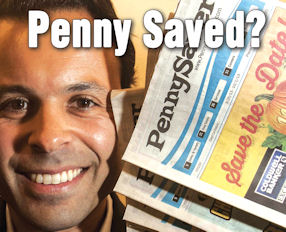
It’s free, chock-full of coupons and worth about 22 million times as much as TV Guide.
It’s Brea-based PennySaver, publisher of those familiar, free classified-ad shopper publications that get mailed to millions of California households.
Last week it became the property of Los Angeles-based buyout firm OpenGate Capital—the same firm that made headlines five years ago when it bought TV Guide Magazine for just $1. It paid much more for PennySaver, shelling out $22.5 million to the publisher’s former parent, San Antonio-based marketing company Harte-Hanks Inc.
PennySaver prints its pulp booklets of mostly black-and-white ads for small businesses and individuals looking to unload spare car parts, used appliances and such. Issues are distributed weekly through the mail to about 9 million households, all in California.
That sounds like a business that should be dead or at least dying in the age of cheap online advertising and free classifieds provider Craigslist Inc. But Andrew Nikou, OpenGate’s chief executive, says PennySaver is profitable and has potential for growth. He’s bucking the conventional wisdom that says print is dead.
“Let that (perception) continue, because we’re definitely enjoying it and definitely capitalizing on it,” Nikou said. “Print is relevant.”
Improving Business
Filings from publicly traded Harte-Hanks show PennySaver’s business has been improving this year, indicating OpenGate bought the business for a song, said Michael Kupinski, an analyst who follows Harte-Hanks for Boca Raton, Fla., investment bank Noble Financial Group Inc.
“It’s curious the company decided to sell PennySaver now,” Kupinski said. “And it’s a fairly low valuation. It could be a pretty good deal for OpenGate if the California economy continues to improve.”
PennySaver had $4.3 million in operating income last year, excluding a write-down.
Its revenue has steadily dropped over the past few years, but the company still brought in $186 million in sales last year—about on par with Santa Ana-based Freedom Communications Inc., publisher of the Orange County Register, another daily in Barstow, and various community newspapers here.
Operating income last year was $4.3 million, excluding a write-down.
OpenGate paid about five times PennySaver’s operating income, a multiple Kupinski called low. That’s close to the multiple Warren Buffett’s Berkshire Hathaway Inc. paid last year when it bought 63 newspapers from Media General Inc. of Richmond, Va. (Berkshire paid about four times the publications’ earnings before interest, tax, depreciation and amortization, a figure that is higher than operating income.)
OpenGate executives said they can ramp up profits by cutting costs and making operations more efficient, but also by boosting PennySaver’s online ad sales and its Web-hosting program for small businesses.
“When you look under the hood, PennySaver is not just print,” said Matthias Gundlach, an OpenGate principal. “There’s also a digital angle to it. I think there’s a lot of opportunity to this.”
Nikou, 36, founded OpenGate in 2005 after working in the Paris office of Platinum Equity, a Beverly Hills-based private equity firm run by billionaire Tom Gores. OpenGate partners Jay Yook and Robert Lezec also are Platinum alumni.
OpenGate likes to buy small business units that are part of larger companies—a strategy shared by Platinum. The firm picks businesses that have good fundamentals but aren’t the focus of their corporate parent and might be worth more as stand-alone companies.
“These are good brands—they’re purely just not part of the core strategy and therefore get no love,” Nikou said. “These businesses have a home. That’s our strategy.”
PennySaver was a smaller, lower-margin business compared with Harte-Hanks’ main lines of direct and digital marketing. PennySaver and a similar company in Tampa, Fla., combined to account for about one-quarter of Harte-Hanks’ revenue. The Florida publication was sold last year to a Tampa firm.
Harte-Hanks took a $165 million write-down on its values last year, citing five years of declining revenue. The announcement of the sale of PennySaver saw Harte-Hanks executives reiterate a view that the publications weren’t a good fit for the company anymore. Revenue was growing again, analyst Kupinski said, but a two-year trend would be needed if Harte-Hanks wanted to get a higher price for the publication. It opted to sell now.
OpenGate was attracted by more than a bargain price.
The company has a soft spot for media amid a diverse portfolio that includes a boat manufacturer and a maker of industrial laboratory equipment. It owns Fleurus Presse, a French publisher of children’s books and magazines formerly owned by newspaper Le Monde. It’s also bid unsuccessfully for troubled publications in recent years, including BusinessWeek, Newsweek and Maxim. And it owns specialty paper mills in Connecticut, Finland and France.
$1 Deal
OpenGate’s most notable deal, though, was its 2008 purchase of TV Guide. It bought the magazine, which was then losing about $20 million a year, for a symbolic $1.
The magazine was profitable again by 2010, thanks to cost-cutting and outsourcing of functions such as circulation and subscription management. OpenGate’s Lezec said it was a simple matter of modernizing the magazine’s operations.
“There was too much staff relative to the needs of the business,” he said. “Operationally and organizationally, it was configured for a different size and a different time. We were running a lot of functions internally that could have been outsourced.”
OpenGate has pinched pennies and sought to boost revenue in other ways, too. TV Guide’s West Coast editorial staff, once based in a Hollywood Boulevard office across from the Chinese Theater, is now based in one corner of the firm’s Century City office.
The magazine also is getting into the custom publishing business. Last year it inked a deal to publish a six-issue lifestyle magazine with Sandra Lee, the host of Food Network’s “Semi-Homemade Cooking,” and Nikou said he hopes to announce more such deals later this year.
“We’re going after TV personalities that want to maintain their intellectual property and their brand,” he said. “We’re producing and distributing her product using TV Guide infrastructure.”
Nikou isn’t the only one who continues to see opportunity in old-school print advertising. Martha de la Torre, chief executive of Spanish-language PennySaver competitor El Clasificado in Norwalk, said print ad revenue accounts for 90% of her company’s business—and that revenue has grown an average of 7% annually for the past five years.
That’s slower than before the recession, but she said El Clasificado’s continued growth and OpenGate’s interest in PennySaver shows there is money to be made.
She said her publication’s target audience is increasingly getting connected to the Web but that many still rely on printed products.
“There are still areas where you can’t get Internet access easily, and people still want print,” de la Torre said. “Everyone sees print has value. You just have to get it to work efficiently.”
Nikou said it’s too early to talk about specific plans for PennySaver, but one obvious cost cut could be outsourcing or downsizing printing operations.
“I think we’re going to bring a set of financial disciplines to the business that’s going to create a more profitable product,” Nikou said. “The scale of the print operations may change. But whether we produce locally or internally, or whether we produce in a different way, there’s always going to be a print presence.”
PennySaver leases two production plants, one in Vista and one in Mira Loma, near Riverside. It also owns a 103,000-square-foot plant in Brea. The building alone could sell for upward of $10 million, according to an analysis of comparable building sales by brokerage firm Cassidy Turley.
The value of El Clasificado and PennySaver is that they are “hyperlocal”—more so than Craigslist and even many community newspapers. Craigslist, for instance, has sites for 36 cities or regions in California.
PennySaver prints nearly 800 editions targeted to markets as small as the Balboa Peninsula or the northeast side of Costa Mesa. Those tiny zones mean advertisers can pay low rates to reach local customers instead of spending more on ads seen by customers too far away.
The challenge for OpenGate is to translate its hyper-local geographic advantage to the Web.
PennySaver sells online ads on PennySaverUSA.com and offers website design and hosting for mom-and-pop businesses, but the biggest part of the company’s revenue comes from print ads.
Nikou wants to see much more online revenue within three years. The company will try to sell more online ads to print customers and get sales representatives to pitch websites to merchants who don’t have them.
Nikou said he’s still brainstorming, too.
“We’re talking to college kids, ex-CEOs, technology guys, who can help us put together a plan to support what we believe is the true value of this business,” he said. “It’s a work in progress.”
Koren is a staff reporter for the Los Angeles Business Journal, a sister publication of the Orange County Business Journal.
