

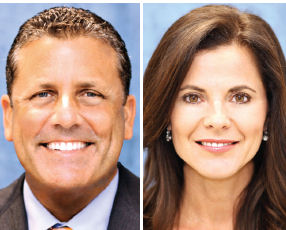
Tustin-based New American Funding is increasing its geographic reach throughout Southern California and in the Western U.S. at a faster rate than it expected when it set out to open more branches in 2013.
The mortgage lender had aimed for 15 more to bring its total to 26. It recently opened its 27th and is gearing up for more before the year ends.
“A lot of our branches are in Southern California,” said Chief Executive Rick Arvielo, who oversaw the opening of the company’s Anaheim branch earlier this month. “In our recent history, we have opened branches in Nevada, Arizona, Colorado and Texas. We’re looking in Utah and Washington, which should be [ready] in the next 60 days. We’re looking at four locations [in Washington State]. I don’t see us branching out any farther than that for right now. We need to digest what we’ve been able to grow.”
New American has nearly quadrupled its revenue over the past two years, with $182 million in total revenue for the 12 months through June. The 294% growth landed the company at No. 29 on this week’s Business Journal list of the fastest-growing private companies based in Orange County (see list, starting on page 50).
The company currently has about 550 employees at its headquarters, an 83,000-square-foot building on Myford Road that it bought last year for $8.4 million. It employs 816 overall—a total that’s expected to grow soon with the hire of about 15 workers for its new branch in Anaheim.
Beginnings, Growth
Arvielo and his wife, Patty, founded the company in 2003 as a smallish lender to serve the Southern California market. It soon became “a full-fledged bank” and now is licensed to lend in 30 states and approved to sell directly to the government-owned Ginnie Mae and government- sponsored enterprises, such as the Fannie Mae.
Arvielo said New American’s growth has been pushed along by recent links with homebuilders, several of which now count on the firm to finance sales.
Nationwide trends in mortgage lending overall have helped, too.
“The larger institutional depository banks have headwinds in a couple of areas,” he said, pointing to Basel III, a set of global reform measures that aims to improve regulation over the banking sector, including setting new capital ratio standards.
“It’s impacting [the big banks’ appetites] for the mortgage asset,” Arvielo said. “Banks need to deploy dollars where they think profit is greatest. With the current reduction in [refinance] volume with interest going up, there’s just better options for them. They’re pushing their attention to other asset classes.”
Big national banks in fact have been steering away from mortgages, largely citing the run-up in interest rates that has negatively impacted their refinancing divisions.
Wells Fargo & Co., the largest home lender in the country, announced last month that it’s laying off 2,300 workers in its mortgage banking unit across the country, including 330 in two of its OC offices. JPMorgan Chase & Co. also cut 245 jobs from its mortgage business division in Irvine, part of its companywide plan to trim about 15,000 mortgage jobs by early 2015.
The large banks’ movement away from mortgages—coupled with the likelihood that smaller brokerages and banks may not have the loan volumes to compete—has left midsize specialty lenders such as New American in a good spot, according to Arvielo.
“That’s created incredible opportunities for companies like us that are well capitalized and involved, in terms of approvals and finances, to take that market share,” he said.
Not that New American is immune to the effects of rising interest rates—it too has seen a scaling back of customer demand for mortgage refinance. It’s making up for the reduction through its growing group of outside brokers who bring purchase transactions to New American.
Outside production now accounts for more than half of the overall sales funded by New American, which come to roughly 1,000 a month. That’s about $400 million a month in lending for the company, which currently services a portfolio of about $3.5 billion worth of loans.
MBK Homes
New American’s recent affilations with homebuilders includes MBK Homes in Irvine and a few others that Arvielo said couldn’t be named yet.
“There’s activity there in the local market,” Arvielo said. “And builders are going, ‘Who’s out there that has the reputation and the ability to do this job?’ I see us making very steady and aggressive inroads in the builder community.”
It’s been about 18 months since MBK and New American have begun working together, and so far so good, according to Rick Fletcher, vice president of MBK.
“New American gets high customer satisfaction ratings,” he said. “We have no problem recommending them to our buyers. We get more than 90% capture rate on non-cash transactions.”
It’s more common for big, publicly traded builder companies to have “their own kind of in-house corporate mortgage company,” Fletcher said. “With MBK, we’re kind of a small, niche builder. We don’t have any plans to open up our own mortgage company. We try to align ourselves with individuals and team members that are as committed to customers as we are.”
Arvielo said working with homebuilders means his team has to have that “builder expertise.”
“[We] really need to work on behalf of the client and the builder to make sure they know what they’re in for. Most lenders don’t have to contend with [the builder-lender relationship] and aren’t familiar with it.”
New Committee
The Latino-American community is another area in which New American is building its reputation. The company launched its Latino Focus Committee in May, with a bid to help Hispanic consumers buy homes, including by providing Spanish-language educational materials and campaigns.
“We … are becoming recognized in the southland as a company that can get the underserved groups’ loans closed quickly and fairly,” Arvielo said.
The committee was initiated by Patty Arvielo, a 30-year veteran in the mortgage industry, who currently serves as New American’s president. She is chief operating officer of the corporate board of governors of the National Association of Hispanic Real Estate Professionals, and also serves on the risk management committee for the Mortgage Bankers Association.
“It’s not like she said one day, ‘Hey, I want to do this,’ ” Arvielo said, referring to his wife’s role in supporting homeownership of the Latino-American community. “She was part of Countrywide’s multicultural efforts in the mid-1990s. It’s something we’re familiar with because of our background. It’s very, very important. We are doing everything we can to influence policymakers.”
