

The largest Orange County-based banks picked up the pace of growing their assets over the past year.
The 24 commercial banks on this week’s Business Journal list combined for nearly $14.3 billion in assets, a 21% increase over the 12-month period through June of this year. The growth rate was 4% on last year’s list, which included 26 banks, some of which have sold.
Banks on this week’s list also grew their profits, notching $62.6 million in combined net income during the first six months of the year. Their year-ago total was $43.6 million.
Assets, which include loans and cash equivalents, have grown steadily at locally based institutions for at least the past seven years, including in 2008 and 2009. Profitability has fluctuated during that period. Local banks had combined losses in 2009 and 2010, reflecting the overall impact of the recession and the pools of loans that soured, as well as low net interest margins. OC banks have collectively been profitable for the past three years.
The list ranks banks based on asset size and includes key metrics for their levels of efficiency and capital, though those don’t figure into the ranking.
• Irvine-based Opus Bank remained No. 1, with $3.2 billion in assets at the end of June, a 29% year-over-year increase.
The bank had $26.6 million in profit for the first six months of the year. It has 259 employees in Orange County, up about 5%.
Opus in recent months has worked to reinforce its corporate structure, including setting up a commercial real estate unit and a healthcare division.
The healthcare unit initially “was focused on the physician group at the practice level,” according to Chief Executive Stephen Gordon. “Now we’re covering the next level up, quasi-institutional, serving at the provider level. That would be the hospitals and the assisted-living facilities. We were focused on the West Coast, but we’re expanding that nationally.”
• Banc of California Inc. was No. 2, with about $2.5 billion in assets as of June 30, up 51%. The bank, which moved to Irvine from San Diego early last year, didn’t rank on last year’s Business Journal list because it had a thrift charter. The company now is licensed as a national bank and supervised by the Office of the Comptroller of the Currency. It had $5.3 million in six-month profit, versus a loss of $362,000 a year ago.
• No. 3, Irvine-based Pacific Premier Bank, had a 47% increase in assets to nearly $1.6 billion. Part of the growth came from two recent acquisitions: Last year’s buy of First Associations Bank in Dallas added about $394 million in assets, and the deal for San Diego Trust Bank this year brought an additional $201 million.
Pacific Premier had $2.8 million in net income, versus $8.9 million a year earlier.
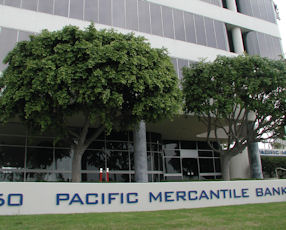
• Costa Mesa-based Pacific Mercantile Bank was No. 4, with $935.6 million in assets. The bank named industry veteran Steven Buster its new chief executive in April following the retirement of founding President and Chief Executive Raymond Dellerba.
Pacific Mercantile had $4.6 million in losses in the first two quarters of this year compared with a profit of $7.7 million a year earlier. It attributed most of the losses to its decision last year to halt wholesale mortgage lending. The bank downsized its local employee base by 36%, or 131 workers, and currently has 233 employees.
• California Republic Bancorp, No. 6, grew its assets by 53%, more than any other bank on the list, with $737.3 million in assets at the end of June. Its profit grew more than threefold, reaching $3.2 million.
The bank moved to Irvine from Newport Beach early this year for larger office space for its quickly growing team, according to President John DeCero.
“We’re already out of space,” he said of the two-floor headquarters office at Irvine Towers.
The bank has hired 34 employees in OC over the year for a total of 128 here.
DeCero said the bank’s profitability hinges primarily on a relatively strong base of noninterest-bearing deposits and its focus on loans for automobile purchases.
“58% of our deposits are noninterest-bearing, which accounts for the low cost of funds and net interest margin,” he said. “And auto loans tend to be better yield. The borrowers are consistent. Our average loan size is not that big, and we don’t do any exotic cars. We don’t do mortgage lending because we don’t like cyclical businesses.”
• Banks whose assets declined included Commerce National Bank, which had nearly $236 million in assets at the end of June, down 3% year-over-year. The drop pushed the Newport Beach-based bank down three spots to No. 14. It had net income of $330,000 in the first six months, about half the amount it notched last year.
• Assets for Buena Park-based Uniti Bank declined nearly 14% to $160 million. Its six-month profit more than quadrupled to $323,000.
Uniti, which primarily serves the Korean-American population, tapped Jack Choi as chief executive in June after Joo Hak Kim resigned in April. Choi previously was chief credit officer at Los Angeles-based Wilshire State Bank. He founded Commonwealth Business Bank in 2005 in Los Angeles and served as president and chief executive for six years.
The list includes each bank’s return-on-average assets ratios to show how efficient management is in using its assets to generate profit. All but three banks had a positive ratio as of June 30, with figures ranging from -1.9% to 2.29%.
All of the OC-based banks had core capital leverage ratios of more than 5%—the threshold set by the Federal Deposit Insurance Corp. to be considered “well capitalized”—with many banks well into the double digits. The ratio reflects the amount of equity capital available to the bank, including common stock, minority interests in subsidiaries and other intangible assets.
Download the 2013 OC’s LARGEST OC-BASED COMMERCIAL BANKS list (pdf)
