

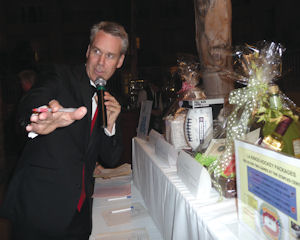
Charity benefit auctioneer Jim Nye begins most fundraising galas by auctioning a glass of tap water.
“Who will give a dollar for a glass of tap water?” he’ll ask the audience.
Everyone laughs. They think he’s kidding.
Soon they’re bidding on the water and laughing at themselves because they’re bidding on water. His record bid for water: $6,000.
The schtick is an icebreaker. But it also reminds everyone that even if they’re buying water, the money raised goes to a cause they care about.
Nye bills himself as Jim Nye the Benefit Auction Guy in a twist on the former PBS host, Bill Nye the Science Guy. The former insurance salesman does as many as 20 auctions a month, mostly during the spring and fall, when many of the charity galas are held.
Nye has been the auctioneer at many black-tie galas, including Pacific Symphony Orchestra, Orange County High School of the Arts and Miracles for Kids.
Most of his events are in Southern California, but he travels all over. In October, he’ll be in Denver, Chicago and Sacramento.
Benefit auctioneers are paid per gig, from $300 to $3,500, according to GigMasters.com Inc.
Auction Strategy
Nye considers himself more of a charity benefit strategist than an auctioneer, because much of the work he does is offstage. He gets to know the charity and sits in on committee planning meetings.
“You have to relate to the cause, find something to love about each charity,” he said.
He researches the items and learns about the donors. He learns how to pronounce the names of donors. He knows in advance whether he can sell an item more than once, which boosts the amount of money a charity raises.
Nye advises on the proper height of centerpieces to ensure everyone can see the bidders. He advises on when dessert should be served—the audience’s blood sugar needs to hit their system at the right time.
“I need them to be awake and alert and alive for item No. 9,” he said.
That’s usually when he auctions a big trip.
Big ticket items usually range from $5,000 to $7,000. Donated items include vacation packages, dinner with a celebrity, spa getaways and cars.
This year, Nye sold a trip to China for $62,000, which was $32,000 more than what the charity had anticipated.
Prep work also includes checking the audio/visual equipment.
Note to charities—Nye says never scrimp on the sound system.
“If they can’t hear us clearly and consistently, table 37 (in the back) is going to give up right away,” he explained.
“You lose the bidders and the energy. I tell people the A/V is most important.”
Meantime, though Nye’s job is to get as much for each item as possible, there is an art in knowing when a bidder has had enough. People get a look that says, “I’m done,” he said, and a “ringman” at each event will help provide non-verbal clues during the proceedings.
“You want to get people to give, but you don’t want to embarrass anyone,” he noted. “If they didn’t feel great about giving, you’re going to lose that supporter.”
Engaging the Audience
Nye tries to get everyone engaged in the auction, but in reality about 15% to 20% of people bid on items.
Charities tend to have a dedicated part of the auction—sometimes dubbed “fund the need” or “bid from the heart”—that attempts to raise money for a specific item or program. It usually follows an emotional speaker or video.
Active bidders tend to sit up front, though not always. At a recent gala, someone at a back corner table yelled out, “$10,000!” Nye recalled. “There is a moment (at such times) when I look at my ringman. Is that real? Is he drunk? Is he being crazy?”
He wasn’t. He wanted to set an example.
Throughout the proceedings, Nye has to be funny and entertaining. It’s a natural talent for the youngest member of a three-kid family.
“The last child is the crazy goofball,” Nye said.
At the end of an event, he’ll walk off stage and shake folks’ hands.
“I spend my life getting to help people,” Nye said. “Every night is different. Every event is a completely unique experience. It’s thrilling. It’s scary. I love every minute of it.”
