

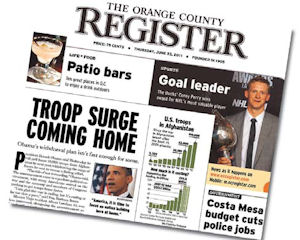
Irvine-based Freedom Communications Inc. and its Orange County Register are at a crossroads—and their next move could reshape the county’s dominant media company.
Freedom runs about 100 newspapers and other publications, and eight TV stations across the country. It’s about a year out of a bankruptcy reorganization that saw creditors and private equity investors take over the company.
After buying Freedom at a steep discount, the company’s private equity investors are looking to cash out. They stand to make a healthy profit under the right terms and timing—but the shifting landscape of the media business could trim that some.
Recent indicators point to a wholesale deal for Freedom as unlikely in the near term. The company’s owners are believed to be considering selloffs of the company’s newspapers or TV stations in separate deals.
A sale of Freedom’s television stations could bring enough cash to pay off an estimated $300 million in debt left at the company after its bankruptcy.
That would leave the Register and Free-dom’s other daily and weekly newspapers in better shape than competitors in the region’s rugged marketplace.
Alternatively, if Freedom’s newspapers end up being sold, the company would end up a small but healthy TV station owner—none of the stations are within 700 miles of its corporate headquarters.
The official line from Bob Emmers, who works for Los Angeles-based public relations firm Sitrick & Co. and serves as a Freedom spokesperson: “The company is continuing the process of evaluating its strategic options.”
So are a lot of others in the industry and beyond.
Freedom recently broke off talks on a sale to MediaNews Group Inc. The Denver-based company owns the Los Angeles Daily News and a string of other newspapers in Southern California.
It’s long been viewed as a likely buyer of Freedom in large part because of the Register, which would round out MediaNews Group’s circulation in the region and bring potential for economies of scale on everything from printing and distribution to sales and management.
Valuations
The breakdown in talks came over the value MediaNews put on Freedom, according to the Wall Street Journal, which cited sources close to the deal.
Freedom was deemed to be worth about $750 million, with the total roughly split between its newspapers and TV stations, according to the report. It’s unclear if any offer was actually made.
The valuations offered new insights on Freedom, which doesn’t make financial data public.
The valuation for Freedom’s newspapers was about four times earnings before interest, taxes, depreciation and amortization. That would put EBITDA at about $90 million.
The Register once accounted for half or more of Freedom’s newspaper revenue and operating earnings.
After a decade spent battling online media and the recent recession—a period that saw many of Freedom’s smaller-market newspapers in other regions face less competition and dodge the worst of the downturn—a much lower estimate is likely closer to the mark, according to sources.
Based on that, the Register would bring in about $23 million or less in operating earnings annually.
Freedom ownership doesn’t lack for points of comparison. New York-based private equity firm Alden Global Capital is its largest shareholder, although it doesn’t have a board seat, and neither do other shareholders. Alden also has stakes in other media companies, including MediaNews Group, Chicago-based Tribune Co., parent of the Los Angeles Times, and others in Pennsylvania.
A combination of the Times and Register is possible, though Tribune Co.’s ongoing bankruptcy reorganization complicates a near-term deal.
Another company that would appear to have a natural interest in the Register is Dallas-based A.H. Belo Corp., which publishes the neighboring Riverside Press-Enterprise.
Ron Redfern—a former vice president of sales for Freedom’s Metro division, which included the Register—is publisher and chief executive of the Press-Enterprise.
The Register also has a cooperative agreement with the Riverside daily, sharing some coverage of professional sports.
Yet Belo seems content to sit out an auction for Freedom amid its own struggles. It recently reinstated a quarterly dividend despite continued losses, including $6.7 million in red ink for the May quarter.
Belo also struck a deal with banks to allow quarterly dividends as long as a revolving line of credit has no balance. Chief Executive Robert W. Decherd addressed investors last month as part of an annual gathering unrelated to any specific acquisitions. He said Belo does not intend to take on debt to fund any large buys.
The San Diego Union-Tribune, currently in the hands of Beverly Hills-based Platinum Equity LLC, could emerge as a bidder.
Executives at Platinum did not return calls seeking comment on Freedom’s sale.
A source close to the recent talks with MediaNews Group said there’s a strong possibility it will go back to the table on Freedom.
Struggles Continue
Whatever changes are in store could come soon as daily newspaper chains continue to struggle with a sagging advertising market. McLean, Va.-based Gannet Co. last week announced plans to lay off 700 workers amid ongoing drops in advertising, with sales down by $2 billion, in the past five years.
John Morton, a veteran newspaper industry analyst based in Silver Spring, Md., said the outlook could hurry the consolidation trend among private equity investors.
“I suspect they just want to get out of this,” Morton said.
