

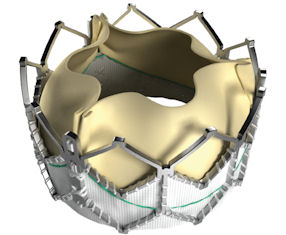
Wall Street analysts are of a mixed mind on Edwards Lifesciences Corp. after the heart valve maker reported disappointing first-quarter earnings and lowered its 2013 outlook.
Some see competitors making inroads in the near future as sales of the company’s much-touted Edwards Sapien, a less-invasive heart valve product, come slower than expected. Others say last week was just a bump in the road.
To investors of Orange County’s fourth-largest public company by market value, last week’s “bump” may have felt more like an earthquake.
The Irvine-based company saw its shares fall by more than 20% on April 24.
Edwards’ shares are down about 30% since the start of the year.
Heavy action was triggered after Edwards revised its guidance “primarily to reflect a slower start to the year and an updated foreign exchange impact,” Chief Executive Michael Mussallem said.
That start included lower-than-expected sales of its Edwards Sapien, which is the centerpiece of its transcatheter heart valve unit and accounts for about 30% of the company’s annual revenue of $2 billion.
Q1
First-quarter transcatheter valve sales came in at $83 million, compared to an $89.7 million target that JP Morgan Chase & Co. analyst Michael Weinstein mentioned in a March investor note.
Edwards’ first-quarter profit, excluding one-time items, came in at $83.9 million, compared to consensus estimates of $88.5 million.
A special gain of $83.6 million from a patent lawsuit with Minneapolis-based rival Medtronic Inc. brought some good news, moving its first-quarter net income to $144.9 million.
Edwards’ first-quarter revenue was up 8% to $496.7 million, but analysts had expected $518.6 million.
As for its 2013 outlook, Edwards could see a full-year profit of $349.5 million to $361.2 million, down from a previous range of $374 million to $385.6 million, excluding one-time items.
Wall Street had expected Edwards to post a full-year profit of $381 million until last week’s slump.
The company now expects 2013 revenue of $2 billion to $2.1 billion. Analysts had estimated that Edwards will have $2.13 billion in full-year sales.
“In summary, U.S. [transcatheter valve] sales are below our expectations, which we believe is primarily the result of evolving economics for some hospitals and still-developing capacity of both hospitals and their heart teams,” Mussallem said during Edwards’ earnings call last week.
Edwards is now expecting $670 million to $750 million in global Edwards Sapien sales this year. Of that total, the company forecasts that $350 million to $400 million will come from the U.S.
Analysts’ Reactions
Analysts had mixed reactions to the device maker’s guidance revision and results.
Spencer Nam of Philadelphia-based Janney Capital Markets said in a research note that heart-valve sales should eventually meet expectations. Nam wrote that Edwards’ “share price will likely pull back but we do not view [first-quarter] results to be signs of broken fundamentals.”
Nam expects Edwards to “remain a lone force in the U.S. [transcatheter valve] market for the foreseeable future.”
But Glenn Novarro of Toronto-based RBC Capital Markets took a run at management: “Given another Sapien disappointment [for the third straight quarter], we no longer have confidence in management executing on the U.S. launch,” he wrote in a client note.
Rajeev Jashnani of UBS also had a cautious view, writing that Edwards’ “U.S. market is developing slower than expected, [international] pricing increased and major new competitors are coming over the next six to 18 months.”
Edwards competes in Europe with Medtronic’s CoreValve, which the competitor developed in Irvine. CoreValve could receive U.S. approval next year, according to analysts.
At least one analyst, though, still considers Edwards’ device to be superior.
“We believe CoreValve has a decent chance of going through the FDA, but we continue to view (that) the device’s high rate of pacemaker requirement … could keep the physicians favoring Sapien for most of the cases,” Nam said in his research report.
Some patients who receive transcatheter heart valves have to have permanent pacemakers implanted in order to stop a condition known as “heart block,” or recurrent sudden attacks of unconsciousness caused by impaired conduction of the impulse that regulates the heartbeat. Edwards’ device has shown a lower rate of that complication, Nam said.
St. Jude Medical Inc., also based in the Twin Cities, recently got European approval for its Portico-branded less-invasive heart valve. Analysts have said that Portico is about two to three years away from FDA approval.
Last week’s stock drop wasn’t the first time Edwards’ shares have taken it on the chin recently.
Its shares fell by 20% in October after the company lowered its third-quarter revenue outlook based on slower-than-expected sales of Edwards Sapien.
Mussallem spent quite a bit of time on last week’s earnings call talking about how the company is tracking Sapien’s usage.
Edwards is “rapidly learning about the factors that influence adoption, and we’re continuing to work closely with sites,” Mussallem said.
“The untreated aortic stenosis population remains large, and we believe our less invasive catheter-based approach remains attractive to patients and clinicians,” he said.
Edwards estimates that there are 260,000 patients with severe symptomatic aortic stenosis in the U.S. and that “only a quarter of those patients are treated,” Mussallem told analysts on the call.
Other analysts asked about Edwards’ guidance revision during the call.
“I know it can’t be fun to cut guidance … Help us to think why you’re confident that you’ve got the correct range now, given the understandable surprises as the procedure gets rolled out and the complication around referrals and reimbursement, etc.,” asked Rick Wise, a medical device analyst with St. Louis-based Stifel Nicolaus & Co.
The device maker always tries to “share our best insight and our best knowledge,” Mussallem said, “and we believe that what we’re sharing now is the most accurate picture of how the U.S. is going to turn out in 2013.”
