

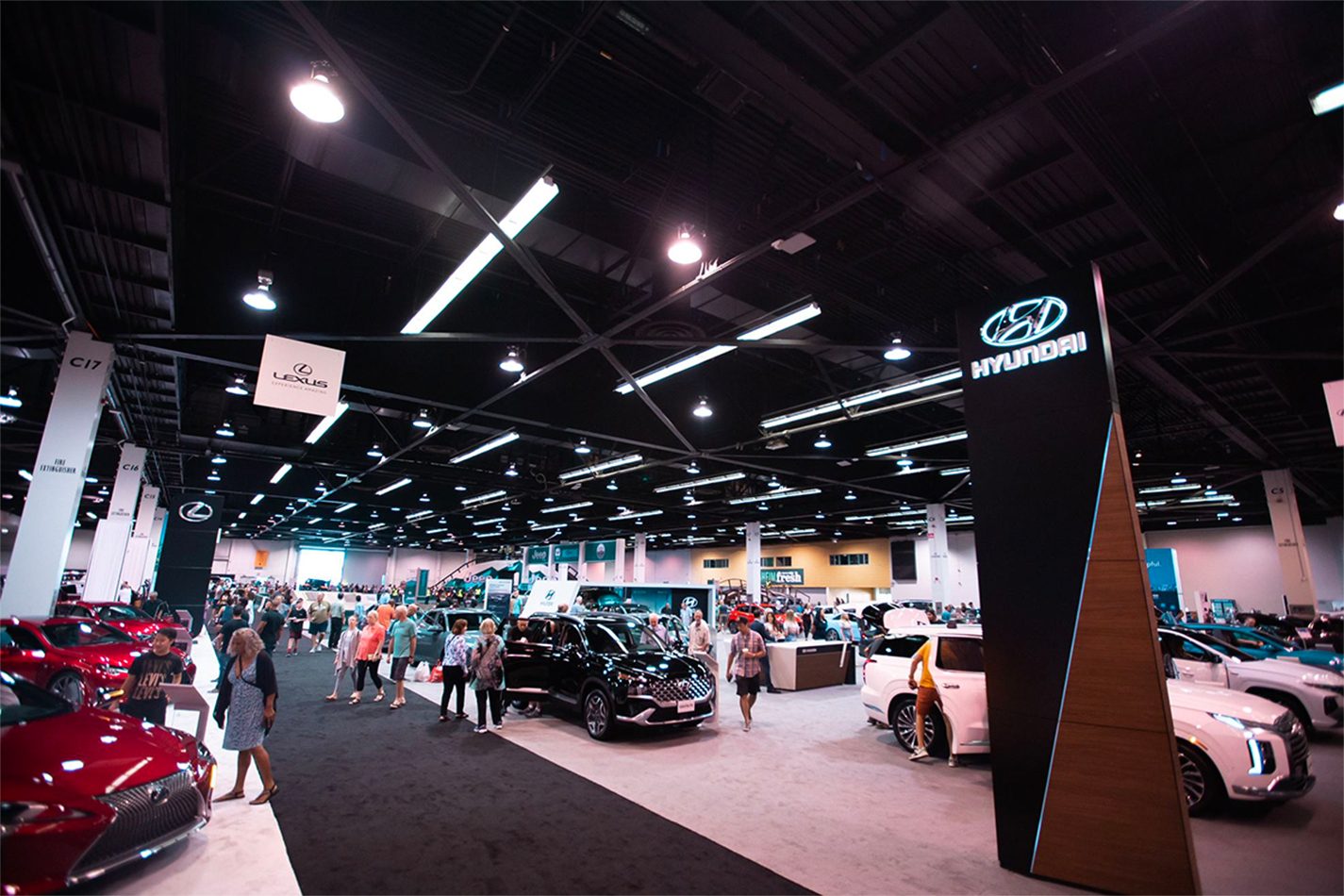
The OC Auto Show returned this month from a two-year hiatus, charged with a growing addition to its electric vehicle exhibit: Electric Avenue.
The exhibit included a 140,000-square-foot EV performance track, the SoCal Electrified Ride Experience, which drew nearly 11,000 guests to ride in the front passenger seat in EVs from Kia America Inc. of Irvine, Nissan Motor Co., Chevrolet, Volkswagen of America Inc. and Ford Motor Co. (NYSE: F).
“A lot of times people think that they’re making a trade-off in performance when they buy something that is good for the environment,” John Sackrison, executive director of the Orange County Automobile Dealers Association (OCADA), which organizes the OC Auto Show, told the Business Journal. “So, we wanted to show them the oftentimes superior performance of an electric vehicle.”
EVs corner better and offer better handling due to their low center of gravity, Sackrison noted.
The OC Auto Show, which took place from Sept. 29 to Oct. 2 at the Anaheim Convention Center, was projected to draw 20,000 attendees and bring $7.7 million to the local economy.
The show featured vehicle exhibits from OC automakers Kia and Fountain Valley’s Hyundai Motor America Inc., an outdoor test drive center, an off-road test track by Jeep—complete with an 18-foot, 35-degree climb and a terrain simulating fallen logs—and an exotic car exhibit featuring models from McLaren Automotive and Lamborghini from Irvine-based Newport Beach Automotive Group.
Kia also included a virtual simulation driving experience for its Telluride SUV.
Other vehicles showcased at the event hailed from Plano, Texas-based Toyota Motor North America Inc., which has regional sales operations in Irvine, Honda Motor Co., Dodge, Ram Trucks, Chrysler, GMC and Lexus, the luxury division of Toyota; see page 29 for a selection of photos from the event.
EV Buzz
The EV buzz in SoCal aligns with the recently passed state legislation that promotes the manufacturing of such vehicles. California regulators in August banned the sale of new gas-powered cars by 2035. Washington and New York shortly followed suit. About 15 other states are considering adopting such legislation, according to reports.
Local demand for EVs has been growing prior to the legislation.
About 20% of new vehicles sold in OC as of August were fully electric, according to Sackrison.
The global EV market surpassed $163 billion in 2020 and is projected to reach $824 billion by 2030 at a compound annual growth rate of 18%, according to industry data firm Allied Market Research.
“There’s tremendous interest in [EVs] and we know that we’re going to have to provide experiences to engage consumers with this new technology,” Sackrison said.
The nearly 11,000-person turnout for the EV performance track exceeded OCADA’s expectations for the new exhibit. Given the success of the show’s newest addition to Electric Avenue, which was launched in 2019, Sackrison said he wouldn’t be surprised if the SoCal Electrified Ride Experience would return to the OC Auto Show in the coming years.
“It was a huge hit. Everything we heard from the manufacturers that participated was overwhelmingly positive,” Sackrison said.
He estimates the show’s new EV performance track is the largest event held during this year’s National Electric Drive Week, which showcases EVs across the country.
EV charging company Volta Inc. (NYSE: VLTA) partnered with the OC Auto Show to introduce the new SoCal Electrified Ride Experience.
Smaller Event
The OC Auto Show this year was smaller in size compared to previous years, a widespread phenomenon the conventions business is facing as the industry continues to handle post-pandemic events.
Planning for the show, which took place during the height of the pandemic, was filled with uncertainty, Sackrison said.
“We didn’t know how much would need to be outdoors or if there were going to be mask or vaccine mandates.”
The uncertainty prompted OCADA to move the traditional ride and drive experience outside, rather than hosting it in its usual home, the convention hall’s lower level.
City officials also chalk up the event’s reduced size to booking issues brought up at a recent customer advisory board meeting for the Anaheim Convention Center and the city’s destination marketing organization, Visit Anaheim.
“This is the auto show’s first time back since 2019 and getting back to those attendance numbers is going to take some time,” Visit Anaheim CEO Jay Burress told the Business Journal via email.
Declining Automaker Sales
While attendance at the OC Auto Show exceeded Sackrison’s expectations, the OC automakers featured at the event continue to face challenges, primarily due to ongoing microchip shortages and supply chain issues.
U.S. vehicle sales for OC automakers from June last year to June this year are down 11.6% to 3,338,796.
The decline follows a roughly 15% national downturn of vehicle sales to about 13.5 million, according to investment research platform YCharts.
Vehicle sales for Toyota, No. 6 on the Business Journal’s annual list of automakers by OC employee count, dropped 17% to 1,602,907 (see list, page 28).
Sales for Hyundai, No. 2 on the list, fell 11% to 647,813.
Kia, No. 3 on the list, reported a 6.4% drop in vehicle sales to 656,425.
“The average car has about 30,000 different parts,” Sackrison said.
“You only need a couple of those parts to be in a shortage, and it stops the production line. All sorts of different things can impact the manufacturing of vehicles across the globe, whether it’s the war in Ukraine, COVID lockdowns in China or any other country that has some sort of crisis or issue.”
Genesis Motor America LLC, the Fountain Valley-based luxury vehicle division of Hyundai, bucked the trend of decline by nearly doubling its vehicle sales to 55,991.
“Customers, retail partners and industry experts alike have responded positively to our latest products,” Genesis Senior Manager of PR and Communications Jarred Pellat said of the sales increase. “While our sedan lineup continues its strong sales performance, last summer, we launched GV70, our dynamic and sporty SUV, and it has quickly become one of our best-selling models.”
The company’s 99% sales jump also encompasses the first full year of sales for its GV80, a midsize SUV launched in 2020, one of the brand’s most popular vehicles.
Although sales are down, OC headcounts for automakers are up from a year ago.
Local employment at OC automakers jumped 55% to 4,687.
Rivian Automotive Inc. (Nasdaq: RIVN), No. 1 on the list, saw the largest increase in OC employees, tripling its headcount to 2,400.
Genesis, No. 8 on the list, also saw a substantial rise in OC headcount, up 85% to 109.
Toyota’s OC headcount rose 36% to 219.
Mazda North American Operations, the only automaker that reported a decrease in headcount, fell 36% to 370 OC employees as more people are working from home instead of commuting to the office.
The cutoff for this year’s list was 75 local employees, a figure that kept some prominent up-and-coming EV makers with operations in the area, like Lordstown Motors Corp. (Nasdaq: RIDE) and Phoenix Motor Co. (Nasdaq: PEV), from being represented.
About a year after Mazda North America Operations released its first EV, the MX-30 crossover, the Irvine automaker announced the vehicle has sold out its low-production offering, which totaled some 500 units.
While most EVs deliver a range of around 200 to 300 miles per full charge, the MX-30, which started at around $33,000, offers 100 miles on a full charge. It’s the automaker’s lowest-selling consumer vehicle, sales reports indicate.
The company, which ranks No. 4 on the Automakers list, has yet to reveal plans for new EVs since the MX-30’s launch.
—Kaitlin Aquino
Hyundai Motor America’s first fully electric sedan, the Ioniq 6, will hit North American markets next year.
The Fountain Valley automaker, No. 2 by local employee count on the Automakers list, said its new EV sedan will deliver about 382 miles per charge. That’s more mileage than the company’s two other EVs, the Ioniq 5 SUV and the Kona SUV, which deliver a range of 303 miles and 258 miles, respectively.
“From the start of Ioniq 6’s development, we set our sights on making it the leading all-electric range EV,” Hyundai Head of Sub-Mid Project Management Center Jae Ho Huh said in a statement. “To become the global leader in electric vehicles, we are committed to providing the best possible EV performance and ownership experience.”
Unique to the Ioniq 6 are the over 700 LED pixel lights lining its interior, allowing consumers to illuminate the inside of the vehicle with nearly any color of their choosing.
Pricing for the Ioniq 6 has yet to be released. Production for the vehicle is expected to begin in third quarter this year.
—Kaitlin Aquino
Mullen Automotive Inc. (Nasdaq: MULN) this month will kick off the first leg of its national “Strikingly Different” tour for its first EV, the Five crossover. The tour will begin at the Rose Bowl in Pasadena and end in Charlotte, N.C., after passing through Nevada, Texas, Tennessee, Florida and Georgia. Production for the Five is projected to begin in 2024.
The Brea EV upstart, No. 9 by employee count on this year’s Automakers list, last month secured 60% ownership in failed EV company Bollinger Motors Inc. for $148.2 million in cash and stock, according to regulatory filings.
Mullen is also currently the leading bidder in the purchase for manufacturing assets of commercial EV maker, Electric Last Mile Solutions Inc. (ELMS), which filed for bankruptcy earlier this year. The company intends to pay $55 million for ELMS’ assets and assume $37 million in liabilities, filings indicate. The deal includes ELMS inventory, customer and supplier information and manufacturing plant in Mishawaka, Ind., among other assets. Mullen has already paid $5.5 million toward the purchase, according to regulatory filings.
—Kaitlin Aquino
Kia America Inc. showcased its two electric vehicle crossover SUVs, the Niro and the EV6, at the OC Auto Show’s new EV performance track.
The Irvine automaker, No. 3 by employee count on this week’s Business Journal’s Automakers list, will introduce seven new EVs by 2026, according to Kia representatives at the OC Auto Show.
The company, through a partnership with EV charging firm Electrify America, is offering 500 kilowatt hours of free charging at any Electrify America station to buyers of the 2023 Niro EV. Kia officials estimate the charging credit will yield up to 1,950 miles.
The Niro EV, with a starting price of $39,990, can charge from 10% to 80% battery in under 45 minutes and has a range of 253 miles. By comparison, the EV6 gets up to 310 miles of range in a single charge.
Kia earlier this year announced an offering of 1,000 kilowatt hours of free charging to EV6 buyers.
—Kaitlin Aquino
