

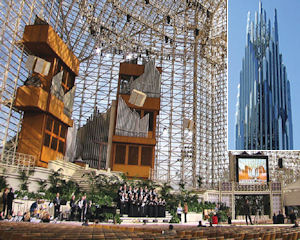
Crystal Cathedral Ministries in Garden Grove is arguably the most prominent Orange County institution to file for bankruptcy since the county itself filed for reorganization in 1994.
The iconic megachurch’s reorganization—which has been playing out in Santa Ana’s federal bankruptcy court for a year—also has the opportunity to accomplish what few other area bankruptcies have in recent years: pay off its debts in full.
Making all creditors whole would bring another unusual twist, allowing the ministry the opportunity to pick a winner among several bidders for its campus in an auction, according to court filings.
The value of the ministry’s holdings—which include its 40-acre church campus, a distinctive nearly 3,000-seat glass-paned church, and several other buildings—makes the difference in this case.
The ministry was estimated to have about $48 million of debt at the time of its October 2010 bankruptcy filing.
That figure has crept up over the past year. As of Oct. 17, there were a little more than $49.3 million in claims by potential creditors, according to a court filing last week by lawyers representing family members of the Crystal Cathedral’s founding minister, Robert H. Schuller.
That total still is less than what some interested buyers are willing to pay for the ministry’s assets. Chapman University in Orange has offered $50 million. The Roman Catholic Diocese of Orange has $53.6 million on the table.
Other entities expressing interest in the campus include My Father’s House International Church in Norco, which has offered $50 million but provided few details on financing, and Oklahoma City-based arts-and-crafts retailer Hobby Lobby, which has said it would bid $47.5 million in cash, with leaseback and buy-back provisions.
The creditor committee’s disclosure statement, approved by the court last month, also noted another, unspecified buyer in the campus.
Robert Lee Tran Truong, a self-proclaimed pastor and billionaire, has publicly offered $99 million for the campus, but hasn’t filed a bid with the court.
Cash
The bids by Chapman and the diocese are both cash offers, and each includes some provisions to allow the ministry to lease back some of the buildings on the campus.
The offers could go higher.
“Presumably, with overbidding and other auction forces, the final net purchase price for the (ministry’s) bankruptcy estate will be substantially higher than the initial bid price range,” said lawyers representing Robert A. Schuller and Donna Schuller.
“If all goes expected at the upcoming sale, the bankruptcy case more than likely will become a ‘net surplus bankruptcy estate’, in which all creditors will be paid in full, and any net distribution refunded back to the debtor,” the Schuller family’s lawyers said in a court filing last week.
That scenario is a rarity for a bankruptcy case of such size, according to area attorneys.
“It’s definitely an unusual case, especially for a nonprofit (entity),” said Suzzanne Uhland, a partner in the Newport Beach and San Francisco offices of O’Melveny & Myers LLP and chair of the firm’s restructuring practice.
“It’s pretty unusual, although it remains to be seen what the final (claim total) will be,” said Jess Bressi, partner-in-charge of the Irvine office of Luce, Forward, Hamilton & Scripps LLP. “There’s still some fighting over claims.”
Figures on creditors’ average recovery rates for privately held entities that file for bankruptcy are hard to come by.
Among larger, public companies that filed for bankruptcy in 2009 and 2010, general unsecured creditors have seen average returns of about 45 cents on the dollar, according to a study from the School of Law at the University of California, Los Angeles.
Other unsecured creditors fare worse—averaging returns less than 20 cents on the dollar, according to the UCLA study.
Intrinsic Value
Seeing a 100% or higher return on a creditor’s claim is likely to happen only when—as in the case of Crystal Cathedral—the debtor’s underlying assets have a high intrinsic value, and the bankruptcy filing was a result of liquidity or cash-flow issues, according to Uhland.
A disclosure statement filed in August by the ministry’s official committee of unsecured creditors—which opposes many of the claims made by the Schuller family members—placed a $55.7 million value on the campus.
Bankruptcy Judge Robert Kwan and the court-approved committee of unsecured creditors is largely “driving the bus” of the bankruptcy case at this point, according to Bressi.
Those creditors have until this week to vote on a plan of reorganization for the ministry, which calls for the auction of its assets. The reorganization plan is slated to be confirmed in mid-November, and a buyer could be chosen in a few weeks.
In a normal bankruptcy case, the court typically has “a strong preference for cash” when choosing a winning bidder, Bressi said.
That would appear to make the Roman Catholic Diocese and its high bid of $53.6 million the front-runner for the campus for the time being.
In typical bankruptcy cases, “if two bids are cash, there’s not much wiggle room” when a court chooses a winning bidder, although factors such as leaseback and buy-back provisions could end up swaying a decision, according to Bressi.
Crystal Cathedral, though, is not your typical bankruptcy case.
In the approved disclosure statement, the creditors committee said that the ministry can get first crack at choosing the winning bid, as long as that bid exceeds $50 million.
Cooperation Required
That arrangement also requires the ministry to cooperate with the creditors committee to maximize the value of its estate.
“The debtor gets to pick, which makes sense, (especially) for a nonprofit,” said Uhland.
“The court’s not going to pick (a winning bid) this time,” Uhland said. “Once creditors are paid in full, it’s the debtor that should choose their own destiny.”
That plan could still fall apart.
If the church doesn’t cooperate with the creditors committee, a buyer would be chosen by the creditors committee without the lease and buy-back options, according to the disclosure statement.
That could result in the ministry leaving the Garden Grove campus shortly after the sale is completed.
