

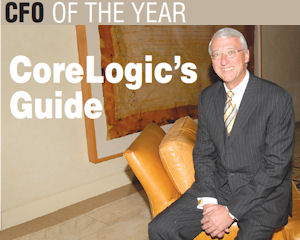
Anthony “Buddy” Piszel has gone through a career’s worth of work in the past two years.
Piszel, chief financial officer of Santa Ana’s CoreLogic Inc., oversaw regulatory approvals and financing deals that paved the way for the data services company to split from Santa Ana-based First American Corp. last year.
CoreLogic’s June split marked the largest debut of a public company here. The company, which provides real estate and other data, had a market value of $2.3 billion last week.
Its emergence played out amid a tumultuous real estate and mortgage market that brought plenty of industry players to their knees.
“This was the most challenging period of my career,” said Piszel, who joined First American two years ago.
Earlier, Piszel was financial chief at McClean, Va.-based Federal Home Loan Mortgage Corp., better known as Freddie Mac.
He also held finance posts at Woodland Hills-based Health Net Inc. and Newark, N.J.-based Prudential Financial Inc.
He received the Lifetime Achievement award at last week’s CFO of the Year awards presented by the Business Journal and the Orange County and Long Beach chapter of the California Society of Certified Public Accountants.
As corporate controller at Prudential, Piszel helped the insurer go public in a $3 billion offering in 2001.
At Freddie Mac, Piszel dealt with issues facing the embattled government-backed mortgage company during the height of the industry’s meltdown.
Those experiences helped Piszel at First American, which was considered to be Orange County’s oldest company.
Split
Nearly two years before Piszel’s hiring, First American announced plans to spin off its title insurance business from its growing data services business.
Those plans soon were put on the back burner as the company weathered the real estate downturn.
Instead of a split, shoring up profits became Piszel’s focus.
The split—in which the company’s title business became Santa Ana-based First American Financial Corp.—presented plenty of challenges, he said.
“We really had to be confident that the capital structure of both companies was set up strong,” he said. “You didn’t want to be in the position where your earnings were under pressure, and you needed to raise capital.”
The biggest trick, he said, “was to figure out how much cash each company should get, and how much debt each company should get.”
First American’s sizeable credit agreements were reworked and two separate credit deals were struck for the successor companies.
When CoreLogic debuted, it had $400 million in cash and a $500 million revolving credit line.
Then there were regulatory approvals.
Along with Securities and Exchange Commission requirements, the companies needed blessing from the Internal Revenue Service for a tax-free distribution of spinoff shares to First American investors.
“There was a lot of heavy lifting,” Piszel said.
Figuring out what businesses went where—either to the title insurance side or to CoreLogic—was another challenge.
“Most were a natural fit, but there were a number of companies (in the middle),” Piszel said. “We had to work that out.”
There were a few executive shakeups, including for Piszel, who thought he’d end up as finance chief at First American Financial.
In late 2009, First American Chairman Parker “Park” Kennedy called Piszel and said it would make more sense for him to go to CoreLogic.
“You could have knocked me over with a feather,” Piszel said. “I was trying to sell CoreLogic (to investors), not learn it. I knew hardly anything about the company.”
Piszel’s background seemed to fit well with CoreLogic’s needs, Kennedy told him.
“He saw the challenges that CoreLogic would have to face,” Piszel said.
The split was designed to better promote CoreLogic’s growing, tech-oriented business to analysts and investors, who tended to focus more on title insurance.
“No one understood us,” Piszel said. “We had to build the investor story.”
Business
CoreLogic provides data on consumers, finances and real estate to banks, corporations and governments. The company bills itself as having the largest real estate, mortgage application, fraud and loan performance databases in the country.
In May, Piszel headed up an investor day conference in New York where CoreLogic was presented to analysts and investors.
After that came a grueling, six-week road show that took company executives—including new Chief Executive Anand Nallathambi—across the U.S. and Europe.
“After that I took a week vacation,” Piszel said.
CoreLogic’s shares are up about 5% since their debut, amid a still-choppy real estate market. Seven analysts follow the company’s stock.
The company’s also attracted major investors. They include Boston-based FMR LLC, parent of Fidelity Investments, Pennsylvania’s Vanguard Group Inc. and New York-based BlackRock Inc.
“I think we’re a great play for when the market recovers,” Piszel said.
Things have stayed busy since the split.
In December, CoreLogic agreed to sell its employer services and litigation support businesses to Palo Alto private equity firm Symphony Technology Group LLC for $265 million.
Earlier this month, CoreLogic agreed to buy the 60% of Australian property information company RP Data Ltd. that it doesn’t already own for about $190 million.
