

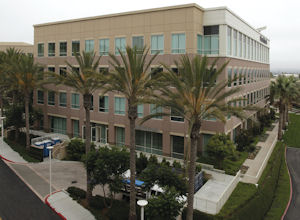
Diversified eye healthcare company Bausch & Lomb Inc. has picked a new leader for its Aliso Viejo-based surgical division.
Rochester, N.Y.-based Bausch last week named John Barr as global president of its surgical business.
Barr will be based in Aliso Viejo and report to Bausch Chief Executive Brent Saunders, according to the company. Saunders had been overseeing Bausch’s surgical business while the company was looking for a new head.
Barr replaces Robert Grant, who left Bausch last December. Grant currently serves as chairman of Myoscience Inc., a Bay Area startup that is developing a medical device that uses needles and cryogenic material that disrupts nerves to prevent facial wrinkles.
Barr comes to Bausch from AGA Medical Holdings Inc., a Plymouth, Minn.-based maker of devices to treat heart and vessel diseases. He spent six years at AGA, which went public and was eventually bought by St. Jude Medical Inc., also in Minnesota.
Bausch’s eye surgery division, which has some 160 workers in Aliso Viejo, includes the Crystalens, SofPort, Akreos and enVista replacement intraocular lenses and Victus, a femtosecond laser for cataract, vision correction and therapeutic procedures.
The company also makes contact lens care products and eye drugs, among other things.
Barr’s appointment comes in advance of its pending acquisition of drug maker Ista Phaarmaceuticals Inc. in Irvine.
Ista’s products include eye drugs such as Bromday for inflammation after cataract surgery and Bepreve for eye allergies. Shareholders of Ista are expected to vote on the $500 million deal next month.
Bausch watchers’ attention is expected to turn to the Ista deal.
June 5 Vote
Ista shareholders are scheduled to vote June 5, according to a Securities and Exchange Commission filing. The deal is expected to close this quarter, if approved by shareholders.
It isn’t clear if Bausch will keep Ista, which has about 120 local workers and 330 overall, in Irvine. The companies have said in federal filings that it would be “premature to speculate about redundancies or layoffs” prior to integration.
Ista’s filing shows that Bausch plans to pay for the drug maker with a mix of cash on hand, a revolving line of credit, and proceeds of a $350 million incremental term loan that will be provided under another line of credit.
Bausch won a bidding war for Ista in mid-March after the latter rejected a pair of well-publicized and unsolicited takeover bids from Canadian drug maker Valeant Pharmaceuticals International Inc. Valeant’s top bid for Ista came to about $360 million.
Several companies were in the running to buy Ista, a federal filing shows. Ista’s filing indicated that consideration of a sale started with a company it referred to as Company A, which made an offer in October 2010.
Valeant contacted Ista in September 2011 about either collaborating on products or an acquisition, Ista said in its filing.
Ista’s management, board and New York-based investment bank Greenhill & Co. reviewed the discussions with Valeant.
Ista directors then decided to continue talking to Valeant but declined to share confidential information prior to sending a confidentiality agreement.
Valeant later in November proposed to buy Ista for about $327 million, a proposal that it reaffirmed in mid-December in a letter to Ista. A day later, Ista’s directors met to consider that proposal and “after discussion, the board concluded that the Valeant offer was grossly inadequate and directed (Ista Chief Executive Vince) Anido to notify Valeant of this conclusion in writing.”
Anido wrote a letter on Dec. 14, two days before Valeant issued a press release on its first bid.
Saunders called Anido after Valeant issued its press release and said if Ista was interested in selling itself, Bausch “would be interested in participating in the process.”
Ista then, either directly or through Greenhill, contacted several potential strategic buyers, including Bausch and Company A, about a potential deal, according to the filing.
A total of 25 potential acquirers—including Valeant, Bausch and Company A—were contacted by Ista or Greenhill, and two other potential buyers made unsolicited calls. Ista met with 11 of those companies at a January industry conference and signed confidentiality agreements with all except Valeant.
Valeant was undaunted and submitted a sweetened bid that came out to about $360 million and sent a letter to Ista directors saying that it would only keep its proposal open until Jan. 31.
Greenhill then sent requests to nine potential buyers, including Company A and Bausch, requesting that they indicate their interest on or before Feb. 8.
Valeant said on Jan. 30 that it would not pursue a deal for Ista.
Ista then got proposals from Bausch, Company A and two other potential acquirers.
Company A was dropped from the process in February because it declined to increase its proposal, which was similar to Valeant’s. Another potential buyer, Company C, said it wouldn’t be able to proceed with a cash deal for Ista.
Company B
The race then came down to Bausch and a potential buyer called Company B. Greenhill sent those companies requests for “best and final bids,” along with a draft agreement, in early March.
Company B told Greenhill it wouldn’t submit a final proposal a week later.
Ista and Bausch met throughout March, and Saunders eventually agreed to boost the price it offered for the drug maker at Anido’s request.
