

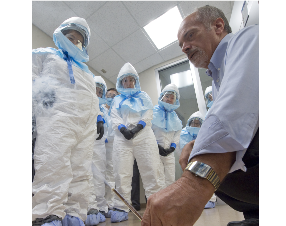
University of California-Irvine’s high-containment, biosafety level 3, training laboratory has been selected as the third facility in the country designated by the National Institutes of Health’s National Biosafety & Biocontainment Training Program to provide continuing education to professionals in a simulated setting. The first two facilities are at Kent State University and Kansas State University.
Outbreaks of infectious diseases such as Ebola, West Nile, virulent flu strains and the more recent Zika virus have flared up over the past few years, with the pace of incidents indicating a threat to public health, according to the University of California-Irvine. Research and development involving many of these special laboratory facilities, termed “high-containment” or “biosafety level 3” are considered a front line in training efforts to contain infectious diseases.
The National Training Center designation will be made official during a May 9 opening event for the training lab, which was the first of its kind in the country to be specifically designed and built for educational purposes.
The designation allows UCI to conduct NIH-sanctioned courses for biocontainment facilities and operations personnel in a safe environment.
The 1,600-square-foot lab, built in 2015, allows classroom and practical training in a real-life setting, but without the risks from hazardous materials and without the inconvenience of having to shut down and decontaminate the lab. Training on how to identify and diagnose mechanical and engineering failures can also be simulated.
National estimates peg more than 2,500 biosafety level 3 training labs in academic, public health and corporate settings.
