

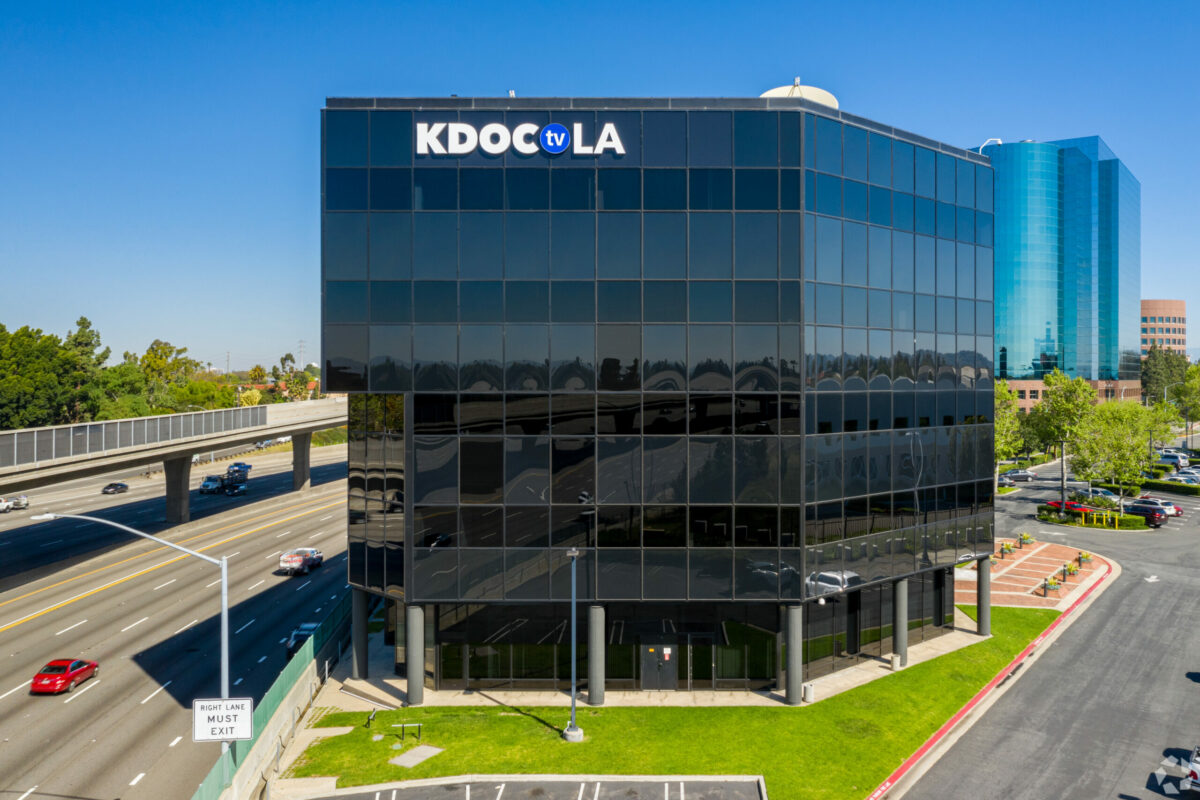
A $30 million acquisition and redevelopment of the former KDOC-TV headquarters in Santa Ana will become the third local campus for the Orange County Academy of Sciences and Arts, a tuition-free public charter school that has partnered with El Segundo-based Red Hook Capital Partners LLC.
The five-story, 62,000-square-foot office building will be transformed into a transiitional kindergarten (TK) through sixth grade school opening in August. The partnership follows the building’s $11.3 million sale to Red Hook last September.
Red Hook helps design, acquire and renovate locations, then leases them to the schools.
“We don’t have the capital to foot the entire cost up front, so by working with Red Hook, we’re able to bring this amazing property to students,” Kapil Mathur, founder and executive director of OCASA, told the Business Journal.
Through the partnership with Red Hook, OCASA is opening a school at the site for the 2026-27 school year. The total project cost from acquisition through property renovation will exceed $30 million, Mathur estimated.
The city of Santa Ana has approved the site, which is within the boundaries of the Tustin Unified School District, to serve up to 900 students in grades TK-6, Mathur said. The first day of school will be Aug. 18.
It will be the third location for OCASA, which has an existing elementary school in Laguna Niguel and a middle school in Aliso Viejo.
Founded in 2015, OCASA is a tuition-free public charter school specializing in STEAM (science, technology, engineering, art and mathematics) education.
The addition of the new Santa Ana campus will allow OCASA to meet growing demand, Mathur said; this school year, the school saw a 20% increase in enrollment to 400 students from the prior year.
“We have a tremendous amount of interest in our school, but our enrollment has been limited due to the size of our current facilities,” Mathur said.
$30M Overhaul to Transform Former KDOC-TV Building
The building housed independent television station KDOC-TV for nearly 40 years.
The station has been on the air since 1982 and is said to be Orange County’s first commercial TV station.
KDOC was initially owned by Golden Orange Broadcasting. In 2006, it was bought by Bert Ellis and Henry and Susan Samueli, owners of the Anaheim Ducks and among Orange County’s wealthiest couples, for $149.5 million.
In 2022, it was sold to the religious broadcasting organization Radiant Life Ministries Inc. for $41 million, and the station transitioned to Christian programming.
Now, the building is undergoing a complete makeover.
“We’re doing a complete gut job of the building,” Mathur said.
He said it took about a year to develop and approve the building plans, and another year for construction after the property went into escrow in 2024.
Part of that cost has gone into converting the building’s interior offices into classrooms. Additionally, the school has added science labs, a large auditorium, a library, outdoor recreational space, changing rooms for physical education (PE) classes and a cafeteria, which will serve free breakfast and lunch to kids.
The school won’t be getting rid of everything—it plans to keep the KDOC-TV broadcast center for students to produce its student-run news program called Rocket News, Mathur said.
Receives $6M Grant from U.S. ED to Replicate Program
OCASA’s recent expansion is made possible in part through a $6 million grant from the U.S. Department of Education.
In 2024, OCASA was one of 16 recipients selected for the national grant.
“The program has been super successful, and we were one of the organizations countrywide that was awarded a grant to expand and replicate our program,” Mathur said.
With the grant, OCASA opened its second location in Aliso Viejo and is now opening a third one in Santa Ana.
“As the only sector in public education that is growing with record demand, public charter schools are urgently needed to serve more families with a high-quality public education,” Eric Paisner, chief executive of the National Alliance for Public Charter Schools, said in a statement.
For the 2024-25 school year, 728,000 students, or 11% of enrolled California TK-12 students, attended one of California’s 1,278 charter schools, according to a charter school brief by S&P Global. The brief found that charter enrollment growth has been positive for seven of the past eight years, increasing by 18% over the same period.
Mathur said that charter schools are “unique” because they’re publicly funded but run independently of school districts. In OCASA’s case, it is operated by a nonprofit. It recently became a portfolio school of Oakland nonprofit Silicon Schools Fund, which is providing funding and technical assistance with OCASA’s expansion.
“We’re neither a district school nor a private school, so it’s been very challenging finding a property that works,” Mathur said.
Started By a Group of Parents
OCASA was founded by Mathur and a group of other parents who strived to create a different type of learning environment for students.
Prior to OCASA, Mathur was a franchise owner of Mathnasium, an after-school math learning center with more than 1,100 locations worldwide.
“During the process of working with Mathnasium, families were asking me, ‘Gosh, my kid understands math when you teach it to them. Why can’t they teach it to them this way in school?’” Mathur said.
When his first and only daughter was born, his wife asked what school they should send her to in Orange County.
His response was to create their own school.
Mathur said that they had 25 families whom he met through Mathnasium volunteer a year of their time and effort to help get the charter petition approved and the first school opened.
OCASA launched in 2015 when Mathur’s daughter was in first grade and she attended the school all the way up into 8th grade, and is currently a sophomore at a local private high school, Mathur said.
OCASA focuses on STEAM education with a project-based learning approach.
Each student undergoes quantitative and qualitative assessments that shape individual learning plans. Classes are taught in small-group formats, where the teacher can assign different exercises based on what students already know and what they need to work on.
“Instead of teaching one lesson to the whole class, the teacher is using that data to group them into small groups and teaching them what they need to know at that time,” Mathur said.
Schools Snap Up Vacant Offices
Orange County Academy of Sciences and Arts’ (OCASA) move to the former KDOC-TV building continues a trend of schools acquiring vacant office buildings for adaptive reuse.
“It’s a really good reuse of space,” Kapil Mathur, founder and executive director of OCASA, told the Business Journal.
He added that the area is undergoing an “amazing renaissance” of new condos, apartments and homes, and that having a school in the heart of where this residential development is happening “will be a great benefit.”
The commercial real estate market saw high office vacancies during the pandemic with stay-at-home orders transitioning office-based employees from work to home. The nationwide office availability rate reached more than 24% three years into COVID-19, compared to 17% at the start of the pandemic, according to Savills.
Just last month, the city of Santa Ana also signed off on another school, Cristo Rey Orange County High School, to move into a 150,000-square-foot campus at SOCO Harbor office park in Santa Ana for $21 million.
The Catholic private school, which has been looking for a larger permanent campus since its inception in 2023, expects to move into the four-building complex by August. It put down an $8 million down payment with help from donor pledges.
“There aren’t generally high school campuses sitting vacant,” Stephen Holte, founding president of Cristo Rey OC, previously told the Business Journal.
He said that there are “different interesting” models for reuse, including another Cristo Rey school in Illinois that moved into a renovated Kmart store in 2018.
And, of course, let’s not forget Orange County School of the Arts. The nationally recognized charter school is a trailblazer in taking over commercial spaces. The former seven-story United California Bank building in downtown Santa Ana has been the school’s main educational building since 2000. It has repurposed several other DTSA buildings for educational purposes over the years, including converting a former Bank of America on Main Street into a performing arts theater and a commercial kitchen for culinary arts training.
— Yuika Yoshida
