

The county’s illegal immigrant workforce is believed to be among the hardest hit in the recession.
Economists and others estimate that deep cuts in industries that rely on unskilled, undocumented workers have led to an unemployment rate higher than the 9.4% figure for Orange County’s overall workforce in September.
A lack of data on undocumented workers makes it hard to say for sure.
Local unemployment numbers from the state Employment Development Department claim to capture undocumented workers, though many doubt the department’s ability to do so accurately.
Many of the workers, most from Mexico, work as day or project laborers, making them hard to track. Wages paid in cash make them even tougher to follow.
Construction sites, factories, restaurants, hotels, car washes and repair shops are the most common places immigrant laborers are found.
“We know all of these sectors are negatively impacted,” said Esmael Adibi, an economist at Chapman University in Orange. “Clearly undocumented workers would be hit hard because of the sectors they’re in.”
Manuel, an undocumented worker who did not want to give his last name, said he was the first to be let go when things got hard for his former company, a maker of aerospace products.
All of the company’s undocumented workers were let go before anyone else, he said.
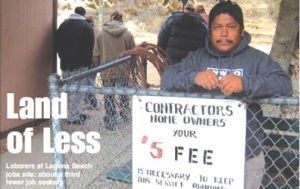
The Laguna Day Workers Center in Laguna Beach, where contractors can pick up day laborers, has seen about a third fewer job seekers than it did a couple of years ago, according to Irma Ronses, a coordinator at the site.
These days it might see about 725 laborers a month, with about a quarter of them finding work, according to Ronses. That’s down from half who were getting jobs a couple years ago, she said.
The site also has seen more white workers than it used to as they look for a quick dollar after being laid off from their jobs.
The scene is similar at other day laborer centers in the county or at makeshift sites outside Home Depot and other home improvement stores.
Workers at the Laguna site expect to be paid $10 to $15 an hour. Even in tough times, they’ll turn their noses at an $8 an hour offer, Ronses said.
A big question is whether laborers who can’t find jobs are returning to their home countries and families during the downturn.
In Santa Ana, Anaheim and across the county, immigrants have built neighborhoods with all the trappings of their home countries, with the benefit of the area’s good roads, clean water and economy, which—even in a downturn—often are better than where they came from.
Still, some have left, according to Ronses.
“If there’s no work there’s no reason to be here,” she said. “A lot are having a real hard time just trying to survive.”
Many do go back home, according to economist Adibi. That was the case with his gardener, whom he said worked here legally. The gardener chose to be with his family in Mexico after he couldn’t find enough work here.
“Many are here only so they can send money back to their families,” Adibi said.
Making Do
Others, like Manuel, survive by moving in with family.
He shares a three-bedroom home with 10 other people. He considers himself “lucky” because he has more space than other people he knows.
The alternative of going back to his home country of Guatemala is less appealing with the economy there in even worse shape, he said.
There’s some evidence the slow economy has tempered the flow of immigrants to the country.
The foreign-born population in the U.S. dropped from 12.6% in 2007 to 12.5% in 2008, breaking nearly four decades of growth, according to Census Bureau estimates released last month.
At the same time, California’s foreign-born population shrunk by 1.6% last year to 9.9 million people, according to the estimate.
A good figure for the population of undocumented workers in the county remains a mystery.
“I am confident that no one has that data, and if anyone claims they have it, it is a guess,” Adibi said.
During the boom, some immigrants bypassed Orange and Los Angeles counties for the Inland Empire, where construction jobs were plentiful, according to a study released in July by the Public Policy Institute of California.
Neighboring states such as Arizona and Nevada also likely drew immigrants who otherwise would have come to Southern California.
“Many likely left Orange County for these areas,” said Sarah Bohn, a researcher with the Public Policy Institute. “They’re very mobile as a group.”
Still, from 2004 to 2007 OC drew nearly 64,000 immigrants, which ranked second behind Los Angeles at more than 220,000 immigrants as the most popular destination for them in the state, according to the study.
Economic Benefit
Adibi and other economists contend the cheap labor provided by undocumented workers benefits the county’s economy.
“Whether we like it or not, we need them to produce services,” Adibi said.
After nine months of being unemployed, laborer Manuel said he believes he’ll eventually find work.
For the past two months he said he’s been able to earn some income at a sewing shop. A barber by training, he’s also cut lawns and done part-time construction to get by.
Manuel, 27, left a wife and 4-year-old boy in Guatemala. He moved here three years ago to join his mother and father, whom he hadn’t seen since he was a young boy.
