

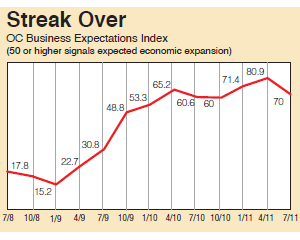
Orange County executives tempered their outlook on the economy for the third quarter amid national and global concerns, according to economists at California State University, Fullerton.
The university’s quarterly index of local business expectations fell to 70—down from 80.9 in the second quarter.
The latest reading snapped two straight quarters of sizeable jumps as executives predicted slower growth and flat employment and sales in the current quarter.
The index is based on a survey of 102 executives, professionals, managers and business owners. It is designed to be a leading indicator of quarterly economic activity here.

An index reading of 50 or more signals a positive outlook.
Troubling economic data and lingering geopolitical issues coupled with the ongoing debate on federal debt and government regulation is behind the lowered expectations here, according to Anil Puri, dean of the Mihaylo College of Business and Economics at Cal State Fullerton.
“It’s all making them nervous on the future strength of the U.S. economy,” he said.
Confidence Up Close
Many respondents expressed confidence in their own company and industry, Puri said, but macro-economic factors, such as Greece’s austerity plan, have undone the forward momentum that held through the first half of the year.
“It will take another quarter before we know which way business demand and the economy are headed,” he said.
The index reached a low of 15.2 for the first quarter of 2009, at the depths of the recession.
Its high-water mark of 94.9 came in late 2004.
Local executives remain relatively optimistic, with 82% of respondents indicating they expect business to improve or stay the same in the third quarter.
That’s down from 88% in the second quarter.
Slightly less than half of the respondents, 49%, expect significant or some growth in their own industry, down from 53% in the second quarter.
About 19% expect some drop, up from 9% last year.
Layoffs Lessen
The Cal State Fullerton survey showed that employers aren’t planning layoffs but are cautious about adding to payroll.
A majority of companies, 58.6%, intend to make no change in their labor force, up from 53.2% from the March quarter.
About 34% intend to add employees, down from nearly 40% three months earlier.
The number of businesses that expect to cut jobs in the third quarter was flat at about 7%.
Less than half of the respondents, 48%, said they expect to see revenue gains in the third quarter, down from 54.4% in the second quarter.
“We’re seeing things flat from a growth standpoint in general,” said Fred Helms, a division manager for commercial banking in the Newport Beach offices of U.S. Bank and a respondent to the survey.
The local division of the Minneapolis-based bank targets companies with $20 million to $500 million in revenue.
Lending demand is strong among consumer product makers, medical device makers, and companies in the food manufacturing, packaging and processing industries, according to Helms. But a lack of revenue growth across sectors has hindered borrowing overall.
“Growth is not much greater than 2010,” he said.
Regulation
THE NEWS:
Cal State Fullerton index of business expectations for the third quarter fell among Orange County executives
BACKGROUND:
The latest reading reversed upward momentum in the first half of the year
WHAT’S AHEAD:
National and global concerns are a key concern, and executives expect to remain cautious and keep hiring in check in the months ahead
Soft on Sales
More businesses expect lower sales in the third quarter, according to the survey, with 11.8% trimming their outlook compared to 7.6% in the second quarter.
Credit has tightened, pinching a key element of job and production growth. Thirty-three percent of executives surveyed cited some improvement on credit, down from 43% from the second quarter.
The overall economy was the top concern for 64.4% of respondents.
Government regulation came next at 18.8%.
Recent changes to regulations on the financial industry and healthcare providers seem to be weighing on the minds of executives, Puri said.
“They are looking for some clarity as to which way these regulations are going to go,” he said.
Sante Fe Springs-based Cascade Pumping Co., a maker and installer of water pumps and pumping equipment, has seen inquiries slow down in the past three months as governments grapple with budget shortfalls. That includes a debate at the federal level over whether to raise the debt ceiling to allow more deficit spending.
Cities Stretch
In some cases, cities have cut orders or stretched them out over a few years.
“We think it has a lot to do with budget discussions taking place,” said Cascade Chief Executive Tom Summerfield.
The 64-year family business relies on government contracts for much of its revenue. It has counted on a backlog of water pump installations, replacements and upgrades since Hurricane Katrina, which heightened awareness and preparedness for municipalities across the country.
