
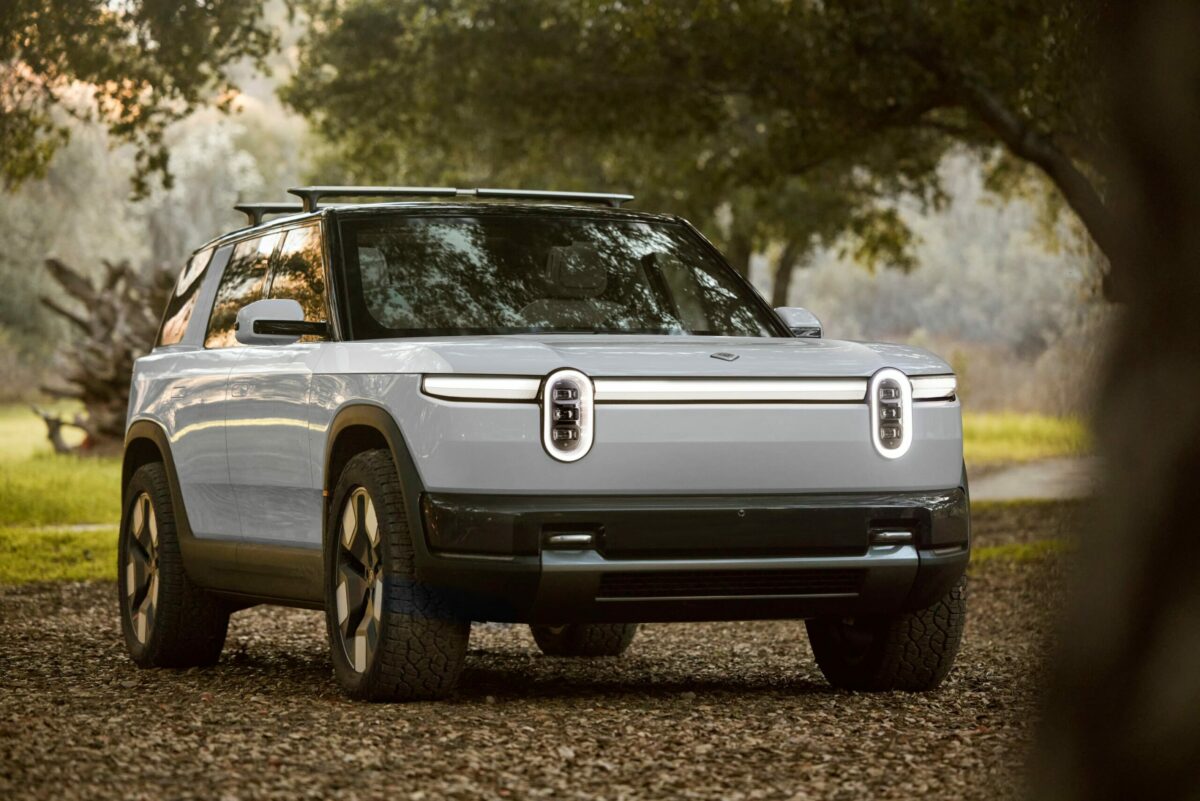
Rivian Automotive Inc. is betting on a major increase in vehicle deliveries for 2026 as the company revs up for the launch of its new R2 electric vehicle.
The Irvine-based automaker announced on Feb. 10 that the first edition of the R2 SUV will launch this spring. Two days later, Rivian predicted that 2026 deliveries would rise to between 62,000 and 67,000, indicating a 47% to 59% jump from the 42,247 EVs delivered in 2025.
The 2026 forecast excited investors with shares surging as much as 32% to $18.48 the day after the report. At press time, Rivian stock was trading at $15.12, with a market cap of about $19 billion, making it the third-most-valuable publicly traded company in Orange County.
Rivian executives expect 2026 to be “an inflection point.” Analysts are projecting that revenue will soar 29% to $6.9 billion this year, followed by a 66% increase to $11.5 billion in 2027. One analyst has predicted that Rivian may be selling as many as 600,000 vehicles annually by 2031.
While the roughly $90,000 R1 was positioned as Rivian’s premium, early-market offering, the smaller R2 is designed as a lower-priced vehicle aimed at expanding the company’s addressable market.
Each R2 will start around $45,000. More details on the pricing and overall product portfolio for R2 are scheduled to be announced on March 12.
There’s a lack of choice for a “midsized SUV with robust technology, autonomous capabilities and a reasonable price point,” Rivian Founder and Chief Executive RJ Scaringe told analysts during the Feb. 12 earnings call.
“We ultimately think the market is really hungry for some choice in this segment.”
Rivian Bets on R2, AI Tech to Boost Profits
Rivian is expecting the scaling of the lower-priced R2 to improve profitability. Scaringe also suggested that the company could benefit as rival Tesla winds down production of its higher-end Model S and Model X, potentially creating an opening for both the initial R2 and the existing R1 lineup.
“We have a lot of confidence in the overall demand, of course. That’s why we’ve leaned so much into the program and lean so much into what we’re about to launch,” Scaringe said when asked about Tesla.
Rivian executives said the carmaker’s technology roadmap will also set Rivian apart from its competitors.
The company has recently developed autonomy and AI projects for new EVs. In December, it unveiled the RAP1 autonomy processor, an updated autonomous driving platform, and a new AI-driven in-car assistant.
Its third-generation autonomy platform, which includes a multi-modal sensor suite of cameras, radar and LiDAR, will launch in R2 vehicles in 2026.
Rivian says the platform is expected to have “one of the most powerful combinations of sensors and inference compute in a consumer vehicle.”
At the center of the new platform is the company’s proprietary Rivian Autonomy Processor (RAP1), Rivian’s first-generation in-house custom chip.
“Developing our own chip was driven by the need for velocity, performance and cost efficiency and is a key development of our autonomy platform,” Scaringe told analysts.
Rivian said RAP1 “delivers four times the peak performance of our second-generation computer.”
The company expects the combination of sensor modalities and R2’s advanced computing with RAP1 will eventually enable “eyes-off” and personal level 4 autonomous features. Last year, Rivian released a universal hands-free feature for R1 vehicles, expanding assisted driving across 3.5 million miles in the U.S. and Canada. Customer utilization of these features has doubled.
“We believe autonomy will be a key fundamental long-term differentiator for our business,” Chief Financial Officer Claire McDonough said.
Earnings: Mixed Analyst Reaction
Rivian on Feb. 12 reported fourth-quarter revenue of $1.3 billion, down 31% from $1.7 billion a year prior—which still topped analysts’ consensus of $1.27 billion (Nasdaq: RIVN).
The sales drop was attributed to the expiration of federal EV tax credits and a decline in regulatory credit sales.
McDonough told analysts that 2025 marked Rivian’s first full year of positive gross profit.
The CFO told analysts that “on a full year-over-year basis, we achieved an approximately $9,500 improvement in automotive cost of goods sold per unit due to material cost reductions and operational efficiencies.”
Rivian noted that it had $120 million of consolidated gross profit for the fourth quarter and $144 million for the full year 2025; it reported a gross loss of $1.2 billion in 2024.
“This is a greater than $1.3 billion improvement year-over-year driven by strong software and services performance, higher average selling prices, and reductions in cost per vehicle,” Rivian said.
The company expects an adjusted loss of $1.8 billion to $2.2 billion, compared with $2.06 billion in 2025 and $2.69 billion in 2024.
Rivian ended 2025 with $6.1 billion in cash and equivalents.
Rivian said the company’s cash burn fell from $1.7 billion in 2024 to $779 million in 2025.
That progress stands in contrast to a warning from Tesla CEO Elon Musk, who in early 2024 suggested that Rivian might go bankrupt by the end of 2025 if it didn’t step up production, as it was burning through so much cash.
Analysts’ reaction to the earnings report was mixed, with the firm D.A. Davidson downgrading Rivian to Underperform in a Feb. 17 note, stating it was cautious about Rivian’s high expectations for R2 “without the benefit of subsidies or legacy OEM advantages.”
“Perhaps the most important reason for our caution on RIVN is what we view as aggressive expectations for the launch of the R2 this year,” according to the note.
Analyst Dan Ives of Wedbush, however, said he’s maintaining Rivian’s Outperform rating with a $25 price target.
“We continue to remain confident in the long-term vision that RIVN is amid a massive transformation while looking to optimize its R1 production and further preparing to ramp its R2 and midsize platform supply chains starting in FY26,” he wrote in a Feb. 13 note.
Volkswagen Update
Rivian said it expects to receive an additional $2 billion in capital from Volkswagen this year as part of the joint venture formed in 2024.
About 60% of Rivian’s software revenue comes from its Volkswagen joint venture, with first vehicles due in 2027. The company already sent test vehicles to multiple VW brands in 2025. Rivian said it delivered the vehicles for winter weather testing last year.