

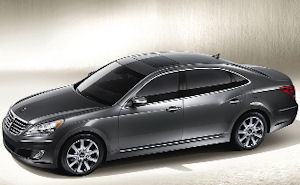
Fountain Valley-based Hyundai Motor America Inc. defied the recent downturn with less expensive, fuel-efficient vehicles. Now it’s going in the opposite direction.
In November, the automaker plans to release a 2011 luxury sedan called the Equus.
The launch is the latest move by the South Korean automaker, part of Hyundai Kia Automotive Group, to shift perceptions about its vehicles.
“We are stirring up things in our industry,” said John Krafcik, chief executive at Hyundai Motor America. “The Equus has great potential.”
The larger Equus follows the Genesis midsize sedan and coupe models, which pushed the budget-friendly automaker into the luxury market.
The Genesis “was compared to Lexus and BMW when it won the North American Car of the Year,” Krafcik said. “The industry took notice and had to start thinking differently about us.”
Equus, which has been sold in South Korea since last year, is being marketed as a challenger to Lexus, Acura and other premium brands.

Hyundai hasn’t given a price for the Equus. Market watchers expect it to sell for $55,000 to $60,000, which is less than some luxury brands.
The automaker is hoping to keep the cost of its luxury car down by selling it through existing Hyundai dealers, rather than creating an entirely new brand as Toyota Motor Corp. did with Lexus.
Hyundai considered creating a separate brand with its own dealers when it launched the Genesis but opted to sell under existing dealerships to control costs.
“The traditional way that premium cars are sold in the industry is automaker’s set up a whole separate channel with separate $20 million to $70 million marble palaces,” Krafcik said. “That cost has to end up in the car as a result.”
Hyundai expects to sell the vehicle through about 250 of its 791 dealers.
The automaker is launching a sales and service program to cater to luxury buyers, which it calls the first by an automaker. Traditionally, luxury dealers offer pampering to keep customers happy.
Hyundai plans to pick up the cost of bringing vehicles to a shopper’s home or business for test drives. Hyundai also will pick up the car from owners when it needs to be serviced.
“We’re calling it ‘Your Time, Your Place,’” Krafcik said.
Service appointments will be made electronically through an iPad, which will be included with every purchase or lease of an Equus. The iPad will serve as the owner’s manual as well.
The company is being conservative about sales expectations of the Equus in 2011, predicting only 2,000 to 3,000 will be sold.
“We are being a little more conservative on how the economy is developing and how demand may come back to our industry,” Krafcik said.
Long-Term Shift
Hyundai has spent the past several years working to shed a low-quality stigma it had from its early days in the U.S.
The automaker started selling cars in the U.S. in 1986 and saw sales fall by 1998 under the crush of quality problems.
Hyundai considered abandoning the U.S. market.
It gave the U.S. market one last shot by developing a program to coax customers into purchases by offering one of the best warranties in the industry.
It launched the program in 1999 and provided a transferable bumper-to-bumper warranty for up to five years and up to 60,000 miles.
“We have always been willing to embrace new ideas,” Krafcik said. “When we launched America’s Best Warranty, it was just a marketing idea. (But it) turned the brand around.”
The automaker put on a similar marketing blitz in late 2008, promoting a program that allowed buyers to return vehicles if they lost their jobs or income.
Later versions of Hyundai’s assurance program had the automaker offering to make up to three months of payments if auto buyers lost their jobs.
Fewer than 100 people actually took advantage of the offer, according to Hyundai.
The successful marketing campaign drew the attention of other automakers.
Joel Ewanick, vice president of marketing, left Hyundai in March to run all of the embattled General Motors Co.’s advertising and marketing. His successor, Chris Perry, left Hyundai in August, to run GM’s Chevrolet brand.
Hyundai saw declines in August sales as part of a larger industry hiccup resulting from the government’s “cash for clunkers” program a year earlier. The automaker saw an 11% decline from a year earlier to 53,603 vehicles sold in August.
It marked the first decline in sales for the automaker after nearly 20 consecutive months of increased sales.
Hyundai set sales records in August 2009 with several of its vehicle models qualifying under “cash for clunkers,” which encouraged consumers to trade in older vehicles for newer, fuel-efficient models with a cash incentive.
For the 12 months through August, Hyundai sold 363,491 vehicles, up 17%.
Hyundai and other automakers now are dealing with a trend in the industry where consumers are holding on to their vehicles for up to six years before trading them in, according to a study by New York-based research firm Gerson Lehrman Group Inc.
In the past, consumers traded in older vehicles every two to three years.
“Something permanent and fundamental has happened,” Krafcik said.
Even with a decline in monthly sales from a year earlier, Hyundai grew its market share to 5.3% in August, from nearly 4% a year earlier.
“We would like to maintain our fair share of the industry growth and one of the things we’re trying to figure out is how much the industry will grow next year,” Krafcik said. “Our focus has always been on the retail market share.”
HQ Expansion
On the heels of a growing lineup, Hyundai is looking to double the size of its Fountain Valley headquarters.
The automaker plans to invest $150 million and increase the facility to 500,000 square feet.
Construction is planned to begin in the middle of 2011 and is expected to be completed by late 2012.
Hyundai also is expected to up its staff to 1,400 workers.
The company is the largest automaker with operations here with 910 workers, according to the Business Journal’s March list of the largest automakers operating here.
The Los Angeles Economic Development Corp. estimates the headquarters project will have a total economic impact of $273 million.
“The investment ensures Orange County will remain Hyundai’s U.S. hub, with our headquarters in Fountain Valley, for the foreseeable future,” Krafcik said.
