

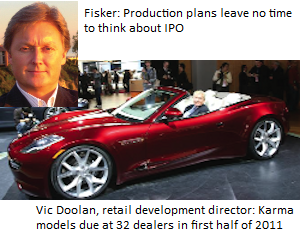
Irvine-based Fisker Automotive Inc. plans to go from 60 to more than 100 local workers as it readies for next year’s debut of its hybrid luxury sedan and works on new models.
The automaker is hiring engineers, designers, sales, marketing and administrative personnel at its headquarters.
“Since the beginning of this year, we have more than doubled our headcount and are continuing our rapid expansion,” Chief Executive Henrik Fisker said.
Early this year, Fisker Automotive moved its Michigan engineering center and two dozen jobs to Irvine.
In the next six to eight months, the company expects to hire up to 100 more engineers.
A big part of the hiring is for the rollout of Fisker Automotive’s Karma hybrid luxury sedan. The first Karma off the factory line debuted at the 2010 Paris Auto Show last month.
The Karma is being built in Finland by contract assembly house Valmet Automotive OY. Valmet also handles production for Porsche AG’s Boxster and Cayman models.
Fisker Automotive developed the Karma, which runs off driven by electirc motors with back-up gas engine, with Irvine’s Quantum Fuel Systems Technologies Worldwide Inc. (see related item, page 6).
Full production of the Karma is expected early next year with deliveries to 3,000 buyers who pre-ordered cars. Shipments to dealers should come in later months.
With the Karma getting close to showrooms, Fisker Automotive is moving ahead with prototypes of several other models, including another sedan and a sports car. The development work also is spurring hiring.
“We’re going to have a range of six vehicles in the next five years,” Fisker said.
The ambitious plans have led to ongoing speculation that Fisker Automotive will follow Palo Alto-based Telsa Motors Inc., another hybrid vehicle company, with an initial public offering.
Tesla raised $226 million from its offering earlier this year.
Some market watchers expect Fisker Automotive to consider filing for an offering after the launch of the Karma and before the production of its other models.
The automaker continues to downplay plans to go public anytime soon.
“We are concentrating on building a great American car company and getting our cars out on the road,” Fisker said. “We haven’t had time to put too much thought into anything else.”
Any money from an offering would be in addition to the $320 million raised from private investors and $528.7 million in low-interest loans from the Department of Energy for the development of two hybrid vehicles.
The loans are part of a $25 billion fund approved by Congress in 2007 to spur automakers to build electric and fuel-efficient autos.
Fisker Automotive plans to use its federal loan and current funding for the estimated $88,000 Karma and a lower-cost hybrid the company calls Project Nina.
The company plans to show off the Nina in early 2012 with a price tag estimated around $47,000, before any federal tax credits and state or local incentives.
Fisker Automotive has grown rapidly in the past two years.
Earlier this year, it bought the 3.2 million-square-foot Wilmington Assembly plant in Delaware for $20 million from Motors Liquidation Co.
General Motors shut down production at the plant in 2009.
The automaker plans to spend $175 million to retool the plant and start production in late 2012 with the Nina. The automaker hopes to eventually hire upward of 2,500 workers to make the Nina.
By 2016, Fisker Automotive plans to move production of the Karma from Finland to Delaware.
The automaker also has also grown its board of directors.
Hans-Joachim Schöpf and Barry Huff joined the automaker’s board last month. Schöpf is a German automotive executive who has served on the boards for Canadian fuel cell maker Ballard Power Systems Inc. and Karma contract maker Valmet.
Schöpf also has held executive positions at Mercedes-Benz AG, including executive vice president and member of the board of Mercedes Car Group.
Huff is a former automotive audit vice chairman at New York-based Deloitte LLP’s lead client service, where he oversaw work for some of the accounting firm’s largest clients, including General Motors.
Fisker Automotive’s board is led by Chairman Ray Lane, managing partner at Menlo Park-based Kleiner Perkins Caufield and Byers, a major Fisker Automotive investor.
Fisker Automotive has seen its share of ups and downs in the past year, including delays in production of the Karma and a political uproar over taking government funding yet making the Karma in Finland.
The Karma was set to arrive at dealerships in May, with the date pushed back to November due to delays in supplies of parts. The car’s presence at the Paris Auto Show suggests a March debut date could be firm.
“We want to get them out on the road,” Fisker said.
Fisker Automotive’s dealer network has taken the delays in stride, according to the company.
“We have a very strong stable of dealers with strong balance sheets,” Fisker said. “They are selling other brands, so they are not depending on us only.”
The company’s current roster of dealers includes Irvine-based Shelly Automotive Group, which was one of the first investors in Fisker Coachbuild, a predecessor of Fisker Automotive. Thirty-two dealers across the U.S. have signed on to sell the cars.
The automaker also is focusing on Europe, where it sees the Karma having a large draw.
“Many Europeans are interested in our Karma,” Fisker said.
The company has signed deals with Nellemann Holding AS in Copenhagen and GP Supercars in Italy.
Fisker Automotive recently struck similar agreements with Switzerland’s Emil Frey AG, which has dealerships in Switzerland, Germany, France, the Czech Republic, Hungary and Poland. Emil Frey will import, market and service the Karma.
All of Fisker Automotive’s plans come amid increasing competition from mainstream automakers that have aggressively entered the “green” auto market.
Japan’s Toyota Motor Corp. is testing a plug-in version of its Prius hybrid. Ford Motor Co. is working on building an electric version of its Focus sedan. Nissan Motor Co. started selling its Leaf electric auto this year. And General Motors is set to launch its Volt model this year.
